Quick Take
- Narration: Kehinde Andrews narrates his own book, and that self-narration is non-optional, his academic authority and personal investment in the argument come through in ways a professional narrator could not replicate.
- Themes: Racial capitalism, the continuity of imperial structures through new institutions, anti-Black racism as foundational to Western modernity
- Mood: Unflinching and intellectually combative, the feeling of a scholarly argument delivered at full force
- Verdict: One of the most rigorous and uncompromising audiobooks on contemporary imperialism available, making a case that will be challenging for many listeners and essential for others, Andrews does not soften the analysis for palatability.
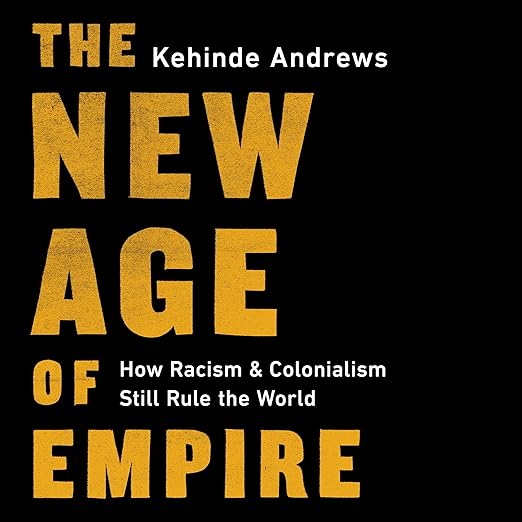
I came to The New Age of Empire having read Andrews’s earlier work and knowing roughly what to expect: not comfort, not balance in the conventional sense, but a kind of intellectual precision about the world’s arrangement that most popular nonfiction, even the progressive kind, tends to avoid. I listened to the first two hours on a run, which turned out to be the wrong listening context. This is a book that requires you to sit with what it is saying, because Andrews is making arguments that do not resolve tidily and that are designed to produce a particular kind of discomfort in readers who consider themselves politically progressive. The discomfort is not incidental. It is the point.
The central thesis is stated without hedging: colonialism and imperialism did not end. They changed form. The mechanisms of Western dominance shifted from direct territorial control to institutional control through the IMF, the World Bank, the WTO, and what Andrews calls the racial logic of the international financial system. The United States replaced Europe as the center of Western dominion, and racial capitalism replaced colonial holdings as the primary instrument of extraction. For readers who absorbed the standard Western education in which imperialism is a historical phenomenon that ended with decolonization, this argument is genuinely destabilizing, and that destabilization is the book’s explicit aim from the first chapter.
The Concept of Racial Capitalism
Andrews draws on the work of Cedric Robinson and the Black radical tradition to argue that capitalism was never a racially neutral system. It was built on and through the specific mechanisms of anti-Black racism and colonial dispossession, and it cannot be reformed into neutrality without being fundamentally restructured. This is not a mainstream academic position, and Andrews does not pretend it is. He argues it directly against both the liberal center and what he calls the white-centered left, including Marxism, which he views as insufficiently attentive to race as an organizing category of capitalist accumulation and expansion.
The China-Africa chapter is one of the book’s most analytically useful sections. Andrews refuses the left-nationalist consolation that non-Western powers are immune to imperial logic. He argues that China’s relationship with African economies replicates neocolonial patterns of extraction regardless of the race of its participants. This willingness to apply the same analytical framework to non-Western actors is one of the book’s marks of intellectual integrity, and it complicates the standard political narrative in ways that prevent the reader from settling into a comfortable position.
What Self-Narration Adds to the Argument
Andrews reading his own work at nearly nine hours is not incidental. His academic register, precise, controlled, occasionally sharp with what feels like repressed frustration at the inadequacy of the objections he anticipates, would be difficult for any external narrator to reproduce convincingly. When he moves through the history of genocide, slavery, and colonialism in the opening chapters, the deliberate containment of his delivery reads more like the sustained focus of a scholar who has thought about this history long enough that ordinary outrage has been replaced by something colder and more analytically rigorous. That quality matters for how the argument lands in the ear rather than on the page.
Who Will Find This Book Difficult and Why
Andrews is not writing for readers who want to feel good about the progress that has been made. His argument is structured to pre-empt the consolations that Western liberal readers typically reach for: multiculturalism, institutional reform, diversity initiatives. He addresses each of these as insufficient responses to a structural problem, and he is not gentle about it. Readers who found Ibram X. Kendi’s work confronting will find Andrews more so, because his theoretical framework is more uncompromising and his rejection of incremental reform more explicit. The 4.7 rating across 348 reviews is meaningful. It suggests a substantial audience that found the book important rather than merely provocative. The dissenting reviews tend to object to tone rather than specific factual claims, which is a fair description of where the friction lives.
Who Should Listen, Who Should Skip
Listen if you want the most rigorous available popular account of racial capitalism and neocolonialism as they operate today, from someone with the academic credentials and conceptual framework to make the argument at full power. Essential for listeners who found the standard decolonization narrative insufficient and are looking for analysis that goes further without losing analytical discipline. Skip if you need measured balance as a precondition for engagement, or if you are looking for policy recommendations rather than structural critique. Andrews is not in the business of telling you what to do. He is in the business of telling you what is actually happening.
Frequently Asked Questions
Does Andrews address reparations or what structural change would actually look like?
The book’s primary mode is diagnostic rather than prescriptive. Andrews argues for the necessity of fundamental restructuring rather than reform, but specific mechanisms of that restructuring are not the book’s focus. His other public writing engages more directly with political strategy and what he calls Black liberation as a framework.
Is the ‘racial capitalism’ concept explained accessibly for readers unfamiliar with Cedric Robinson’s work?
Yes. Andrews builds the concept from its historical foundations rather than assuming prior knowledge of Robinson or the Black radical tradition. The theoretical apparatus is explained as it becomes necessary, making the book accessible to readers without a background in critical race theory or Marxist economic analysis.
How does Andrews treat the emergence of India and China as world powers relative to his imperialism argument?
He addresses the argument that non-Western nations rising to global economic power represents the end of Western dominance, and he rejects it. His argument is that the logic of racial capitalism can be reproduced by non-Western actors, with the China-Africa relationship as his primary case, and that national identity does not automatically transform the structural dynamics of extraction.
Is this book suitable for undergraduate courses on postcolonial studies or international relations?
Absolutely, and it is already widely used in university settings. Andrews is a professor and writes with academic precision, though the text is accessible enough for a general audience. It pairs well with Fanon, Rodney’s How Europe Underdeveloped Africa, and recent scholarship on racial capitalism for a comprehensive reading list.