Quick Take
- Narration: Duke Holm delivers all 14 works with a sonorous, meditative quality that suits Goddard’s cadence without tipping into affectation. He keeps the listener oriented across 20-plus hours of philosophically dense material.
- Themes: imagination as divine faculty, consciousness shaping external reality, New Thought metaphysics
- Mood: Quietly intense, like sitting in a darkened lecture hall with a very confident speaker
- Verdict: The complete Goddard in audio is genuinely useful for listeners who want to understand his system in full, but it demands sustained attention over a substantial runtime.
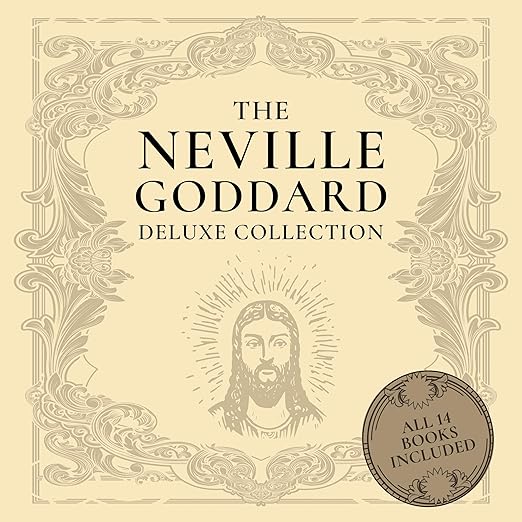
I have a complicated relationship with Neville Goddard. I first encountered his work during a graduate seminar on American New Thought movements, where he was discussed alongside Emmet Fox and Florence Scovel Shinn as part of a tradition that the academy tends to categorize and then move on from quickly. What the seminar did not give me was extended time with the actual texts, which are considerably stranger and more internally consistent than the brief excerpts suggested. This collection, all 14 books narrated across more than 20 hours by Duke Holm, finally gave me that time.
Goddard was writing and lecturing from the 1930s through the early 1970s, and the arc of his thinking is not always obvious if you encounter the individual works in isolation. The collection, which begins with At Your Command and moves through to Your Faith Is Your Fortune, reveals a mind that was refining rather than repeating itself. The early works are relatively straightforward declarations of principle. The later ones, particularly The Law and the Promise and Awakened Imagination, show Goddard developing the biblical interpretive framework that distinguishes his work from more conventional positive-thinking literature.
What Goddard Actually Argued
The central claim Goddard makes across these works is more radical than it is often summarized. He is not saying that positive thinking attracts positive outcomes in any simple motivational sense. He is saying that imagination is the only reality, that the physical world is the projection of what he calls the human imagination operating at the level of feeling, and that the figures of scripture, particularly the narrative of Christ, are not historical records but psychological allegories for the movement of consciousness. This is the claim that, as one reviewer here noted, initially conflicts with traditional religious upbringing before something in it starts to resonate.
Feeling Is the Secret is probably the most compact statement of the core principle, and it is the work I would recommend listening to first within this collection regardless of the sequence Goddard wrote in. The argument there that the state of consciousness you inhabit as you fall asleep determines what manifests in your waking life is presented with a directness that the longer works sometimes dilute with extended illustration. In contrast, The Power of Awareness, one of the final works in the sequence, is where Goddard is most philosophically mature, connecting the idea of divine imagination not just to practical manifestation but to questions of identity and the nature of self.
Duke Holm and the Challenge of 20 Hours
Narrating Goddard presents specific problems that Holm handles reasonably well. The prose is formal, often lecture-inflected, and laced with biblical quotation. A narrator who reads it as straight inspirational content would flatten the strangeness. Holm finds a register that is reverent without being pious, measured without being cold. Across a collection of this length there are inevitably passages where the pacing feels slightly too uniform, where a passage that wants to land with weight gets delivered at the same cadence as the passage preceding it. But these are minor complaints for a project of this scale.
The reviewer who described this collection as being for people who feel that the first pages were written for them is onto something real. Goddard’s system is not one you sample neutrally. Either the central premise, that your imagination is the God in whom you live and move and have your being, strikes you as a key to something you had sensed was there, or it strikes you as metaphysical overreach. Most listeners know within the first hour of At Your Command which camp they belong to.
The Friction with Orthodoxy and Why It Is Instructive
Several reviewers note that Goddard’s interpretation of scripture caused initial friction with more conventional religious backgrounds. This is worth addressing directly for potential listeners because it shapes the experience significantly. Goddard reads every biblical figure, including Christ himself, as a personification of psychological states. Salvation, in his framework, is not an external event but the awakening to the understanding that your own consciousness is the creative principle. He uses the vocabulary of Christianity with complete seriousness while emptying it of its literal content entirely.
For listeners from traditional religious backgrounds, this can feel like an appropriation. For listeners from secular backgrounds, it can feel like an unnecessary constraint, making philosophical claims in the dress of a tradition they left behind. The people who respond most strongly to Goddard tend to be those who are already working in the space between those positions, who take scripture seriously as a record of inner experience without requiring its historical literalism. If that describes you, this collection is 20 hours well spent.
Who Should Listen and Who Should Skip
This collection rewards listeners who are already curious about New Thought, mystical interpretation of scripture, or the philosophy of consciousness, and who want a comprehensive rather than selective engagement with Goddard’s system. Skip it if you want a single introductory text rather than a complete archive: in that case, start with Feeling Is the Secret or The Power of Awareness individually. Also skip it if explicit religious vocabulary used in non-literal ways will be a persistent obstacle.
Frequently Asked Questions
Is this collection the best way to read Goddard for the first time, or should you start with a single book?
For a first encounter, a single book such as Feeling Is the Secret or The Power of Awareness is more focused and less daunting. This collection is best appreciated once you already have some familiarity with the core ideas and want a complete picture of how Goddard’s thinking evolved across his career.
How does Duke Holm handle the biblical quotations and scriptural language that appear throughout the texts?
Holm treats the scriptural material with the same measured gravity as the philosophical passages, which is the right call. He neither performs religiosity nor undercuts the seriousness of Goddard’s interpretive claims. The consistency of tone across all 14 works is the narration’s main achievement.
Is Neville Goddard’s philosophy compatible with traditional Christian belief, or does it fundamentally conflict with it?
It fundamentally conflicts with historical and doctrinal Christianity while using Christian vocabulary extensively. Goddard reads scripture as psychological allegory rather than historical record, and places divine creative power in the human imagination rather than in a personal God external to the individual. Some readers find this liberating; others find it a misuse of the tradition.
Does the sequence of the 14 books in this collection follow a logical progression, or can they be listened to in any order?
The collection appears to follow a rough chronological and developmental sequence. At Your Command and Feeling Is the Secret, which come early, are the most introductory. The Law and the Promise and The Power of Awareness, which come later, assume more familiarity with the system. Listening in order gives you the arc of Goddard’s intellectual development, which is genuinely illuminating.