Quick Take
- Narration: Charlie Brogan delivers a clear, unhurried performance suited to the primer format, accessible without being condescending.
- Themes: Human evolution, archaeological discovery, DNA inheritance across species
- Mood: Brisk and quietly revelatory
- Verdict: A compact entry point into Neanderthal studies that earns its runtime by packing genuine surprise into seventy-two minutes.
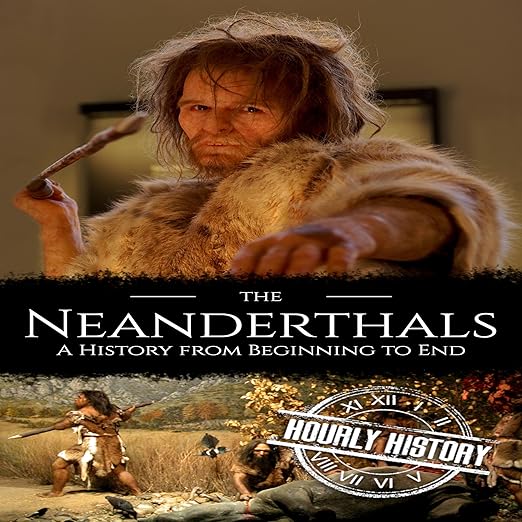
I was driving back from visiting my parents on a rainy Tuesday afternoon, the kind of drive where a full-length audiobook felt like too large a commitment and music felt like too little. That is when I queued up Hourly History’s The Neanderthals, part of their Prehistory series, and by the time I hit the motorway the story had already started unsettling things I thought I knew.
The running time is seventy-two minutes. That is not a long time to cover a species that roamed Europe and western Asia for roughly 400,000 years, and narrator Charlie Brogan moves at a purposeful clip. But there is something clarifying about a book that refuses to sprawl. The Hourly History format imposes discipline on author and listener alike: no digressions, no padding, no footnotes in audio form. Either the substance is there or it is not.
The 1856 Discovery and What It Broke
The synopsis opens with the Feldhofer Grotto find in Germany’s Neander Valley, and the audiobook leans into that moment well. Johann Carl Fuhlrott’s examination of the bones, his collaboration with Hermann Schaaffhausen, their 1857 announcement, and the cold reception from a scientific community still anchored to biblical creation accounts, this is the kind of institutional resistance story that lands differently when you hear it spoken aloud. Brogan does not editorialize, but the pace he adopts during this section slows just enough to let the irony register: here was possibly the most important anthropological find of the nineteenth century, met with indifference and suspicion.
Reviewers have noted this sequence as particularly strong. One listener described it as opening curtains on old beliefs, and that is accurate. The book does not frame the scientific community’s early rejection as ignorance, it situates it as a predictable collision between evidence and prevailing worldview, which is a more honest reading of how scientific revolutions actually unfold.
What the DNA Evidence Changed
The finding that most people alive today carry measurable traces of Neanderthal DNA is, as one reviewer put it, genuinely surprising to a general audience, and this is where The Neanderthals earns its modern relevance. The shift from a narrative of primitive replacement to one of interbreeding and partial assimilation is not a minor revision, it fundamentally reframes what it means to say Homo neanderthalensis went extinct. The audiobook handles this transition without overplaying it, which is the right call. The science here is settled enough to state clearly, uncertain enough in its full implications to warrant humility.
Brogan’s reading during these later sections has a slight uptick in energy that tracks the material well. When the content is intellectually exciting, a good narrator lets that show without theatrics, and he manages exactly that.
The Scope Question
A seventy-two-minute runtime means real choices about what to exclude. Listeners who come in hoping for coverage of specific Neanderthal sites beyond Feldhofer, detailed analysis of Neanderthal burial practices, or the linguistic debates around Neanderthal cognitive capacity will find the book a prompt rather than a destination. One reviewer said it piqued his interest in locating a more detailed nonfiction book, and the author seems to intend exactly that. This is not a weakness if you approach it correctly: the Hourly History model functions as a structured orientation, and The Neanderthals delivers on that promise with a 4.5-star average across nearly three hundred ratings.
For listeners who want to go deeper after this, the natural next step would be something like Johannes Krause’s more technical writing on ancient DNA, or Clive Finlayson’s The Humans Who Went Extinct. But this primer does its job honestly.
Who Should Listen, Who Should Skip
This title works well for commuters looking for a single-session nonfiction listen, anyone who enjoyed popular science podcasts covering human evolution and wants a more structured account, and listeners who prefer their prehistory without jargon. Skip it if you already have a solid grounding in paleoanthropology, there is nothing in here that will surprise an informed reader, and the brevity that serves a newcomer will frustrate someone looking for depth. At seventy-two minutes, the risk-reward calculation for curious generalists is straightforwardly positive.
Frequently Asked Questions
Is this part of a series, and do I need to listen to other Hourly History titles first?
It belongs to the Hourly History Prehistory series but functions as a standalone title. No prior knowledge or prior volumes are required.
Does the audiobook cover the debate around whether Neanderthals and modern humans interbred?
Yes, this is one of the book’s central and most surprising points. It draws on modern DNA evidence to explain why most non-African people today carry a small percentage of Neanderthal genetic material.
How does Charlie Brogan’s narration suit a scientific history title like this?
Brogan reads clearly and without affectation, which suits the Hourly History format. The pacing is brisk but not rushed, and he handles technical terms like Homo neanderthalensis without stumbling.
Is seventy-two minutes enough to get a meaningful understanding of Neanderthal history?
For a general introduction, yes. The book covers the discovery, early scientific debate, Neanderthal culture and technology, and the DNA evidence. It is explicitly designed as a starting point, and reviewers consistently praise it for being substantive without being overwhelming.