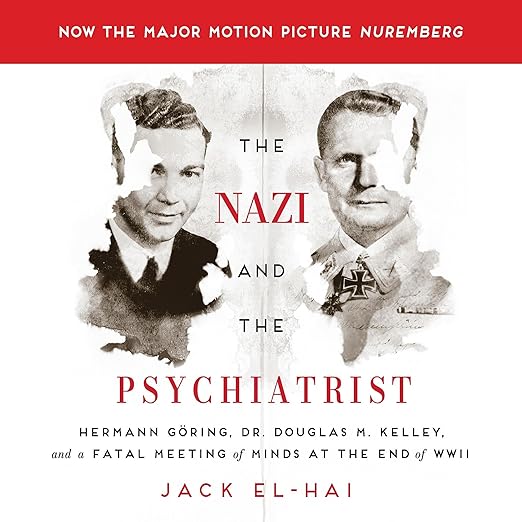
Captain Douglas Kelley arrived at the American detention center in Luxembourg in 1945 with a specific professional hypothesis: that the senior Nazis interned there - including Hermann Goering, who arrived with sixteen suitcases and a red hatbox - must possess some distinguishing psychological trait that set them apart from ordinary people. Jack El-Hai's audiobook The Nazi and the Psychiatrist, narrated by Arthur Morey, is the story of what happened to that hypothesis, and to Kelley himself, over the course of his time with the Nuremberg defendants.
The result is one of the more genuinely disturbing works of popular history to come out of the postwar archive, and Morey's narration captures that disturbance without sensationalizing it. At 8 hours and 53 minutes, the book moves quickly for the weight of its subject matter. One reviewer described it as a page turner, which is accurate - El-Hai writes with the momentum of a thriller even when the evidence he is presenting is purely documentary. The book was cited as the basis for a major film, and it is easy to hear why: the central relationship between Kelley and Goering has the structure of a psychological drama built on mutual fascination and progressive danger. Morey's voice finds the right register for this from the opening pages - serious, authoritative, and alive to the strangeness of the story being told.
Ordinary Minds Committed the Century's Worst Crimes
Kelley came to Nuremberg hoping to find monsters he could label and contain. What he found, over weeks of daily sessions with Goering and the other detainees, was something more troubling: men of ordinary or above-average intelligence, without diagnosable psychopathology, who had committed the century's worst crimes not despite their normalcy but through it. The conclusion that these were not aberrations - that the conditions for mass atrocity do not require clinically unusual minds, only particular circumstances and choices - was one that Kelley struggled to integrate, and the book tracks that struggle with care.
The Goering relationship is the book's gravitational center. Goering was charming, politically sophisticated, and consciously working to influence Kelley's perceptions. The more time Kelley spent in conversation with him, the more he found himself appreciating rather than analyzing, and El-Hai does not elide the professional and ethical danger of that shift. One reviewer criticized the final section, where El-Hai applies his own psychological reading to Kelley, as inducing eye rolls - a fair point about the risks of the author inserting interpretation where evidence should speak. But the observation that Kelley's quest proved hazardous, as the synopsis promises, has specific biographical weight: what happened to Kelley after Nuremberg is one of the book's darkest undercurrents, and Morey's narration handles that trajectory with the gravity it requires.
Morey Marks the Shifts Without Overplaying Them
Morey is consistently effective in historical nonfiction, and he handles this material with the precision the subject requires. The book spans multiple registers - courtroom procedure, psychological theory, personal biography, postwar political context - and Morey does not flatten them into a single tone. The interview sequences with Goering carry a different weight than the chapters covering Kelley's subsequent career, and the narration marks those shifts without overplaying them.
El-Hai's research is rigorous, drawing on Kelley's own case files and the testimony of family members who spoke to him after decades of silence. The book achieves something rare: it is both scrupulous with its sources and genuinely readable. Reviewers who came to the book from the film found it richer and more focused than the dramatized version. Those who arrived knowing little about the Nuremberg trials, or who had confused the Kelley-Goering relationship with other wartime psychology research, found the audiobook thoroughly reorienting. The 8-hour runtime is well calibrated to the material - substantial enough to develop both Kelley and Goering as full biographical subjects, short enough to maintain narrative momentum throughout.
A Clinical Fingerprint of Atrocity Comes Up Empty
The book's central argument - that evil at scale does not require evil psychology, only the right conditions - deserves careful attention rather than quick summary. El-Hai is precise about what Kelley's findings did and did not establish. He is not arguing that Goering was a good person or that ideology is purely situational; he is arguing that the search for a clinical fingerprint of atrocity came up empty, and that this result has implications for how we think about prevention rather than diagnosis.
The third critique from reviewers - that the book suffers from too many themes - is worth addressing: El-Hai covers the psychology of the defendants, the logistics of the detention center, the political pressures on the trial, and the personal biography of Kelley's later years. Some readers find this breadth energizing; others find it diffuse. Morey's narration keeps the threads distinct enough that the multi-topic structure does not collapse into confusion, but listeners who want a single through-line will need to track Kelley as that line themselves rather than expecting the book to do that work for them.
What Kind of Person Does This?
This audiobook is for listeners drawn to the intersection of history, psychology, and biography - particularly those interested in the sociology of extremism, the mechanics of the Nuremberg proceedings, or the postwar lives of the people who prosecuted and examined the Nazi leadership. It is also for readers who find the psychological framing of evil more interesting than the political one: El-Hai is fundamentally asking what kind of person does this, and Morey's narration carries that question through every chapter with appropriate gravity and without easy resolution.
A Few Questions About The Nazi and the Psychiatrist
Is this audiobook connected to the film Nuremberg starring Russell Crowe?
El-Hai's book is cited as a source for the major motion picture referenced in the synopsis. The audiobook covers the actual historical record of the Kelley-Goering relationship and the Nuremberg detention period more comprehensively than any dramatized version could.
Does the audiobook require prior knowledge of the Nuremberg trials to follow?
No - El-Hai provides sufficient historical context that listeners without detailed knowledge of the trials can follow the narrative. One reviewer described being largely unfamiliar with the Nuremberg proceedings and finding the book both eye-opening and accessible.
How does this audiobook handle the psychological conclusions about the Nazi defendants?
Carefully and with significant implications. Kelley's finding that the senior Nazis showed no distinguishing psychopathology is presented seriously and with the disturbing implications El-Hai believes it carries. This is not a book that offers clean answers, and Morey's narration reflects that ambiguity.
Is the audiobook balanced in its portrayal of both Kelley and Goering, or does it take sides?
El-Hai's approach is biographical rather than polemical. He documents Kelley's growing fascination with Goering as a documented fact, and his treatment of Kelley's own later psychology is the one section some reviewers found overreaching. The Goering portrait is rigorous throughout.