Quick Take
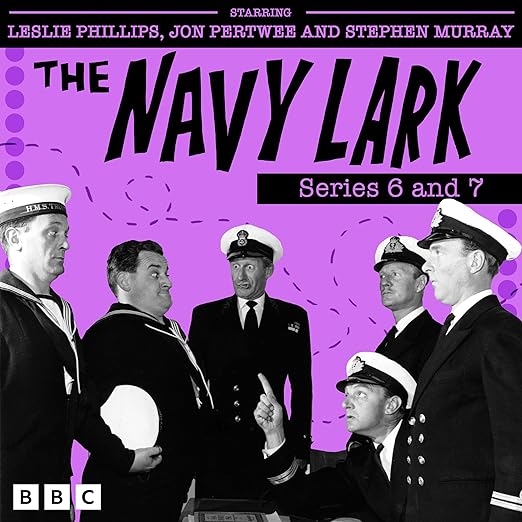
- Narration: The original BBC cast recording features Leslie Phillips, Jon Pertwee, Stephen Murray, Ronnie Barker, and a full ensemble with the easy chemistry of years of working together.
- Themes: British institutional comedy, class hierarchy played for chaos, the absurdity of military protocol
- Mood: Warmly nostalgic, broad and cheerful, quintessentially early-1960s BBC radio
- Verdict: A reliable choice for listeners who want the texture of classic British radio comedy without the effort of tracking down the original broadcasts.
There is a specific kind of Sunday listening that I associate with BBC radio comedy archives: something that doesn’t require you to follow it too closely, that rewards attention when you give it but doesn’t punish you when you don’t, that creates the sound of a particular era rather than making an argument about it. The Navy Lark: Series 6 and 7 is precisely that kind of listening, and I mean that as measured praise rather than faint praise.
The production context matters here. These 33 episodes, originally broadcast on the BBC Light Programme between late 1963 and late 1965, plus the Christmas Special transmitted to British Antarctic Survey Teams on Christmas Day 1965, represent the show at the height of its run. HMS Troutbridge had been sailing since 1959, and by Series 6 the ensemble had developed the kind of collective timing that only accumulates across years of live radio recording. Leslie Phillips, Jon Pertwee, Stephen Murray, Ronnie Barker, Richard Caldicot, Michael Bates, Tenniel Evans, and Heather Chasen are working together with the ease of musicians who know each other’s rhythms without discussion.
The Architecture of Lawrie Wyman’s Scripts
Wyman’s scripts operate on a reliable formula that the series never pretends otherwise: Pertwee’s money-making schemes, Povey’s domestic complications, Johnson’s culinary and literary disasters causing maximum inconvenience, and the romantic competition between Mr. Phillips and Mr. Murray for Wren Chasen’s attention. The genius, such as it is, lies in the variations played on these themes across 33 episodes without the variations feeling exhausted. Titles like The Bungalese Spies, The Submerged Island, and The Mysterious Pudding Mine give a sense of the invention applied to the situation comedy format.
The Pertwee presence is of particular note. This is Jon Pertwee before the role that made him internationally famous, working in an ensemble context rather than carrying the dramatic weight he would later carry as the Third Doctor. His comic instincts here are different from what Doctor Who fans might expect: broader, more physical in feeling even without the visual dimension, and entirely committed to the ensemble rather than seeking to dominate it.
The Sound Quality Advisory and What It Actually Means
The synopsis includes a note that due to the age of the source material, the sound quality may vary, and potential listeners should take this seriously without being deterred by it. Ted Kendall’s remastering work has made these recordings listenable, but they are archival recordings from 1963 to 1965, and they carry the acoustic signature of that era. For listeners accustomed to contemporary audio production, there will be an adjustment period of perhaps two episodes before the ear acclimates. After that adjustment, the variable quality becomes part of the texture rather than an obstacle to it.
The language advisory, that some content reflects the era in which it was first broadcast, is also worth noting. This is a production made in the early 1960s for a general BBC audience of that period. The humor reflects assumptions about gender, class, and nationality that are period-accurate rather than current. The romantic rivalry plots in particular read as dated in ways that require some tolerance from contemporary listeners.
Why Thirty-Three Episodes in One Package Works
The volume, the complete Series 6 and 7 plus the Christmas Special in a single package running to 15 hours and 48 minutes, is the correct way to encounter this material. Individual episodes of early BBC radio comedy often feel slight when extracted from their context. Here, across 33 episodes, the cumulative effect of returning to the same ship, the same crew, and the same underlying dynamics creates something genuinely comforting in the way that long-running series can be comforting. You are not surprised by what happens. You are pleased to see it happen again.
This is a fundamentally different relationship to narrative than contemporary comedy audio seeks to create. There is no arc, no character development, no thematic resolution. Troutbridge sails, mishaps occur, the hierarchy reasserts itself, and next week everything resets. For listeners who understand and want that contract, this collection delivers it reliably.
Who Should Listen and Who Should Skip
Listen if you have an interest in British radio comedy history, if you are already a Navy Lark fan looking for the convenience of streaming access to these series, or if you enjoy the texture of ensemble radio comedy from its high-water mark in the early 1960s. The Ronnie Barker material alone makes this worthwhile for fans of his later career who want to hear how he worked before his starring roles.
Skip if you need contemporary audio production values, if period British class comedy makes you impatient, or if you are coming to The Navy Lark without context expecting something like modern British panel show comedy. This is a different and older form.
Frequently Asked Questions
Do I need to have listened to Series 1 through 5 before starting here, or is Series 6 accessible on its own?
The series is episodic enough that Series 6 is perfectly accessible without prior episodes. Character relationships are established by the scripts within each episode rather than requiring accumulated knowledge. Prior listening adds texture but is not a prerequisite.
How significant are the sound quality variations mentioned in the advisory?
They vary. Some episodes sound remarkably clean for their age; others have audible tape hiss or occasional distortion. The variations are generally brief and do not interrupt the comedy. Listeners with noise sensitivity may find it distracting; listeners accustomed to vintage radio will barely notice.
Is Leslie Phillips as central to the series as the narrator credit suggests, or is this truly an ensemble production?
He is one of three roughly equal leads alongside Pertwee and Murray, which the scripts balance fairly carefully. The romantic subplot positions his character prominently in some episodes, while others are more Pertwee-focused. The ensemble distribution is the point rather than a single dominant lead.
The Christmas Special was originally broadcast to Antarctic Survey Teams, is it notably different from the regular episodes?
It is shorter and has a slightly different register. The holiday context and the knowledge that it would reach a very specific and geographically isolated audience gives it a warmth that distinguishes it from the regular run. It makes a satisfying conclusion to the collection.