Quick Take
- Narration: Leslie Phillips, Jon Pertwee, Ronnie Barker, and the full original cast, this is not a narrated audiobook but a complete archival radio comedy recording, remastered from 1959-1960 BBC broadcasts.
- Themes: Military incompetence as a national sport, class hierarchy under pressure, the comedy of men trying not to be found out
- Mood: Cozy and anarchic in equal measure, like a vintage British sitcom you can listen to with your eyes closed
- Verdict: Forty-three episodes plus a special of vintage BBC radio comedy featuring pre-Doctor Who Pertwee and a young Ronnie Barker, essential for anyone serious about British comedy history.
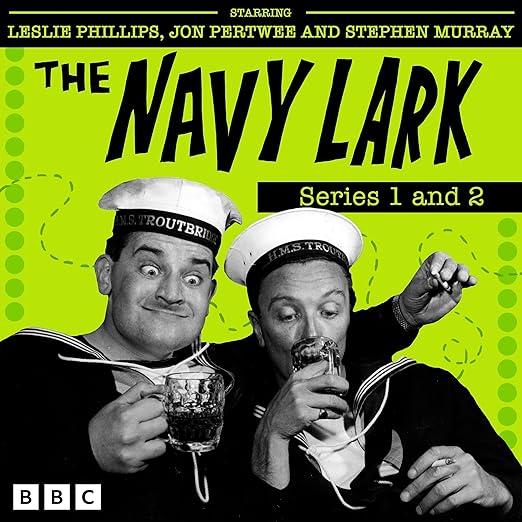
There is a specific pleasure in listening to comedy that was made before the idea of listening to comedy at home was even particularly unusual, when the BBC Light Programme was what you put on in the evening after tea, and the jokes were designed for the whole house rather than the individual with headphones. I came to The Navy Lark: Series 1 and 2 the way I come to most vintage radio comedy, sideways, through a recommendation from a colleague who mentioned Jon Pertwee in the same sentence as Patrick Troughton, and who seemed genuinely horrified that I had only encountered Pertwee in his Third Doctor incarnation. This recording is the correction he prescribed.
The Navy Lark ran for 15 series between 1959 and 1977, making it one of the longest-running sitcoms in BBC Radio history. What is collected here are the first 43 episodes plus The Wrens’ Reunion special, the entirety of Series 1 and 2 as originally broadcast on the Light Programme between March 1959 and April 1960. The premise is elegant in its simplicity: HMS Troutbridge is a Royal Navy frigate crewed almost entirely by people who would rather be doing something else. Chief Petty Officer Pertwee is conniving. Sub-Lieutenant Phillips is a beautifully rendered silly-ass innocent. Commander Povey is perpetually on the verge of a naval court-martial that somehow never quite arrives. Below decks, a very young Ronnie Barker is Able Seaman Johnson, known to everyone as Fatso, working his passage through comic scenes that are a clear premonition of what he would become in the following decade.
Leslie Phillips and the Art of Being Incorrigibly Dim
Phillips, who passed away in 2022 after a career that stretched from these 1959 recordings to roles in the Harry Potter films, was one of the most specific comic performers in British broadcasting history. His Sub-Lieutenant is not a generic buffoon but a precisely calibrated construction: well-meaning, utterly without strategic awareness, convinced that his charm is handling whatever situation his incompetence has just made catastrophic. The dynamic between Phillips’s innocence and Pertwee’s roguery is the engine of the series, and it still works because neither performance is mugging. They play these characters with the commitment of actors who know the jokes have to be earned, not signaled.
Pertwee Before the TARDIS
For listeners who know Pertwee primarily from Doctor Who, these recordings provide a fascinating documentary context. His Chief Petty Officer is physically different from his Doctor, more elastic, more willing to let the voice run ahead of the character, more comedically opportunistic. The voice manipulation that made his Doctor distinctive was already present and fully developed in 1959, deployed here for comic effect rather than alien authority. He plays the character as someone who genuinely enjoys the chaos he causes, which gives the role a warmth that purely venal characters often lack.
The Remastering Question
The synopsis is appropriately transparent about two things: some of the language reflects 1959 broadcasting norms, and the sound quality varies with the age of the source material. Both caveats are accurate. Certain episodes have the warm crackle of recordings that survived decades in BBC archives; others have been brought up to a cleaner standard by Ted Kendall’s remastering work. The variation is part of the experience rather than a problem to be solved. Listeners expecting pristine modern audio quality should adjust expectations. Listeners who appreciate archival radio comedy for what it is, a specific medium at a specific moment in cultural history, will find this collection exceptionally well-presented.
Who Should Listen / Who Should Skip
The right listener is someone with genuine interest in British comedy history, vintage radio sitcoms, or either Pertwee or Barker’s pre-fame careers. This is not background listening; the format rewards attention. Skip it if dated cultural references will irritate rather than contextualize, or if variable audio quality breaks your immersion. For everyone else, twenty-plus hours of this material is a remarkable archival gift.
Frequently Asked Questions
Is this an audiobook with a narrator reading a novel, or an actual recording of the original radio show?
It is the original radio broadcast recordings, remastered. There is no narrator. You are listening to the actual cast performing the episodes as originally aired on the BBC Light Programme between 1959 and 1960.
Where does Ronnie Barker appear in the series, and how significant is his role?
Barker plays Able Seaman Johnson, known as Fatso, in a recurring supporting role throughout both series. His scenes are not the center of episodes but are clearly the work of a performer developing the timing and character specificity that defined his later career.
Does the variable sound quality make it difficult to follow the dialogue?
The remastering is solid and dialogue is generally clear, but some episodes from the earliest recordings have more audible degradation than others. The synopsis explicitly notes this variability. Most episodes are entirely followable.
Is the Wrens’ Reunion special a standard episode or something different in format?
It is a one-off special recorded live at the Royal Festival Hall in 1960 to mark the 21st anniversary of the Women’s Royal Naval Service. It differs in tone from the regular episodes and functions as a historical document as much as a comedy recording.