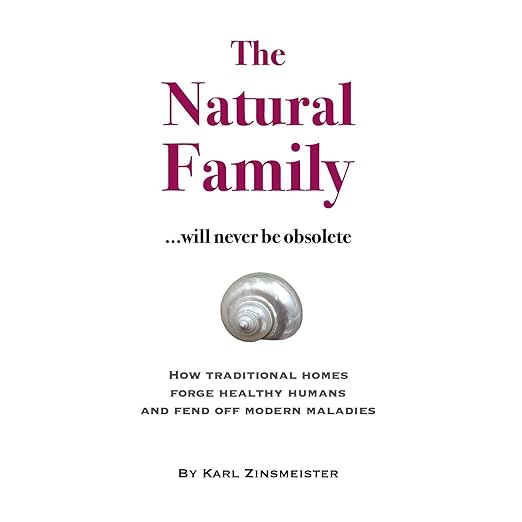
Say the verdict plainly: this is an argument rather than a guide, and the audiobook edition adds friction, because a synthetic voice carries seven hours of deliberately charged rhetoric. Karl Zinsmeister contends that the two-parent household, mother and father, bound to each other and to the children they raise, has never been surpassed, and that the alternatives tried over the past sixty years have fallen short. Whether that lands as obvious or as objectionable will depend almost entirely on where you already stand, and the book makes no attempt to meet a skeptic halfway.
Zinsmeister's Factory Metaphor for Family Life
Start with the metaphor the description leads on, because it sets the register for everything after it. The family, we are told, has been described as 'the factory that manufactures mankind', and the sentence immediately following talks about products of family life emerging damaged. That is an industrial frame, not a sentimental one, and it does specific work: a factory has inputs, outputs, tolerances and defect rates, and once you accept the analogy, questions about family structure become questions about production quality. Whether or not you find the framing persuasive, notice how much of the argument it pre-decides.
Kibbutz Evidence Tests a Pre-Decided Case
The claim itself is enormous in scope, and the copy states it without hedging. In this telling, the frail and unstable home life that arrived from the 1960s onward, itemized as divorce, birth outside marriage, father flight, careerism and neglect, now sits 'at the root of our most worrisome social problems', a list that runs from drug abuse and crime through poverty and mass loneliness to weak schooling. Zinsmeister also takes on the substitutes directly, naming the kibbutz, the nanny nursery, scientific day care and step families as attempts that proved, in the book's word, shockingly inadequate.
That last item is worth pausing on, since it is the one genuinely testable case in the list. Communal children's houses in the early kibbutz movement were a real, documented experiment in raising children outside the parental household, and scholars have argued over its results for decades. Bringing it in is a legitimate move for an argument of this kind. It also shows the method: the book reaches for history, biology and psychology in support of a position it holds before it starts, which is what a case is, and which a listener should hold in mind rather than mistake for a survey of the literature.
Seven Hours Built as One Long Case
A sustained argument delivered continuously is one of the things audio genuinely does better than print. Seven hours of somebody building a case, without the temptation to skip to the conclusion or skim the supporting chapters, reproduces the experience of a long lecture, and long lectures are how contested positions are best understood even by people who reject them. Anyone who wants to know what the strongest version of this argument sounds like will get it here in continuous form, which is more useful than encountering it in fragments.
The sweep across biology, history and psychology is the book's stated method and its main offer. Arguments about family structure usually arrive from one discipline at a time, and assembling several into a single case at least makes the reasoning visible enough to be examined. Seven hours and six minutes is roughly the length of an intelligent book that knows it has one thing to prove, which is a reasonable investment for a reader who wants the position laid out at full length rather than compressed into an opinion column.
Know which shelf you are actually buying from. The listing places this next to parenting and personal development as well as politics and social science, and those two audiences want incompatible things. Nothing in the description promises guidance for raising children, resolving conflict, or handling a particular family situation. What it promises is a demonstration that one family form outperforms the others, which is a very different purchase, and the mismatch is worth catching before hour one rather than during hour three.
Virtual Voice Narration Flattens the Persuasion
The narration credit reads Virtual Voice, which means synthetic rather than human. For procedural or reference material, that trade is often acceptable. For prose written to persuade, it is a heavier cost, because emphasis, irony, the weight of a rhetorical question and the pause before a hard statistic are precisely the effects synthesis handles least reliably, and this book's copy runs on all four. My recommendation on any synthetic edition of an argumentative text is the same: play several minutes of a sample from the middle rather than the opening, and decide whether the delivery flattens the case.
The feedback available is close to nonexistent. Three ratings, averaging five stars, and not one written review anywhere on the listing. A perfect score across a sample that small carries no information at all, and the recording is recent enough that no fuller picture has had time to form. Anyone hoping to triangulate against the experience of other listeners will have to decide without them, which makes the sample and the description the only evidence in play.
Hold the causal claims loosely, whichever direction you lean. Correlations between family structure and social outcomes are real and heavily studied; the question of what causes what, and in which direction, is among the most contested in social science. A seven-hour book crossing three disciplines is a briefing on that literature rather than an adjudication of it. Listeners already persuaded will hear confirmation, listeners opposed will hear selection, and both reactions are predictable enough to be worth naming in advance.
Skip It If You Want a Balanced View
Readers who already hold this position and want it argued at length are the obvious audience, along with anyone working in family policy who needs the case stated in its own terms rather than paraphrased by opponents. Students of American social argument will find it a clean specimen of the genre, complete with its industrial metaphor and its itemized indictment of the 1960s. And listeners genuinely undecided, who want a committed case to weigh against a committed case from the other side, can use it that way with their eyes open.
A balanced review of the evidence is not what this sets out to be. Neither is a treatment of single-parent, adoptive or same-sex households that engages them on their own terms, nor practical parenting help of any kind. Anyone sensitive to the framing of their own family as a defective product should also weigh the opening metaphor carefully before committing seven hours. This book knows exactly who it is talking to, and it spends none of its time reassuring anyone else.