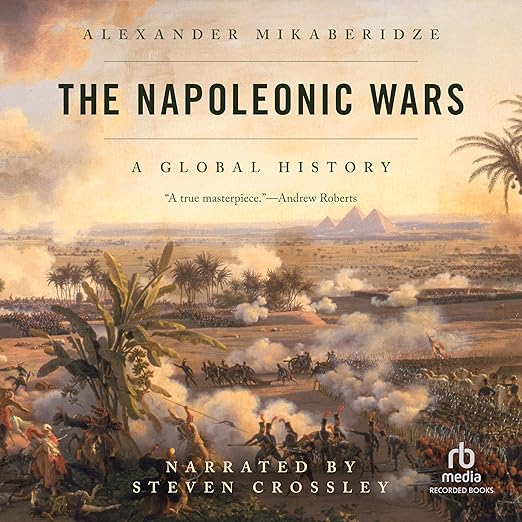
Quick Take
- Narration: Steven Crossley brings professional steadiness to a 35-hour marathon, his pacing and clarity are exactly what a global military history of this scope requires.
- Themes: The global reach of Napoleonic conflict, the interplay of empire and resistance across continents, the mechanics of coalition warfare
- Mood: Authoritative and wide-ranging, more comprehensive survey than dramatic narrative
- Verdict: Alexander Mikaberidze’s global history is the definitive single-volume audio account of the Napoleonic era, built for serious students of the period rather than casual listeners.
I started this one on a long drive and did not expect to still be listening three weeks later. Alexander Mikaberidze’s The Napoleonic Wars: A Global History is not the kind of audiobook you finish in a weekend, and it is not trying to be. At thirty-five hours and ten minutes, it is closer to a graduate-level survey course than a narrative entertainment, and approaching it on those terms changes the experience entirely. What it delivers, delivered by Steven Crossley with consistent professional steadiness, is the most comprehensive single-volume treatment of the Napoleonic era currently available in audio, a Herculean effort, as one reviewer put it, noting the 250 pages of detailed notes and bibliography in the print edition alone.
The scope is what distinguishes this from older accounts of the period. Earlier Napoleonic histories tended to treat the conflict as a European story with peripheral colonial notes. Mikaberidze’s fundamental argument is that this framing has always been incomplete. The wars that began in the aftermath of the French Revolution and ended at Waterloo in 1815 were genuinely global in their reach and consequences, shaping the political futures of Latin America through the Peninsular War’s effects on Spanish imperial control, reverberating through the Ottoman Empire, the Indian subcontinent, and sub-Saharan Africa in ways that most Western military history has consistently underexamined.
A Political and Economic Setting That Actually Makes Sense
One of this book’s most valuable contributions is its opening account of the political and economic context from which Napoleon emerged. Mikaberidze does not begin with Bonaparte as a given; he traces the conditions of the French Revolution, the instability that made a military strongman possible, and the international dynamics that shaped the shifting coalitions of European powers who spent the better part of two decades trying and failing to defeat him. This foundational work pays dividends throughout the rest of the audiobook, because listeners who understand the stakes and the structural tensions of the period are equipped to make sense of military campaigns that would otherwise blur into a sequence of battles.
The case studies in specific campaigns are handled with the organization that one reviewer praised: the book’s structure prevents the listener from being overwhelmed by the complexity of simultaneous developments in different theaters. Mikaberidze moves between the frozen expanses of Russia, the brutal attrition of the Peninsular War in Spain and Portugal, and the political maneuvering in Vienna and London with a clarity of transition that thirty-five hours of audio could easily lose. He does not. The chapter architecture is doing considerable work behind the scenes.
The Global Argument and Its Evidence
The subtitle, A Global History, is not cosmetic. Mikaberidze makes the global reach of the Napoleonic era concrete rather than rhetorical. His treatment of how the wars affected the independence movements of Latin America, for instance, is grounded in the specific political dynamics created when French invasion of the Iberian Peninsula destabilized Spanish and Portuguese imperial authority. The independence revolutions in Venezuela, Argentina, and Mexico did not happen in a vacuum; they happened because Napoleon’s intervention in European dynastic politics created an opening that colonial subjects had not previously had.
This global framing is one place where the book’s critical reception has been almost uniformly positive, even among reviewers who found other aspects of the execution uneven. One careful reader described the book as providing “a global linkage of events” that would be useful even to specialists in the period who know their particular corner of it well but lack the connective tissue between theaters and continents. The bibliography, described as “generous with foreign language sources,” signals that Mikaberidze is drawing on scholarship across national traditions rather than primarily Anglophone historiography.
Where the Execution Has Limits
Honesty requires acknowledging what the critical reception also noted: the book is not without flaws in execution. One reviewer, writing with evident subject-matter expertise, described it as “a bit sloppy” in places, not in its historical claims but in its prose, where errors of precision and occasionally rushed transitions appear at the scale you might expect from a project this large. For a general listener, these are unlikely to register. For a specialist, they are present.
The audiobook also does not deliver the narrative drama that popular military history sometimes provides. Mikaberidze is a historian, and the book reads like a historian’s work, synthesizing evidence, weighing interpretations, building argument. Steven Crossley’s narration handles this register professionally, but listeners hoping for the cinematic sweep of a Stephen Ambrose or the novelistic intimacy of a Hilary Mantel will find this a drier experience. The thirty-five hours are earned by scope and authority, not by storytelling that makes you forget you are learning.
Who Should Commit to Thirty-Five Hours and Who Should Not
Serious students of the Napoleonic period, listeners who have already absorbed the major narrative accounts and want analytical depth and global context, and history readers who are comfortable with a survey format will find this audiobook exceptional. It is also genuinely useful as an ongoing reference, the kind of recording you return to when a specific campaign or political development comes up in other reading.
Casual listeners or those new to the period should approach with honest expectations. This is not the most accessible entry point into Napoleonic history; it assumes some familiarity and rewards existing knowledge more than it creates it from scratch. Start elsewhere if you are coming to the period fresh, and return to Mikaberidze when you are ready for the full, complicated, global picture.
Frequently Asked Questions
Is The Napoleonic Wars by Mikaberidze a good starting point for someone new to this period of history?
Not ideally. The book works best for listeners who already have some familiarity with the major figures, battles, and political dynamics of the period. Its strength is synthesis and global scope rather than narrative introduction. If you are coming to Napoleonic history for the first time, a more narrative-driven account would serve as better preparation.
How does Steven Crossley handle 35 hours of dense military history as a narrator?
With professional steadiness. He is not a showman, and the material does not call for one. His clarity and consistent pacing make the long runtime navigable, and he handles the transition between geographic theaters and political arguments without losing the thread. This is the kind of narration that becomes invisible, which is exactly right for a text of this scholarly density.
Does the book’s global framing actually change the conventional story of the Napoleonic Wars, or is it primarily additive?
It changes the story in meaningful ways, particularly in how it treats Latin American independence movements, Ottoman and Egyptian dynamics, and the British imperial context. The European core of the narrative is well-established; what Mikaberidze adds is the connective tissue showing how events in Europe cascaded into consequences across five continents. That framing is genuinely revisionary, not just supplementary.
Given the 35-hour runtime, is this audiobook structured so listeners can pause and return without losing the thread?
Yes. The chapter architecture is organized by geographic theater and chronological period, which makes it relatively easy to reorient after a break. Most audiobook apps also allow you to set bookmarks at natural stopping points. Mikaberidze’s transitions between sections are clear enough that returning listeners can quickly re-establish context.