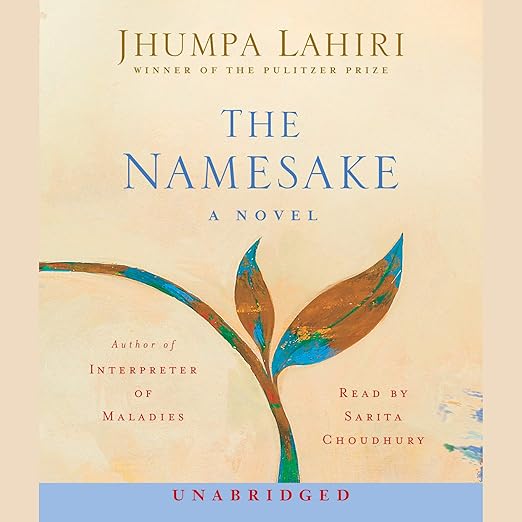
I came to The Namesake later than I should have, which is a confession I make with some embarrassment given my literary background. Jhumpa Lahiri's debut novel had been in my periphery for years, I had read her Pulitzer-winning story collection Interpreter of Maladies and knew what she was capable of, but I kept putting off the novel. Then I listened to Sarita Choudhury read it on a flight, and I spent the last ninety minutes of that journey quietly undone in the middle seat of a full aircraft. This is that kind of book.
The Namesake follows the Ganguli family from Calcutta to Cambridge to the Boston suburbs across roughly three decades, beginning with Ashima and Ashoke Ganguli's arrival in America in the late 1960s and tracking their son Gogol, named, in circumstances the novel explains with great care, after the Russian writer Nikolai Gogol, through his adolescence, young adulthood, and eventual reckoning with both his name and his inheritance. The novel is, among many other things, a meditation on what names carry and what they cost. Gogol Ganguli spends much of the book fleeing the name his father gave him, not understanding until it is almost too late what that name is actually made of.
Our Take on The Namesake
Lahiri writes with what one reviewer aptly called "enormous powers of description", a precision with sensory detail that gives her scenes an indelible quality. The moment on the train in India where Ashoke Gogol stays awake reading and survives the derailment that kills the sleeping passengers around him; Ashima learning to navigate an American supermarket alone in Cambridge during a New England winter; Gogol at the dinner table of the woman he is trying to assimilate into, feeling the impossibility of translation between his two worlds. These are scenes that accumulate into something larger than any single moment, which is how Lahiri's narrative method works, she captures decades in a relatively compact space by zooming in at exactly the right instants.
The novel is a first novel, and it shows in places. The pacing in the final third occasionally feels compressed in ways the middle sections do not, and Gogol's relationships with women are sketched more thinly than his relationship with his parents. But these are small complaints against a book that achieves something genuinely difficult: making the immigrant experience specific and universal simultaneously. Multiple reviewers, from an Indian immigrant in France to an academic reader in the United States, describe finding their own lives in the Ganguli family's story. That breadth of recognition is the mark of fiction that is doing more than documenting a particular community.
The Strengths
Sarita Choudhury's narration is what elevates this audio edition above any other way of encountering the book. She brings a dual cultural fluency, moving between Ashima's Indian-inflected English and Gogol's American-inflected resistance to his heritage, with naturalness that feels lived-in rather than performed. She handles the emotional high points of the novel with restraint, which is exactly right; the scene of Ashoke's death, which leaves multiple readers describing genuine tears, works precisely because Lahiri's prose and Choudhury's delivery allow the grief to speak for itself without embellishment.
The audiobook's runtime of just over ten hours covers the novel comfortably. Lahiri's chapters are long enough to develop scenes fully but Lahiri controls time in the novel with such precision that the listening never feels padded. This is one of the rare literary fiction audiobooks where the format adds to the experience rather than simply accommodating it.
Before You Commit to The Namesake
The Gogol intertextual thread deserves attention. Ashoke's relationship with the Russian writer, having been rescued by staying awake to read Gogol's stories on the train that derailed, gives the name its emotional charge, and Lahiri weaves references to Gogol's themes of alienation and identity throughout the novel without making the connection heavy-handed. Listeners who come to the book with some knowledge of Gogol's fiction, particularly "The Overcoat," will catch an additional layer of meaning in the way Lahiri mirrors certain preoccupations. But the novel is fully navigable without that prior knowledge.
The novel's ending, which I will not describe specifically, requires sitting with rather than resolving. Lahiri is not interested in the satisfactions of closure. What she offers is something more honest: a character who has finally begun to understand what he is made of, which is both a beginning and a form of peace.
Who Should Listen to The Namesake
This is essential listening for anyone interested in American immigrant fiction, in contemporary literary novels that work across generational time, or in Lahiri's career as a whole. Listeners who have read Interpreter of Maladies and want to understand how Lahiri extended those concerns into longer form will find the novel a natural progression. Readers looking for conventional plot momentum will find the novel slower than they prefer; this is character and milieu fiction, not story-driven in the traditional sense. Those with personal connections to the immigrant experience, especially South Asian diaspora readers, consistently report the deepest engagement.