Quick Take
- Narration: Ivan Bercholz reads with careful restraint, honoring the density of Trungpa’s lectures without over-performing the material.
- Themes: The trap of spiritual materialism, working with negativity, the paradox of seeking freedom
- Mood: Quiet and challenging, with the particular demand that comes from teachings meant to be returned to rather than consumed once
- Verdict: A fifty-year-old teaching that has not aged in its essential challenge: that the pursuit of spiritual freedom can become its own sophisticated trap.
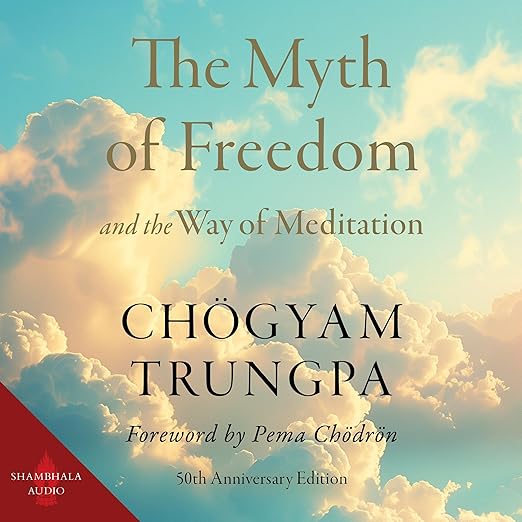
I have returned to Chögyam Trungpa’s work at different points in my life, and each time it strikes differently. The first time I encountered Cutting Through Spiritual Materialism, I was in my mid-twenties and found it clarifying in a way that felt almost too direct. The Myth of Freedom, reissued by Shambhala for its fiftieth anniversary and now available in audio, is a companion text in the truest sense: it extends and deepens the central argument of that earlier work, moving from diagnosis to something approaching practical guidance.
Published by Shambhala Publications and running four hours and twenty minutes, this audiobook collects lectures Trungpa delivered to Western audiences during the early 1970s. Ivan Bercholz narrates, and Pema Chodron, one of Trungpa’s closest students and the bestselling author of When Things Fall Apart, provides a foreword that situates the teachings for contemporary listeners.
Our Take on The Myth of Freedom
Trungpa’s central provocation is in the title. Freedom, as most Western practitioners understand it, is something to be achieved through spiritual practice: meditate enough, accumulate enough insight, and you will arrive at liberation. Trungpa argues that this framing is itself the problem. Preconceptions, attitudes, and even spiritual practices can become the chains that bind, he writes, which is a statement that challenges the entire consumer relationship many Western readers have with Buddhist teaching.
The lectures cover a range of specific obstacles: disappointment and suffering, self-absorption and paranoia, simplicity and boredom, working with negativity, the bodhisattva vow, surrender and commitment. What is remarkable about Trungpa’s approach, and what has made his work enduringly useful, is his ability to take these concepts out of a purely monastic or Asian cultural context and render them in the language of ordinary modern Western experience. The reviewer who describes his books as taking the practice of Buddhism out of the monastery and putting it on the street level captures the essential quality accurately.
The foreword from Pema Chodron is a genuine addition rather than a celebrity endorsement. Chodron studied directly with Trungpa, and her framing of the text reflects that intimacy. For listeners new to Trungpa’s work, her introduction serves as a useful bridge. For listeners who already know Cutting Through Spiritual Materialism or Shambhala, her perspective adds a layer of context about how these teachings were received and transmitted.
Why Listen to These Teachings in Audio
Ivan Bercholz’s narration is appropriate to the material in a way that matters. Trungpa’s prose, which is the translation of spoken lectures into written text, has a density and a rhythm that requires careful handling. Bercholz reads with restraint, allowing the ideas their weight without dramatizing or editorializing. This is the correct approach for dharma text: the reader’s job is to stay out of the way of the teaching.
The four-hour runtime is both a feature and a characteristic of the format. These are lectures, not a systematic textbook, and their value comes partly from the accumulation of perspective across individual talks rather than from any single passage. Audio allows for the kind of ambient listening that suits teachings meant to percolate rather than be mastered in a single sitting.
What to Watch For in the Density of the Material
This is not a light or casually accessible audiobook. Trungpa’s language is precise and his concepts are philosophically demanding, even when expressed in conversational English. One reviewer describes him as always a challenge, which is accurate and important. The book rewards listeners who are willing to pause, return, and sit with confusion rather than those seeking immediate clarity.
The concept of spiritual materialism, the tendency to use spiritual practice as just another mechanism for ego reinforcement rather than ego dissolution, is the thread that runs through the whole collection. Listeners who are resistant to that particular critique, or who are not actively engaged with some form of contemplative practice, may find the teachings abstract in a way that limits their impact.
Who Should Listen to The Myth of Freedom
This audiobook is most valuable for listeners already engaged with Buddhist practice or contemplative spiritual practice of any tradition who want a teacher that challenges their assumptions rather than confirms them. Trungpa is particularly useful for practitioners who have been on the path long enough to recognize the ego’s capacity to colonize spiritual aspiration.
Complete beginners to Buddhist thought may find the lectures require more foundational context than the text provides. Starting with Pema Chodron’s own When Things Fall Apart or Thich Nhat Hanh’s Peace Is Every Step before returning to Trungpa is a reasonable path. Returning to this audiobook after that grounding will make the fifty-year-old teaching feel newly immediate.
Frequently Asked Questions
Is prior knowledge of Buddhism required to benefit from this audiobook?
Some familiarity with basic Buddhist concepts is helpful. Trungpa writes for Western practitioners and explains concepts accessibly, but the lectures assume listeners who have at least some engagement with contemplative practice. Complete beginners may want foundational context first.
How does this audiobook compare to Trungpa’s earlier Cutting Through Spiritual Materialism?
Both address the central problem of ego appropriating spiritual practice, but The Myth of Freedom extends the argument into more specific practical territory, covering topics like the bodhisattva vow and the path of surrender in more detail. They are companion texts and are usefully read together.
What does Pema Chodron’s foreword contribute to the audiobook?
Chodron studied directly with Trungpa and her foreword provides genuine contextual grounding from someone who received these teachings in person. For new listeners, it serves as an introduction; for those familiar with Trungpa, it adds personal testimony about the teaching’s impact.
Is the audio format appropriate for teaching material of this density, or would a print edition be better?
Both formats have merits. The audio allows for the kind of ambient, recurring listening that suits teachings meant to be returned to, and Bercholz’s restrained narration does not add noise to the material. However, listeners who want to annotate or re-read specific passages may find print more practical for active study.