History Wearing Detective Fiction's Clothing
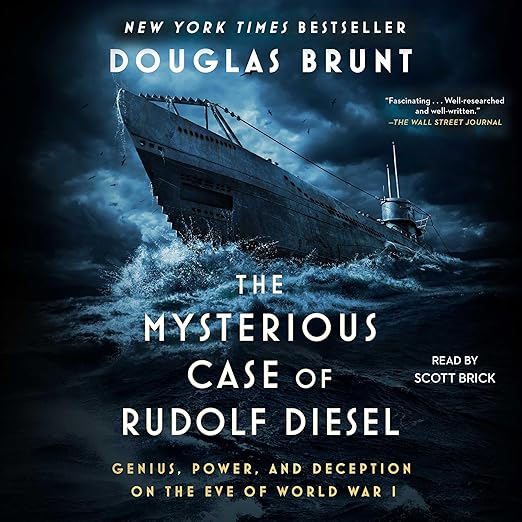
Rudolf Diesel vanished from the steamship Dresden on September 29, 1913, somewhere in the dark water between Belgium and England, and Douglas Brunt's audiobook treats that night less as a historical footnote than as an unsolved case file worth reopening more than a century later. By the time he disappeared, Diesel had already risen from an impoverished European childhood to become a multi-millionaire inventor whose internal combustion engine, notably one that did not require expensive petroleum-based fuel, was on the verge of reshaping global industry. That single technical detail turns out to matter enormously to the plot: an engine independent of oil fuel made Diesel a genuine threat to John D. Rockefeller's Standard Oil empire, and a genuine asset to Kaiser Wilhelm II, who reportedly wanted the technology to power a submarine fleet capable of challenging the Royal Navy.
Brunt structures the book as history wearing detective fiction's clothing, and reviewers keep landing on that same comparison independently: one blurb calls it equal parts Walter Isaacson and Sherlock Holmes, and a listener review separately praises it for reading as engaging as a novel despite being fully sourced nonfiction. Scott Brick narrates, and his register, controlled, slightly cinematic authority, suits that dual identity well; Brick is an established, prolific voice in narrative nonfiction and thriller-adjacent history, and this book asks a narrator to sell both registers simultaneously rather than choosing one, which is a harder needle to thread than either genre alone would require.
Douglas Brunt's background as a novelist before turning to narrative nonfiction is worth noting as context for the book's pacing: chapters are constructed with genuine scene-setting and tension rather than the more academic, source-forward structure a historian-by-training might default to. That novelistic instinct is precisely what multiple reviewers point to when praising the book for reading like fiction despite being fully researched, and it shows most clearly in how each chapter builds toward its own smaller revelation instead of accumulating flat chronological detail the way a conventional biography typically would.
Brick's Dual Registers, Doctrine and Detective Work
The central mystery, accident, suicide, or murder, gives the book genuine narrative propulsion that pure biography often lacks, and Brunt earns that structure by grounding it in real competing interests rather than speculation alone. A listener review specifically connects the book to the Ludlow Massacre and the broader Rockefeller-era industrial conflicts of the period, context Brunt discussed in interviews promoting the book, which suggests the mystery sits inside a genuinely researched account of early twentieth-century industrial power rather than functioning as a gimmick layered on top of straightforward biography, and that grounding is a big part of why the detective framing works rather than feeling opportunistic.
Listeners drawn to the turn-of-the-century industrial era specifically, the period bridging Gilded Age capitalism and the outbreak of the First World War, get a genuinely fresh entry point through Diesel's story rather than the more familiar Rockefeller or Carnegie angle. One reviewer notes a longstanding personal interest in exactly this period as the reason they picked up the book, and came away satisfied that Brunt delivers real new material rather than retreading familiar industrial-history ground, which is a meaningful claim for a period this heavily covered elsewhere.
Scott Brick's other work offers direct precedent for this dual-register demand. His narration of Under the Banner of Heaven, Jon Krakauer's account of Mormon fundamentalism and murder, is specifically praised for handling theological history and violent crime narrative without jarring tonal shifts, delivering genuinely disturbing material through restraint rather than editorializing on top of it. That same skill, keeping two very different registers, doctrine and crime there, biography and detective mystery here, from ever feeling like two separate books, is precisely what The Mysterious Case of Rudolf Diesel asks of him.
Brunt Argues a Confident, Case-Closed Conclusion
Brunt ultimately offers a new conclusion about Diesel's fate rather than leaving the mystery permanently open, which listeners should know going in if an unresolved historical mystery is specifically what they are hoping for. The book's own marketing leans into a confident, case-closed framing, so anyone preferring pure ambiguity over an author's argued conclusion should adjust expectations, even as the reasoning Brunt presents earns credit from reviewers as rigorous rather than speculative overreach dressed up as a twist ending.
At twelve hours and forty-one minutes, the book sits comfortably within standard narrative-nonfiction length, not a quick listen but far from the multi-week commitment longer biographies demand. The rating, a strong 4.6, comes from only two reviews at time of writing, a small sample worth factoring in even though both are enthusiastic and specific in their praise. Listeners wanting deep technical detail on diesel engine mechanics itself should note this is fundamentally a political and biographical history, not an engineering text, so the mechanical specifics stay in service of the human story rather than the other way around.
The book's placement within a broader wave of early-twentieth-century industrial espionage narratives is worth situating for listeners who enjoy the genre generally: the years bridging the Gilded Age and the First World War produced genuine, well-documented corporate rivalries with real geopolitical stakes attached, oil, steel, armaments, and Diesel's story fits naturally alongside that pattern even though his name is less immediately recognized today than Rockefeller's or Carnegie's. That relative obscurity is part of the book's appeal, a genuinely under-told story rather than a new angle on an already-exhausted subject.
Rockefeller and the Kaiser as Real Antagonists
Readers of Erik Larson's blend of true crime and history, or listeners who enjoyed Walter Isaacson's biographical approach to major inventors, are the clearest natural audience here, especially anyone who wants their industrial history delivered with genuine narrative tension rather than a straightforward chronological account. Listeners specifically curious about the hidden power struggles behind early oil and automotive industry history will find the Rockefeller and Kaiser Wilhelm angles particularly rewarding, since both figures get treated as real antagonists with real motives rather than background scenery.
Listeners who prefer their history delivered without a mystery framing device, or who find speculative conclusions about unsolved historical events uncomfortable regardless of how well-argued, may want a more conventional biography instead. For anyone willing to meet Brunt's detective-story approach on its own terms, though, this is a genuinely well-constructed account of one of early industrial history's stranger disappearances, and Scott Brick's narration gives the whole account exactly the controlled tension it needs.
Does the Rudolf Diesel audiobook resolve the mystery of his disappearance?
Yes, Douglas Brunt argues for a specific conclusion rather than leaving the case permanently open, so listeners wanting pure unresolved ambiguity should know a confident theory is presented.
Is the Mysterious Case of Rudolf Diesel audiobook heavy on engineering detail?
No, this is fundamentally a political and biographical history rather than an engineering text, with technical detail kept in service of the human and industrial-power story.
Who narrates the Rudolf Diesel audiobook?
Scott Brick narrates, bringing controlled, cinematic authority that suits the book's dual identity as both biography and detective story.