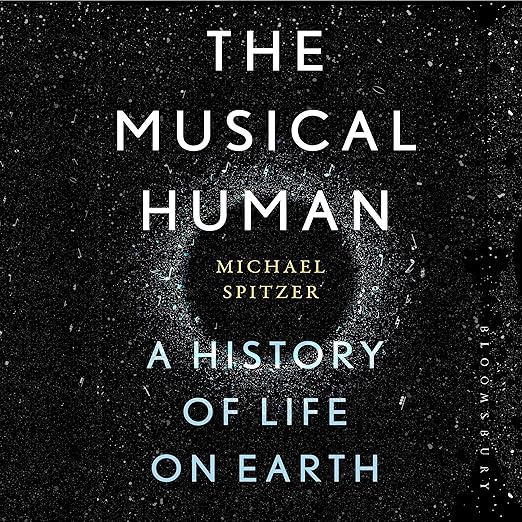
Quick Take
- Narration: Daniel Levitin narrating a book he praised as ‘a Guns, Germs and Steel for music’ creates an unusual dynamic: you are listening to one music scientist deliver another’s argument, with real enthusiasm but occasional moments where his own perspective bleeds through.
- Themes: Music and human evolution, cross-cultural musicology, the biology of rhythm and melody
- Mood: Expansive and intellectually adventurous, occasionally vertiginous in scope
- Verdict: One of the most ambitious popular books about music in years, most rewarding for listeners willing to tolerate genuine scholarly complexity alongside its more accessible passages.
I was on a Sunday afternoon walk when I reached the section of The Musical Human that describes rhythm appearing 165 million years ago, and I had to stop and stand still for a moment. Not because the claim was verified, but because the sweep of it was stunning: the idea that what I was listening to in my earbuds was connected to a sound produced by an insect on a branch before flowering plants existed. Spitzer is after something grand here, and he is not embarrassed about the ambition.
The book was published to strong attention in academic circles and cautious reception from some general readers. The gap between those responses is the most honest thing I can tell you about it. For listeners who come equipped with some background in music, biology, or cognitive science, the experience is dazzling. For listeners who want accessible popular science without the accompanying challenge, it can be demanding in ways that feel less like enrichment and more like work.
Our Take on The Musical Human
Spitzer organizes the book around three levels of inquiry: music in everyday lives, music in world history, and music in evolution. The result is a book that ranges from Bach to BTS and back, as the synopsis puts it, and also from insects to apes to AI. That range is genuine, not gestured at. Spitzer is a world-leading musicologist who has done the reading across disciplines, and it shows in the density of synthesis. One reviewer described it as the first book for general readers to comprehensively explore music’s extraordinary diversity across world cultures, exhaustively researched and beautifully written.
The central argument, that music is the most important thing our species ever did, is provocative and not fully proven, but that is not the point. The point is that it opens a space to reconsider how central music has been to cognition, social bonding, emotional regulation, and the transmission of culture across time and geography. Spitzer makes that case through accumulation rather than through a single decisive argument, and the accumulation is impressive.
Why Listen to The Musical Human
The narrator choice is a fascinating one. Daniel Levitin, who wrote This Is Your Brain on Music and is himself a leading figure in the science of music cognition, narrates this book. He is the source of the Guns, Germs and Steel comparison that appears prominently in the marketing. Listening to Levitin deliver Spitzer’s argument means you are occasionally in the presence of someone who knows the field well enough to have strong opinions about what is being claimed. That tension is mostly productive. Levitin reads with genuine engagement rather than mere competence, and his authority in the subject lends the more speculative passages something to lean against.
At seventeen hours, the book is long but not exhausting in the way that the forty-seven-hour histories in this batch can be. The subject matter provides enough variety of example and cultural context that the rhythm of the listening changes regularly enough to prevent settling.
What to Watch For in The Musical Human
A sharp dissenting review pointed out several passages where Spitzer reaches for profundity and achieves only obscurity. The critique is fair. Lines like mimesis is what music does with one foot in biology and another in religion, quoted by the reviewer, are gesturing at real ideas but not quite landing them. There is a strain of writing in The Musical Human that aspires to the poetic and occasionally loses contact with the ground. Listeners who are tolerant of ambitious uncertainty will find that forgivable; those who need each sentence to carry precise meaning will find it frustrating.
The cross-cultural scope is genuinely impressive but also risks the usual pitfalls of sweeping world-history synthesis: the selections are inevitably partial, and what gets left out shapes the argument as much as what is included. Spitzer is aware of this risk, but awareness does not eliminate it.
What Spitzer does particularly well, and what saves the book from the trap of evolutionary grand narrative, is his attention to specific musical cultures in their own terms before absorbing them into the larger argument. The sections on non-Western musical traditions resist the tendency to treat everything outside European art music as background material for a story about Western development. That care is not universal across the seventeen hours, but it is present enough to distinguish this from comparable synthesis attempts. One reviewer with musician’s background noted that the book helps you understand why you react the way you do to certain music and get totally absorbed in other music. That specific, experiential payoff is the book at its best.
Who Should Listen to The Musical Human
Listeners with background or deep interest in music, evolutionary biology, cognitive science, or world history will find this most rewarding. Musicians curious about why they do what they do will encounter illuminating material here. Also suited for fans of books like This Is Your Brain on Music or Guns, Germs and Steel who want the same scale of ambition applied to music. Skip it if you are looking for a focused, argument-driven popular science book; this is wide-angle, and some passages require genuine effort to follow.
One last note on narrator and author relationship: Levitin’s presence here as narrator is not just a production decision. He is, in a genuine sense, in conversation with Spitzer across the seventeen hours. He has his own published views on music cognition, and occasionally you sense him amplifying the arguments that align with his research while reading more neutrally through the ones he might contest. For listeners who know Levitin’s work, that subtext is part of what makes the recording interesting rather than merely competent.
Frequently Asked Questions
Does the book require musical training or music theory knowledge to follow?
No formal music theory background is necessary. Spitzer writes for general readers, though some familiarity with musical concepts will make certain sections more accessible. The evolutionary and cross-cultural sections are the most accessible; the more analytical musicological passages are the most demanding.
Daniel Levitin is himself an expert on music and the brain. Does his narration add a layer of interpretation to Spitzer’s text?
It does, and that dynamic is worth being aware of. Levitin praised the book publicly before narrating it, so he comes to it as an advocate. His engagement is genuine and adds energy to the recording, but listeners occasionally sense a specialist’s perspective inflecting delivery of another specialist’s argument.
Is the book’s central claim, that music is the most important thing humans ever did, actually argued or just asserted?
It is argued through accumulation: Spitzer builds a case across the entire book for music’s centrality to cognition, social bonding, cultural transmission, and emotional regulation. The claim is intentionally provocative, and he does not offer a simple proof, but the supporting material is extensive enough that the assertion does real work.
One reviewer found some passages obscure. Is this primarily a popular science book or an academic one?
It occupies an in-between space. Spitzer clearly intends it for general readers, and much of it is accessible and vivid. But it also aspires to genuine scholarly depth, and some passages sacrifice clarity for scope or resonance. It is more demanding than most popular science in the genre.