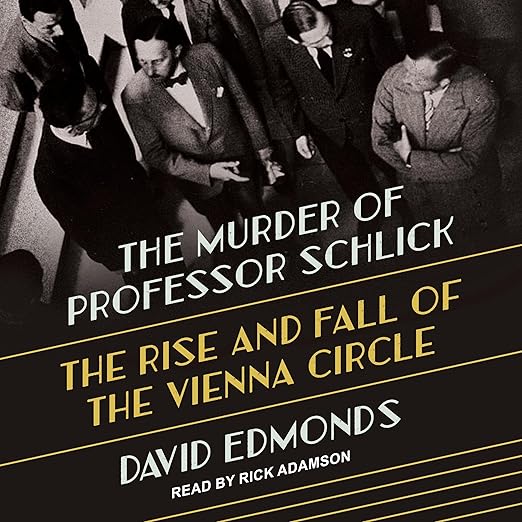
Quick Take
- Narration: Rick Adamson’s measured academic delivery suits the book’s intellectual register, he handles philosophical vocabulary with confidence and gives the biographical passages the human weight they require.
- Themes: The vulnerability of enlightenment thought in the face of political extremism, intellectual exile and the dispersal of ideas, logical positivism as both a philosophy and a historical phenomenon
- Mood: Intellectually absorbing and quietly elegiac, the feeling of watching a civilization fold itself up
- Verdict: An outstanding work of intellectual history that operates simultaneously as philosophical biography, political history, and portrait of Weimar-era Vienna, one of the best audiobooks available for listeners interested in the history of ideas.
I came across The Murder of Professor Schlick by accident, misreading a title recommendation in a footnote. I have been recommending it to people ever since. David Edmonds writes intellectual history at a level that makes most popular philosophy look either too easy or too inaccessible, and this book, which reconstructs the rise and fall of the Vienna Circle in the years between the wars, is his best work. Rick Adamson’s narration keeps it in audio form for the full twelve hours without ever feeling like a lecture you are trapped inside. It is the rare twelve-hour book that does not feel long.
The facts of Schlick’s murder are almost literary in their awful irony. On the steps of the University of Vienna in June 1936, a former student named Johann Nelböck shot him dead. Nelböck argued in court that Schlick had promoted a treacherous Jewish philosophy, an argument that sections of the Austrian press found more sympathy for than should be imaginable from where we stand now. But the murder, which functions as the book’s narrative frame and emotional climax, is in some ways the least philosophically interesting thing in it. What Edmonds is really writing about is the question of why anyone wanted to kill logical empiricism in the first place, and what it tells us about the relationship between ideas and the political climates that tolerate or destroy them.
The Vienna Circle and Its Enemies
The Circle’s program, associated with Otto Neurath, Rudolf Carnap, the brilliant and eccentric Kurt Gödel, and on its margins with both Wittgenstein and Popper, was in essence an attempt to purge philosophy of metaphysics and pseudoscience. If a proposition could not be verified through experience or proven analytically, it was not merely false; it was meaningless. That radical claim made logical empiricism the most fashionable philosophical movement of the 1920s and early 1930s, and it also made it an enemy of every ideological system, Nazi, fascist, Catholic, Austro-fascist, that depended on propositions that could not survive empirical scrutiny. The Circle’s commitment to verifiable truth was, in a very precise sense, a political act, and it was treated as one.
Edmonds traces this political entanglement with the care of a historian who knows that ideas do not live outside their social contexts. The Vienna Circle was not merely philosophically controversial: it was ideologically targeted. Many of its members were Jewish, and nearly all were politically left-liberal at a moment when the Austrian Republic was lurching toward what Edmonds calls Austro-fascism. By the time Schlick was killed, almost all of the Circle’s members had already fled to Britain, to the United States, to wherever the anglophone philosophical tradition was open to their program. The diaspora of the Circle is one of the major intellectual migrations of the twentieth century, and Edmonds traces it with the biographical precision it deserves.
Three Books in One
One reviewer observed accurately that this is really three books: a surface overview of logical positivism, a set of biographical portraits of Circle members, and a political history of the conditions that ended the Circle. That is a fair description, and it explains why the book is more satisfying than any of those three components would be separately. The philosophical content, handled well enough for general readers without requiring prior philosophy, gives depth to the biographical portraits. The biographical portraits make the political destruction personal rather than abstract. The political history explains why the philosophical program was not merely marginalized but actively hunted through a period when the distinction between ideas and their bearers had collapsed entirely.
The Wittgenstein and Popper passages are among the most interesting in the book. Both figures had complicated, ambivalent relationships with the Circle. Neither fully belonged to it, and both ultimately rejected its core commitments, but both were shaped by it in ways that inflected their most important work. Edmonds is good on the sociology of philosophical influence: how ideas travel through personal contact, resistance, and revision rather than through simple intellectual transmission from one mind to another.
Rick Adamson and the Twelve-Hour Architecture
Twelve hours of intellectual history is an ask, and Adamson earns the runtime consistently. He reads the philosophical passages with the clarity of someone who has internalized the argument rather than simply performing it, and the biographical sections, which require tonal variation between admiration, tragedy, and occasional dry humor, are handled with the necessary range. The German and Austrian names and institutional titles that populate every chapter are navigated fluently, which matters more than it might seem for an audiobook in which unfamiliar vocabulary encountered repeatedly can create cumulative friction that breaks concentration.
Who Should Listen, Who Should Skip
Listen if you have any interest in the history of twentieth-century philosophy, the intellectual world of interwar Vienna, or how political regimes target ideas as well as people. Also essential for listeners who find the question of what philosophy is good for genuinely urgent, because this book, among other things, is an answer delivered through the story of what happened when the answer was threatening enough to kill over. Skip if you need a fast pace or if dense intellectual biography feels like obligation rather than pleasure. At twelve hours, this is a book for listeners who want to live inside its world for a while, and the world it creates is worth the time.
Frequently Asked Questions
Do you need a background in philosophy to follow the logical positivism material?
No. Edmonds is a skilled popular philosopher who co-created the long-running Philosophy Bites podcast, and the technical content is handled accessibly throughout. The core ideas of logical empiricism are explained clearly enough that a reader with no prior philosophy background will follow the argument without difficulty or frustration.
How is Kurt Gödel treated, does the book engage with his incompleteness theorems technically?
Gödel appears as a fascinating biographical subject rather than a technical case study. His incompleteness theorems are mentioned in the context of his relationship with the Circle and the ways his work complicated logical empiricism’s ambitions, but Edmonds does not attempt a full technical treatment. The focus is on Gödel as a person and as part of the Circle’s intellectual and social world.
Is Johann Nelböck’s motivation explored in psychological depth, or is he mainly a symbolic figure?
Edmonds engages with Nelböck’s psychology with more seriousness than the murder’s apparent randomness might suggest. The defense argument, that Schlick promoted immoral Jewish philosophy, is traced as a cultural symptom rather than dismissed as simply deranged. Nelböck functions as a case study in how ideological extremism selects its targets from among the most intellectually threatening rather than the most physically threatening.
Does the book follow the Circle’s members into exile and trace what happened to their ideas after they left Vienna?
Yes, and this is one of the most interesting sections of the book. The logical empiricist program’s absorption into anglophone analytic philosophy, through A.J. Ayer in Britain and Carnap at the University of Chicago, is traced as an intellectual migration story. The ideas survived the destruction of their original community and transformed the philosophical tradition they entered, which is its own kind of vindication.