The Short Version
- Read by: Clifford Ponder delivers the material with clarity and professional steadiness; his even pacing suits a book dense with financial frameworks, keeping the listen from feeling like a lecture.
- At its heart: small multifamily investing, financial independence, deal analysis and scaling
- Vibe: Focused and practical
- Short version: Volume I of this two-part series builds a credible step-by-step system for multifamily investing and earns its thirteen hours of runtime with concrete, specific guidance.
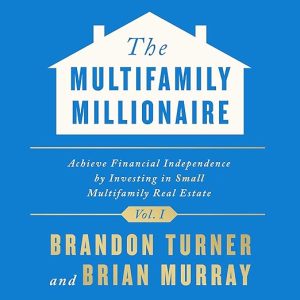
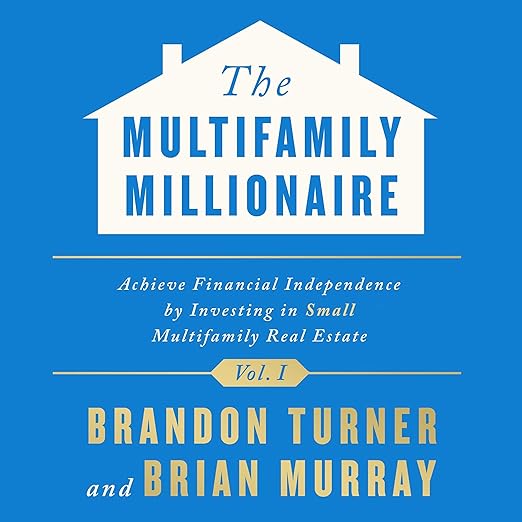
Brandon Turner went from minimum wage to millionaire by thirty through multifamily real estate, and this audiobook, The Multifamily Millionaire, Volume I, co-authored with Brian Murray and narrated by Clifford Ponder, is his attempt to document that system in enough detail that a listener starting from scratch could replicate it. Over thirteen hours and four minutes, Ponder works through a curriculum covering small multifamily properties, the two-to-twenty unit range that most individual investors can finance personally without commercial capital structures. This is the first volume of a deliberate two-part series; Volume II handles larger commercial deals and is designed as a sequel once you have mastered the foundation presented here.
Named Systems Instead of Motivational Abstractions
Turner's strength as a real estate educator has always been the specificity of his systems. The Stack method, the BRRRR method, the proprietary expense algorithms for deal analysis: these are not motivational abstractions but named frameworks with defined steps that can be applied to specific properties in specific markets. That specificity is what separates this audiobook from the general-interest investing titles that dominate the genre. A reviewer who described it as the best step from single-family to small apartment investing was accurate but slightly understated: a careful listener with no prior real estate experience could use this as a starting point, since Turner builds the foundational logic before layering the multifamily-specific techniques on top. Another reviewer who had been a landlord for years noted they still found material they had not encountered elsewhere, which speaks to the depth of the curriculum.
Murray's contribution to the co-authored structure is the Inc. 5000 company that his real estate operation built, a fifty-million-dollar empire constructed using the same principles Turner describes. That parallel credibility is valuable in a genre full of single-narrator success stories. When both authors claim that the strategies work, the audiobook can point to two distinct trajectories rather than one. The framing is also honest about the effort involved: this is not a passive-income fantasy book. The promise is a repeatable system, not a lucky break, and the tone throughout reflects that distinction without becoming preachy about it.
Ponder Delivers Density Without Performing It
Thirteen hours is a significant commitment, and this audiobook earns that time through density rather than padding. Each major section addresses a concrete decision point: how to identify profitable properties using specific criteria, how to secure deals with no money down through creative financing structures, how to find off-market properties in competitive markets, and how to manage properties at a standard that retains tenants rather than losing them to preventable frustrations. The house hacking strategy alone, in which the investor lives in one unit of a small multifamily property to eliminate personal housing costs while building equity, is presented in enough operational detail to be immediately actionable for someone willing to move.
Ponder's narration is well suited to material of this density. He does not perform the content; he delivers it with a consistent, professional steadiness that keeps thirteen hours from feeling like a lecture. For listeners who want to follow along with notes or return to specific frameworks later, that plain delivery is an asset rather than a limitation. A reviewer described the series as an incredible resource that moves past the author's autobiography and into substantive guidance fairly quickly, which is an accurate assessment of the pacing choices Turner makes throughout.
Recycling Capital Until One Deal Funds the Next
The BRRRR method chapters, covering Buy, Rehab, Rent, Refinance, Repeat, are where the book's compounding logic becomes clearest. The system is designed not just to acquire properties but to recycle capital so that each acquisition funds the next, which is the mechanism through which a two-unit starter property eventually becomes the foundation of a much larger portfolio. Listeners who understand that architecture will get significantly more from the later sections about scaling. The transition points between asset classes are also worth particular attention: Turner explains why two-to-four unit properties are fundamentally different from single-family homes in terms of financing eligibility, tax treatment, and management complexity, and those distinctions anchor everything that follows in the curriculum.
Volume I ends with a chapter on transitioning from small deals to large commercial investments, serving as a deliberate bridge to Volume II. It is worth listening to that section carefully even if you do not intend to continue immediately, because it clarifies the underlying philosophy of the whole series: small multifamily is the training ground, not the destination. Turner and Murray are explicit that the Stack method is designed to generate the equity and experience base that makes Volume II territory achievable for someone who started with nothing but a willingness to execute the system.
Small Multifamily Welcomes Investors at Any Level
This audiobook is for investors at any level who are specifically interested in the two-to-twenty unit property range, including those who have never purchased a property at all. It rewards listeners willing to engage with financial frameworks in detail and to revisit specific sections multiple times as they move toward their first acquisition. Those looking for motivational content rather than operational guidance will find the density off-putting. Anyone already active in large-scale commercial real estate should begin with Volume II instead, as this volume covers ground they likely know and is most valuable to those for whom the Stack method is genuinely new territory.
Before You Listen
Does this audiobook require Volume II to be useful, or does Volume I stand on its own?
Volume I stands on its own. It covers small multifamily properties from acquisition through scaling and provides a complete framework for that segment of the market. Volume II handles larger commercial deals and is designed as a sequel, not a prerequisite.
How does this audiobook compare to Brandon Turner's earlier book on rental property investing?
Turner's earlier rental property book is a strong general foundation. This audiobook is more focused, covering multifamily-specific strategies like the Stack method and BRRRR in greater depth, and it benefits from co-author Brian Murray's large-scale empire-building experience alongside Turner's framework.
Is this audiobook accessible to someone with no real estate background?
Yes. Turner builds foundational concepts before layering in multifamily-specific techniques. A reviewer with no prior investing experience described it as a genuinely workable starting point, though some financial terminology will require active engagement.