Quick Take
- Narration: Matt Zapotosky, a Washington Post reporter who covered the investigation, reads with appropriate gravity and clarity.
- Themes: Democratic accountability, obstruction of justice, the mechanics of political interference
- Mood: Dense and procedural, with moments of genuine historical weight
- Verdict: A formidable listen that rewards the patient citizen willing to engage with the actual text rather than any partisan summary of it.
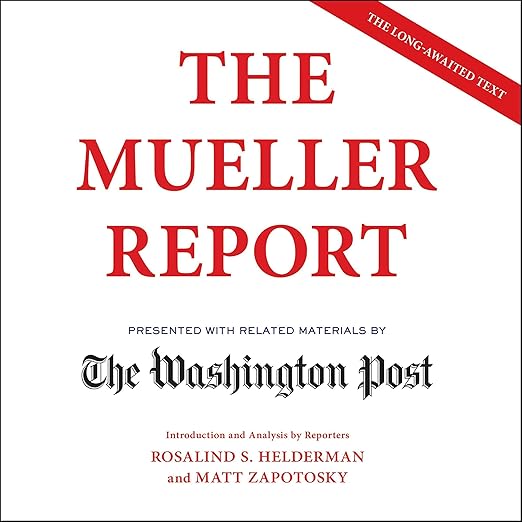
I listened to significant portions of this one during the spring of 2019, when the report was still dominating every news cycle and it felt almost irresponsible not to engage with the primary document. A reviewer once wrote that very few people who have strong opinions about a document have actually read it. That observation applies with particular force to The Mueller Report, which may be the most discussed unread document in recent American history. The audiobook edition, narrated by Matt Zapotosky with accompanying analysis from the Post’s investigative team, is the most serious attempt to make the text genuinely accessible.
This edition is more than a straight reading of the Special Counsel’s report. It includes a Washington Post introduction titled A President, a Prosecutor, and the Protection of American Democracy, a detailed timeline of the investigation from Mueller’s May 2017 appointment through delivery, a guide to the dozens of individuals involved, and key supplementary documents including filings related to Michael Flynn, Paul Manafort, Michael Cohen, Roger Stone, and the Russian internet operation based in St. Petersburg.
Our Take on The Mueller Report
The report itself is genuinely dry in places. This is a legal document, not a thriller, and the audiobook experience requires patience and an acceptance of procedural density. But the dryness is also part of its significance. Mueller’s team was not writing for a general audience. They were building a legal record, and the careful, footnoted, evidence-anchored prose carries its own authority. One reviewer compared listening to it to engaging with Watergate-era documentation, and the comparison is apt: the stakes feel historical in a way that most political audiobooks do not manage.
Zapotosky is an ideal narrator for this material. As a Post journalist who covered the investigation from its beginning, he brings contextual understanding that a conventional narrator would lack. He reads the legal language clearly without either dramatizing it or deflating it, and his familiarity with the cast of characters means the sprawling roster of names is handled with confident clarity.
Why Listen to The Mueller Report
The strongest argument for listening to this rather than reading summaries or watching cable commentary is straightforward: almost every popular account of the report’s findings was shaped by confirmation bias before the public had access to the text. Reading or listening to the actual document allows you to form your own assessment of what Mueller’s team found, documented, and deliberately chose not to conclude. The tension between the evidence assembled and the prosecutorial decisions made is one of the most interesting aspects of the report as a document, and it gets flattened in almost every secondary account.
At nineteen hours and fourteen minutes, this is a significant time investment. But reviewers who committed to it consistently describe the experience as clarifying rather than exhausting. The Post’s accompanying analysis helps listeners contextualize sections that would otherwise require substantial background knowledge to interpret.
What to Watch For in The Mueller Report
This is not an audiobook to play passively in the background. The information density requires attention. One reviewer recommended taking it in segments to keep the facts organized, which is sound advice. The guide to individuals included in the edition helps, but listeners new to the story’s cast will benefit from having that section available for reference while listening.
The redactions, present in the publicly released version, occasionally create gaps that are audible in the text. These are faithful to the document’s actual release state and cannot be helped, but listeners should be prepared for sections where the legal architecture is visible but pieces of the factual picture are withheld.
Who Should Listen to The Mueller Report
Citizens interested in forming a direct, unmediated view of what the Special Counsel’s investigation found will find this edition the best available tool for doing so. Political science readers, historians of the Trump presidency, and listeners interested in constitutional questions around obstruction and executive power will find the document rewarding rather than merely dutiful. Those looking for a fast political read or a narrative-driven account should look elsewhere: this is primary source material, and it behaves accordingly.
Frequently Asked Questions
Does this edition include the full Mueller Report or an abridged version?
Reviewers confirm the full report is included, sandwiched between the Post’s introductory analysis and supplementary related filings. Nothing from the report itself has been cut or condensed.
Is Matt Zapotosky’s narration neutral, or does it reflect a political viewpoint?
Zapotosky reads the material with journalistic neutrality. He does not editorialize during the narration of the report itself. The Post’s introductory material reflects the paper’s analytical framing, which some listeners may find carries an implicit perspective.
How difficult is the legal language to follow in audio format?
Some sections are dense. The guide to individuals and the Post’s timeline help listeners maintain context. Most reviewers found it manageable with attentive listening, though pausing and replaying specific sections is common.
Is this edition still relevant given how much time has passed since the investigation?
As a historical document about a specific investigation into Russian interference in 2016 and related conduct, it remains the primary source for understanding that period of American political history. Its relevance as documentation of constitutional boundaries around presidential conduct is ongoing.