Quick Take
- Narration: Dan Woren delivers a steady, authoritative read that suits the weight of the subject matter – measured pacing, clean diction, no theatrics where none are needed.
- Themes: judicial overreach, democratic accountability, the Roberts Court
- Mood: Rigorous and unsettling, like a slow audit of something everyone assumed was working
- Verdict: If you want to understand how nine unelected lawyers came to hold more sway over American life than Congress, Kaplan’s account is the most candid starting point I’ve found.
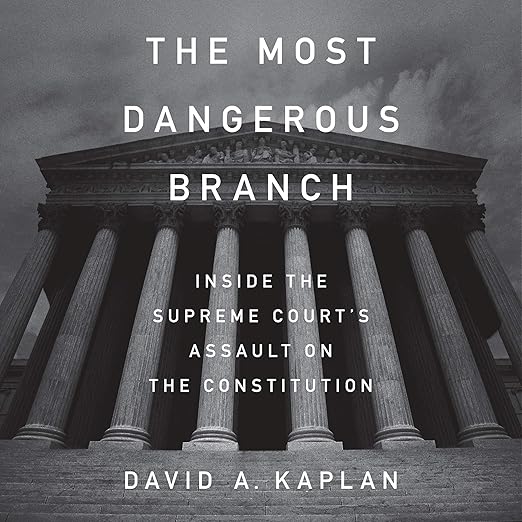
I came to this one during a long train ride, somewhere between cities, and found myself so absorbed that I missed my stop. That doesn’t happen often with political nonfiction. David A. Kaplan, former legal affairs editor at Newsweek, has written the kind of book that makes you feel like you’ve been let into a room where the real conversations happen – candid, a little alarming, and very hard to put down.
What sets The Most Dangerous Branch apart from most writing about the Supreme Court is its refusal to pick a side. Kaplan’s central argument is not that conservative justices are bad or that liberal justices are virtuous. His claim is that the Court as an institution has accumulated power it was never designed to wield, and that both wings of the bench have participated in this expansion with enthusiasm. That’s a harder sell than partisan outrage, and it’s the more important one.
Our Take on The Most Dangerous Branch
Kaplan structures the book in two halves: Characters and Cases. The character portraits are the most entertaining part. He writes about Clarence Thomas’s simmering rage, Ruth Bader Ginsburg’s celebrity, Antonin Scalia’s death, and the petty friction between Neil Gorsuch and Chief Justice Roberts with a journalist’s eye for the telling detail. These aren’t caricatures. The justices emerge as recognizable human beings who have convinced themselves, with varying degrees of sincerity, that their expansive readings of the Constitution are acts of restraint rather than ambition. The section on what John Roberts thinks of his critics is particularly sharp.
The cases section traces a through-line from Roe v. Wade in 1973 to Citizens United to Bush v. Gore. Kaplan’s argument is that Roe, whatever one thinks of its outcome, established a template for the Court to reach beyond the text of the Constitution using inferred rights – and that subsequent Courts, left and right, have treated that template as permission. Whether you find this argument convincing will depend on your priors, but he makes it with enough historical texture and interview material that it’s difficult to dismiss.
Why Listen to The Most Dangerous Branch
The answer is Dan Woren’s narration. Woren has the kind of voice that legal nonfiction needs: authoritative without being pompous, paced for complex ideas rather than narrative excitement. He handles the shifts between character sketches and doctrinal analysis without losing the thread. At sixteen and a half hours, this is a commitment, but Woren makes it feel earned rather than exhausting. The interview-derived passages, where Kaplan quotes justices and law clerks directly, land with particular clarity in his reading.
What reviewers who praised this book consistently note is its research depth. Kaplan conducted exclusive interviews with the justices themselves and dozens of their law clerks. That access gives the book textures that pure legal analysis cannot. The gossip is real, the insider detail is real, and the structural argument is built on a foundation solid enough to withstand disagreement.
What to Watch For in The Most Dangerous Branch
The book’s thesis can feel overstretched in places. Some reviewers found the argument not entirely convincing when it comes to distinguishing legitimate constitutional interpretation from illegitimate overreach – a line that is genuinely difficult to draw, and Kaplan doesn’t always draw it consistently. There’s also the question of timing: this was published in 2018, before the Court’s seismic 2022 term. Kaplan analyzes Kennedy’s retirement and Kavanaugh’s confirmation as pivotal moments, but he couldn’t have known how completely the balance of power would shift. Listeners should treat the later chapters as historical context rather than current analysis.
The book does not pretend to offer solutions, which some listeners find frustrating. If you come looking for a prescription for how to restrain the Court, you won’t find one. What you’ll find instead is a compelling diagnosis, delivered with the authority of someone who spent years watching these people work.
Who Should Listen to The Most Dangerous Branch
This works best for listeners who already follow Supreme Court news and want deeper context – the personalities, the internal dynamics, the historical arc of how we got here. It’s equally useful for people across the political spectrum who are troubled by judicial maximalism regardless of which outcomes it produces. Skip it if you’re looking for a purely partisan takedown or a how-to guide for legal reform. This is journalism in the best sense: reported, argued, and honest about its own limits.
Frequently Asked Questions
Does Kaplan favor liberal or conservative justices in his critique?
Neither, deliberately. His argument is that overreach is an institutional habit, not a partisan one. He criticizes the Warren Court, the Rehnquist Court, and the Roberts Court with roughly equal sharpness. Reviewers on both sides of the aisle found things to object to, which is probably the right outcome for a book making this argument.
Is this book still relevant given it was published before the 2022 Dobbs decision?
Yes, with the caveat that it reads as historical context rather than current analysis for the most recent term. Kaplan’s structural argument about judicial overreach applies just as well to Dobbs as to the cases he covers, even though he couldn’t address it directly.
How does this compare to other Supreme Court books like The Nine or The Brethren?
The Most Dangerous Branch shares the insider access of both books but is more explicitly argumentative than either. Where Woodward and Bernstein in The Brethren focused on reporting, and Jeffrey Toobin in The Nine on narrative, Kaplan is making a sustained case. Listeners who want pure storytelling may prefer The Nine; those who want the argument should come here.
Are the character portraits of the justices fair or sensationalized?
Mostly fair, with occasional moments of journalistic sharpness that feel pointed rather than documented. The Clarence Thomas section in particular drew some pushback from reviewers who felt the ‘simmering rage’ framing was reductive. Kaplan is a good reporter but he’s also a writer with a thesis, and those two things occasionally pull against each other.