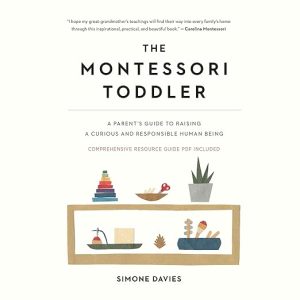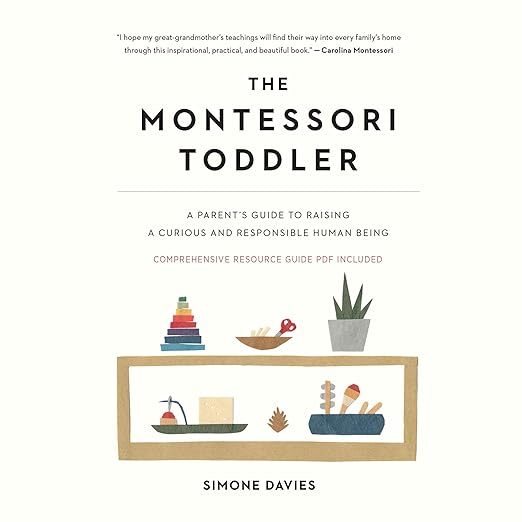
I don't have toddlers, but I have spent enough time around parents of toddlers to understand the specific exhaustion that drives people toward books like this one. There's a category of parenting book that promises transformation and delivers philosophy without implementation; another that delivers implementation without any framework for understanding why. Simone Davies's The Montessori Toddler manages to do both in ways that the reviews, across multiple countries and languages, consistently praise.
The audiobook is narrated by Susie Berneis and runs just over seven hours. The synopsis is minimal, Davies describes the book as a step-by-step plan for cultivating daily routines that make life with toddlers a time of curiosity and learning. That undersells what's inside.
Davies is a Montessori guide and blogger whose approach is characterized by something specific: she translates Montessori principles into observable daily situations rather than treating the philosophy as an aspirational system. The book covers how toddler brains develop, how to create environments that invite independence, how to speak with children in ways that acknowledge their capability, and how to handle the developmental challenges, tantrums, resistance, testing limits, that define the toddler years. Crucially, she addresses the emotional experience of the parent throughout, acknowledging that the Montessori approach sometimes runs directly against instinct, and offering frameworks for managing your own response when a toddler is struggling with a task you could resolve in thirty seconds.
The emphasis on the prepared environment is particularly well-developed. Davies explains not just what Montessori spaces look like but why they're arranged that way, what the low shelves and child-height furniture are doing for the child's sense of agency and capability. That 'why' is what separates this from a design book with a Montessori label on it.
Why It Works in Audio
One reviewer described returning to this book repeatedly as a reference, pulling it out for specific challenges or developmental moments rather than treating it as a one-time read. That's telling about its structure. Davies organizes material in ways that make it findable: activity ideas, communication guidance, developmental milestones each have their own section. The audiobook format limits that reference-book function somewhat, but the first listen-through functions beautifully as a framework-building pass.
Susie Berneis's narration is a strong match. She reads with a patience and warmth that reflects the Montessori orientation toward the child, and by extension toward the parent, without becoming saccharine. Her pacing is generous without dragging, and she handles the practical sections (scripts for talking with toddlers, step-by-step activity descriptions) with clear, usable delivery.
Before You Commit to The Montessori Toddler
The most honest caveat about this book is that it's oriented toward a specific kind of implementation. Setting up a Montessori home environment, low shelves, child-sized furniture, curated accessible materials, requires some investment of both money and space. Davies is thoughtful about this and doesn't assume unlimited resources, but the full vision of a prepared environment involves more infrastructure than some families can realistically create.
One reviewer noted the book doesn't work for every parenting style. That's simply true. The Montessori approach asks parents to manage their own impulses to help before the child has tried, to tolerate more mess and time in the name of capability-building, and to rethink discipline as guidance rather than control. If those reorientations conflict with deeply held parenting instincts, the book will feel like friction rather than support.
Who Will Get the Most From It
Best suited for parents with children aged approximately one to three who are curious about Montessori principles and want to apply them at home, particularly those whose children are entering or preparing to enter a Montessori school, who want to understand and reinforce the approach. Also useful for grandparents, caregivers, and early childhood educators who want a grounded introduction to Montessori practice. The audiobook is a strong first-listen framework-builder; many parents who reviewed this book described keeping the print edition as an ongoing reference, so consider pairing both formats if this material becomes central to your approach. Not the right starting point if you're looking for quick behavior-management fixes or if you prefer a more directive parenting style, this book requires patience with process, which is itself a Montessori virtue.
Good to Know
Is The Montessori Toddler useful for parents who don't have their child in a Montessori school?
Yes, Davies explicitly addresses home implementation throughout, and much of the philosophy applies regardless of school setting. The prepared environment sections, communication guidance, and developmental framework are all designed for home practitioners. You don't need a Montessori school enrollment to get significant value from the book.
Does Susie Berneis's narration include the visual elements like photographs that are referenced in the print edition?
The audiobook doesn't reproduce the print edition's photographs and visual examples. Several reviewers of the print book praised the visual Montessori environment examples. If you have young children and want to see the environmental setup, the print or e-book version supplements the audiobook usefully.
At what age range is the content most applicable, does it cover infants or older children beyond the toddler years?
Davies focuses primarily on the one-to-three age range, which defines the toddler period in Montessori terms. Some principles carry into the preschool years, but this isn't a comprehensive Montessori guide for older children. Families with newborns will find some applicable material but may want to supplement with Montessori infant resources.
Does the book require significant financial investment to implement the Montessori principles it describes?
Davies is mindful of accessibility and provides guidance that doesn't require purchasing complete Montessori furniture sets. DIY solutions and purposeful selection of existing materials are discussed. That said, the full prepared-environment vision involves some investment in accessible storage and child-sized furniture, families can implement the philosophy at different levels depending on resources.