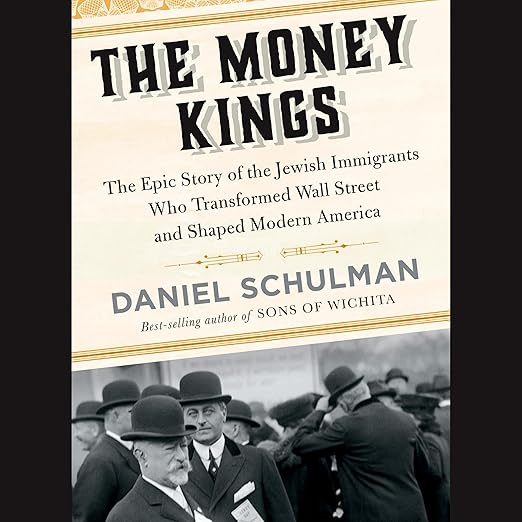
Joseph Seligman arrived in the United States in 1837 with the equivalent of $100 hidden in the lining of his pants. Within a generation, his family would be operating one of the most influential investment banks in America. That opening fact is the kind of detail that Daniel Schulman's audiobook The Money Kings, narrated by Jonathan Davis, returns to again and again: not as inspiration-poster material but as a specific historical starting point from which to measure the full complexity of what these families built and who they navigated to build it.
German-Jewish Dynasties Built Wall Street Despite Antisemitism
Schulman traces the interconnected histories of the German-Jewish immigrant dynasties that became Goldman Sachs, Lehman Brothers, Kuhn Loeb, and J. and W. Seligman and Co. These are names now familiar primarily as institutional abstractions, but Schulman restores the human dimension: the peddlers who bought up shopkeepers' IOUs in the antebellum South, the men who navigated the Civil War's financial chaos, the families who used their positions on Wall Street to advocate for the millions of Eastern European Jews arriving in New York Harbor in the early 1900s. That last element, the political and philanthropic dimension of their financial power, is one of the book's most interesting threads and separates it from straightforward business history.
The antisemitism these families encountered is documented in sustained detail. The Gilded Age upper class that these men entered, and in some cases helped finance, was explicitly hostile to them in social and institutional terms even while depending on their capital. Schulman does not simplify this contradiction or resolve it into a triumphant narrative; the tension between financial inclusion and social exclusion is one of the book's defining tensions throughout. For Schulman, the subject is also personal: his paternal grandparents came to America on those same steamships from Eastern Europe, which gives the book an autobiographical dimension that surfaces in the writing without overwhelming the historical argument.
The Zionist question produces some of the book's most nuanced passages, as the established German-Jewish banking families held complex, often skeptical positions on the movement that Eastern European immigrants arriving later tended to embrace. Schulman handles this internal Jewish political conflict with the same care he brings to the external antisemitism narrative, refusing to reduce either side of the debate to a simple position. The result is a portrait of a community navigating extraordinary pressure from multiple directions simultaneously while transforming the financial landscape of a nation.
Davis Keeps Five Dynasties Distinct Across Decades
At 22 hours and 21 minutes, this is a substantial audio commitment, and Jonathan Davis earns the investment. His narration handles the book's range from intimate family scenes to large-scale financial transactions with consistent authority. The multiple family lines, Seligmans, Lehmans, Goldmans, Warburgs, Schiffs, are kept distinct in his delivery, which matters enormously in a dynastic history where the cast expands across generations and decades. One reviewer called it extremely well researched and very interesting, and Davis delivers that research in a way that keeps it from feeling like an academic exercise.
The format suits this kind of sweeping narrative history better than it suits more analytically dense financial writing. Schulman is fundamentally a storyteller working with historical material, and Davis responds to that orientation with a narration that emphasizes the dramatic shape of events rather than their technical complexity. Listeners who commit to the full 22 hours will find the cumulative effect considerable: the sense of these families' collective influence on American life grows progressively more vivid as the book proceeds.
Listeners Need Patience While the Cast Assembles
The book's scope is also its primary challenge. Schulman covers more than a century of interconnected family and financial history, and the narrative becomes denser as the number of figures expands across generations. Listeners who encounter this audiobook cold, without some background in Gilded Age American financial history, may find the early chapters require closer attention as the cast assembles. The rewards arrive once the relationships between these families and the institutions they clash with, particularly J.P. Morgan and E.H. Harriman, are established and the dynamics become clear.
The book is also explicitly a work of advocacy for taking this history seriously, and Schulman makes clear that the German-Jewish bankers' contributions to American finance have been systematically underacknowledged in conventional histories of the period. That perspective shapes the narrative without distorting the research, but listeners expecting a neutral survey of early Wall Street should know the book has a corrective argument built into its structure.
One Reviewer's Grandfather Loved This Book Too
This audiobook rewards listeners who are drawn to dynastic financial history, American Jewish history, or the Gilded Age period broadly. Readers who have worked through books on J.P. Morgan or the Vanderbilts will find Schulman's account fills in a significant gap in the conventional story of American finance. The 22-hour commitment suits the scope of the subject; listeners who prefer tightly focused narrative nonfiction over sweeping multi-generational accounts should know what they are entering. This is history at full scale, and it earns that scale with the depth of research and narrative ambition Schulman brings to the project. One reviewer whose grandfather loved the book speaks to its capacity to resonate across generations and levels of prior knowledge, which is the mark of historical writing that serves a genuinely broad readership rather than a specialist audience alone. Davis delivers the full 22 hours with a consistency of presence that earns its place on any serious listener's library.
The Short Version
- Performance: Jonathan Davis brings the sweep and gravitas that a 22-hour dynastic history demands, sustaining engagement across decades and multiple family lines without flattening the human drama into a financial textbook.
- What it covers: Immigration and financial ascendancy, antisemitism in Gilded Age America, identity between nations
- Feel: Expansive and scholarly, with the momentum of a family saga
- Our call: An essential audio listen for anyone serious about American financial history and the German-Jewish immigrant families whose decisions shaped Wall Street, delivered with scope and narrative depth the subject deserves.
Does the audiobook version of The Money Kings work for listeners without a financial background?
Yes. Schulman writes for a general audience rather than a specialist one. The financial mechanisms are explained in accessible terms, and the book's primary interest is in the human and political dimensions of these families' stories rather than technical financial analysis.
How does Jonathan Davis handle the large cast of dynastic figures across multiple generations in this audiobook?
Davis manages the cast with clear tonal differentiation and steady pacing. Because the book follows overlapping family lines across roughly a century, his ability to sustain narrative clarity across dozens of named figures is essential, and he delivers it consistently.
Is The Money Kings audiobook primarily a financial history or a history of Jewish American identity?
Both are central and intertwined throughout. Schulman uses the banking dynasties as a lens onto larger questions about immigrant identity, antisemitism, philanthropy, and political advocacy. Readers who come expecting only financial history will find considerably more than they anticipated.
Is 22 hours a realistic audio commitment, and does the book justify its length?
The length reflects the genuine scope of the subject: multiple families, more than a century of history, and several major historical events. Listeners who engage with it in focused sessions over several weeks will find the investment worthwhile. It is not padded; the narrative needs the time it takes.