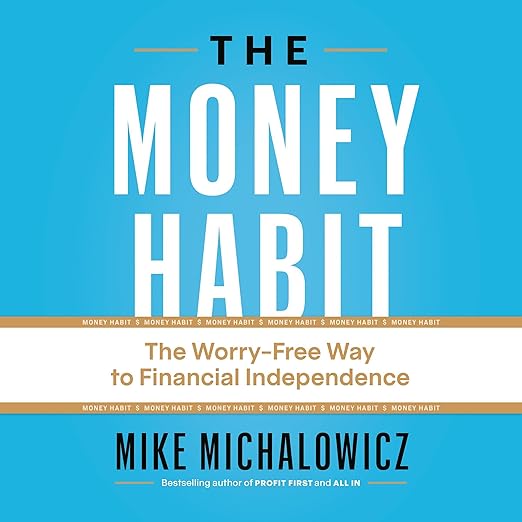
Quick Take
- Narration: Michalowicz narrates his own book with the energy of a persuasive presenter, engaging and direct, occasionally lecture-like.
- Themes: behavioral finance and habit design, the psychology of money avoidance, building financial systems that work with human nature
- Mood: Encouraging and practical, with urgency but without alarm
- Verdict: A genuine extension of the Profit First methodology to personal finance, more actionable than most personal finance books and more honest about why conventional budgeting fails.
I have a recurring frustration with personal finance audiobooks: they diagnose problems I already know I have and then prescribe discipline I have already demonstrated I do not consistently maintain. The standard budget book assumes that the reader simply lacks information about what they should be doing, when the actual problem is almost always behavioral. Mike Michalowicz understood this for business finance with Profit First, and The Money Habit applies the same insight to personal finance. It is a more interesting book than most of its genre neighbors because it begins from a fundamentally different premise.
The premise: humans are not naturally bad at money. We are trying to follow systems designed for a different kind of cognitive agent than the one we actually are. Conventional budgeting, track every dollar, sacrifice the small pleasures, project thirty years forward, works for approximately nine percent of people who attempt it. Michalowicz is not interested in making you feel guilty about being in the other ninety-one percent. He is interested in building a system that activates what you already do rather than requiring you to become someone you are not.
Our Take on the Multiple Bank Account Method
The core mechanism is the same one that made Profit First compelling: separate bank accounts for separate purposes. Rather than one pool of money from which you spend and save and invest and feel anxious, you divide your income into distinct accounts at the moment it arrives. The accounts are given specific functions, spending, saving, a target purchase, long-term wealth. The division happens automatically or near-automatically. You do not have to remember to not spend the money you set aside for something else, because that money is no longer in the account you spend from.
Several reviewers highlight the emotional shift this creates. One described gaining clarity and control after experiencing both a career disruption and the pressure of starting a new business. Another, a person who had successfully implemented Profit First in a business context, describes the personal finance adaptation as equally transformative. The system works because it aligns with the way people actually make spending decisions, not the way financial textbooks assume they do.
Why Listen to The Money Habit in Audio Specifically
Michalowicz narrates his own book, which creates a specific experience. He has the energy of someone who has told this story in keynote presentations and understands how to land a point. The personal anecdotes, including his own story of losing his first fortune and rebuilding from scratch, carry more weight when delivered in his own voice than they would in a professional narrator’s rendering of them. The guest contributions from Jean Chatzky, Pete Adeney (Mr. Money Mustache), Ramit Sethi, Tiffany Aliche, and others appear as part of the audio production, which gives the book a documentary texture that print cannot replicate.
At seven hours and thirty-one minutes, the runtime is appropriate. The book is structured to move through its method systematically without dwelling on any section past the point of diminishing returns. One reviewer described it as automating things and using a budget without complicated spreadsheets and analysis, which captures the tone: thorough enough to be useful, lean enough to be listenable.
What to Watch For in the Guest Expert Segments
The inclusion of additional personal finance voices, Sethi, Aliche, Collins, and others, is more integrated than a typical blurb-collection. Each contributor addresses a specific aspect of the behavioral approach to money that Michalowicz is developing. The result is that the book covers a broader range of financial contexts than any single author could provide. A reviewer who had already implemented Profit First in their business noted that the guest expertise brought home some of the system’s most powerful applications. Those familiar with any of the contributors’ own work will find the cameos adding dimension rather than redundancy.
Who Should Listen to The Money Habit
This audiobook will resonate most with listeners who have tried conventional budgeting, found it unsustainable, and concluded, wrongly, that they are simply bad with money. It is also a natural companion for anyone who has used Profit First in a business and wondered whether the principles could be adapted for their household. Listeners looking for investment strategy, tax optimization, or market analysis will not find that here, this is behavioral systems design for personal cash management, not investment advice. Those seeking an ideologically minimal approach to financial organization, without moral lectures about spending habits, will find Michalowicz a refreshing change from the more prescriptive end of the personal finance genre.
Frequently Asked Questions
Is it necessary to have read Profit First before listening to The Money Habit?
No. The Money Habit is designed to stand alone for personal finance readers who have no business context. However, listeners who have already implemented Profit First in a business will recognize the structural logic immediately and may find the adaptation to personal finance particularly resonant.
Does Michalowicz narrating his own book add to or detract from the experience?
Mostly adds to it. His delivery is energetic and direct, and the personal stories carry more authenticity in his own voice. Listeners who prefer polished professional narrators may find the presenter-style energy occasionally lecture-like, but the overall effect is engaging.
How many separate bank accounts does the system require, and is setup realistic for the average listener?
The system involves several dedicated accounts, typically four to five for different financial purposes. Michalowicz designs the setup to be as frictionless as possible and addresses the practical steps within the audiobook. Many reviewers report finding the setup straightforward.
Are the guest contributions from Ramit Sethi, Tiffany Aliche, and others integrated into the audio, or are they print-only additions?
Based on the synopsis and the overall production, the additional contributors are part of the audio experience. This is one of the features that distinguishes the audiobook format, as it gives the production a multi-voice texture beyond a single narrator reading their own work.