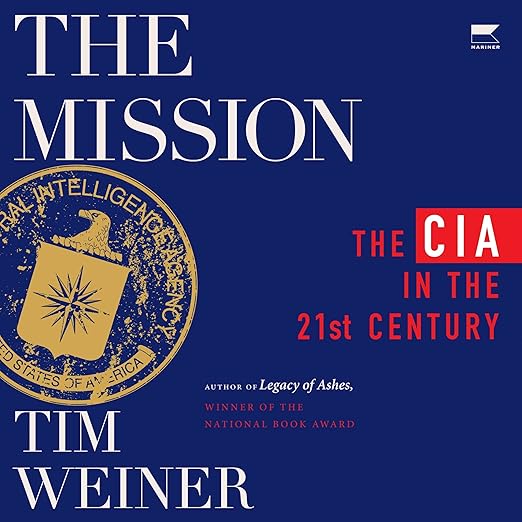
Quick Take
- Narration: Stefan Rudnicki brings the gravitas this material demands, his deep, unhurried delivery well suited to a book that is essentially a series of institutional reckonings.
- Themes: intelligence failure, post-9/11 transformation, CIA institutional survival
- Mood: Dense and sobering, with the cumulative weight of decades of documented error.
- Verdict: The best comprehensive account of the modern CIA in audio, essential for readers of Legacy of Ashes who want to know what happened next.
I had already listened to Tim Weiner’s Legacy of Ashes a few years earlier, a National Book Award winner that laid out sixty years of CIA failure with almost clinical thoroughness, and I was not sure what The Mission would do that the first book hadn’t. That skepticism lasted about forty minutes. By the time Weiner had finished reconstructing the agency’s internal collapse in the late 1990s, its stations closed, its technology outdated, its intelligence product degraded to near-uselessness, and then pivoted to the morning of September 11, 2001, I understood that this was a different kind of book. Legacy of Ashes was a history of what was built wrong. The Mission is a history of what happened when that broken apparatus was handed an impossible task.
The book covers the period from 9/11 through the current administration, with Weiner building his account on something unusual: on-the-record interviews with six former CIA directors, thirteen station chiefs, and scores of operations officers who had never previously spoken to a journalist. That sourcing is not decorative. It changes what the book can say and how it says it. This is not reconstruction from declassified documents and congressional testimony. This is the institution talking about itself, which creates both unparalleled access and certain predictable blind spots that Weiner is at least partially aware of.
The Paramilitary Turn and Its Cost
The central argument of The Mission is that after 9/11 the CIA transformed itself into something it was never designed to be: a lethal paramilitary force running drone strikes, managing secret prisons, conducting what Weiner documents as brutal interrogations, and in the process gutting the espionage and counterespionage capacity that had been the agency’s actual reason for existing. The consequences Weiner documents are specific and severe. Recruited foreign agents died. Chinese intelligence stole the CIA’s personnel files. Russian services penetrated the agency’s computer networks. And in Afghanistan and Iraq, the intelligence that shaped major military and policy decisions was worse than useless.
Reviewer Kirk Kulgavin highlights the book’s account of the current political assault on American intelligence, and Weiner does not pull those punches. The final section of the book addresses a CIA fighting for institutional survival against a president who has attacked it as a subversive force, and Weiner frames this as the latest iteration of a decades-long pattern rather than an unprecedented aberration. Whether that framing is persuasive depends on how you read recent history, and the book’s publication date means the outcome is still unresolved.
Stefan Rudnicki’s Particular Usefulness Here
Weiner’s prose is precise and weighted rather than propulsive. He is a journalist who writes like a historian, building analytical argument through accumulated documented fact rather than narrative momentum. That style can flatten in audio if paired with the wrong narrator. Rudnicki, who has spent decades narrating serious nonfiction, knows how to honor this kind of writing without making it feel like a deposition. His pacing is slow enough to allow each revelation its due weight without descending into monotony. The chapters covering individual spy operations and the human cost of CIA-recruited assets dying when the agency’s operational security failed are particularly well handled. He doesn’t amplify the emotion; he trusts it to be already present in the material.
The reviewer who described the book as a heavy read but educational is not wrong. This is 17 hours of institutional history at a level of documented specificity that rewards concentrated listening rather than commute-time half-attention. It is probably best approached in sessions long enough to hold the analytical threads across chapters.
What Legacy of Ashes Readers Need to Know
The two books are continuous but not strictly sequential in the sense of requiring the first to follow the second. The Mission opens with enough contextual grounding that readers new to Weiner can orient themselves. That said, Legacy of Ashes establishes the baseline of structural failure that The Mission builds on, and the emotional weight of watching the same institutional dysfunctions reassert themselves in new contexts is considerably greater for readers who have already absorbed the first book’s evidence. If you have not read Legacy of Ashes, this is a good entry point; if you have, the sequel is the completion of an argument that was always pointing here.
The book’s central question, whether the CIA can rebuild genuine espionage capacity after a generation of paramilitary distraction while simultaneously fighting off political actors who would rather have it neutered, remains open. Weiner presents the evidence without offering resolution he cannot honestly provide. That restraint, coming from a reporter with this level of access, is itself a kind of answer.
Who Should Listen and Who Should Think Twice
Essential for readers with serious interest in American foreign policy, intelligence history, or the institutional mechanics of how democracies govern secret power. The sourcing is extraordinary and the argument is rigorously made. Those looking for an action-oriented spy narrative will find this too analytic. Those who have been following Weiner’s CIA reporting for decades will find it the culmination they’ve been waiting for.
Frequently Asked Questions
Does The Mission require reading Legacy of Ashes first?
No, Weiner provides enough context for new readers. But those who have read Legacy of Ashes will find The Mission substantially richer, since the new book explicitly continues the institutional argument the first one established over sixty years.
How current is the CIA material in The Mission given its 2025 publication date?
Very current. Weiner addresses the CIA’s situation through early 2025, including the agency’s conflict with the current administration. That contemporaneity is part of the book’s value and also means some aspects will continue to evolve after publication.
Is Stefan Rudnicki’s narration suited to dense policy and intelligence history?
Yes. Rudnicki’s deliberate pace and tonal gravity match Weiner’s analytic prose better than a faster, more theatrical narrator would. He treats the documented failures and institutional breakdowns with appropriate seriousness without editorializing.
The Guardian says this deserves Weiner a second Pulitzer. Does The Mission match Legacy of Ashes in analytical depth?
The sourcing is arguably stronger, given on-the-record access to six directors and scores of operations officers. Whether the book exceeds Legacy of Ashes in depth is a matter of which period you find more historically significant. Both are landmarks.