Quick Take
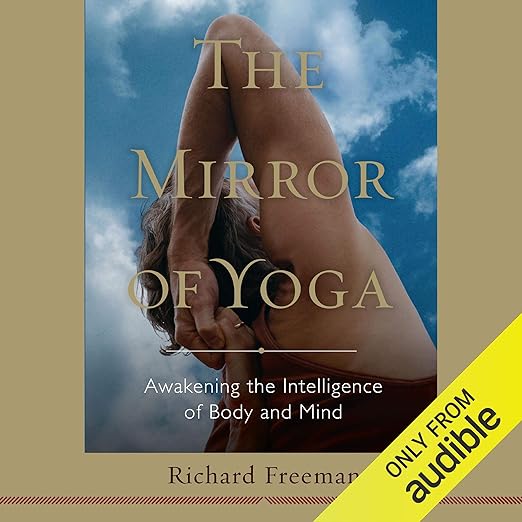
- Narration: Erin Moon brings clarity and measured warmth to Richard Freeman’s dense philosophical material, making the Upanishads and Patanjali’s Yoga Sutra accessible without stripping them of their depth.
- Themes: The unity of yoga traditions, the relationship between practice and philosophy, liberation as lived experience
- Mood: Contemplative and richly layered, best absorbed in shorter listening sessions rather than long stretches
- Verdict: An essential audio companion for anyone who takes yoga seriously as a philosophical tradition rather than a fitness practice, though beginners will need patience with the density.
I came to The Mirror of Yoga after years of treating asana as a largely physical practice, which meant I came to it with approximately the correct amount of ignorance for Freeman’s book to be genuinely useful. I listened during early mornings over the course of about three weeks, rarely more than forty minutes at a time, which turned out to be the right pacing for material this dense. More than once I had to back up ten minutes to recover a thread I had lost, not because the writing was unclear but because the ideas accumulated in ways that rewarded attention rather than passive absorption.
Richard Freeman is described by reviewers as the most important yoga writer since Iyengar, and having spent nearly eleven hours in his company, the assessment seems defensible. He writes from decades of practice and study, and what distinguishes his approach from the more accessible yoga literature on the market is his insistence that the various schools and traditions are not competing but interpenetrating. Hatha, bhakti, jnana, karma, tantra: Freeman presents them as facets of a single inquiry rather than separate disciplines with separate answers.
Our Take on The Mirror of Yoga
The book’s central argument is philosophical and structural: that all yoga traditions share a common aim, the discovery of the essence of existence at the core of being, and that the apparent diversity of schools is a diversity of approach rather than of destination. Freeman unpacks this through the Upanishads and Samkhya philosophies, the Yoga Sutra of Patanjali, the eight limbs of astanga yoga, and the process of hatha yoga, among other frameworks. This is not a book about poses. It is a book about what poses are pointing toward, and why the pointing matters.
For audio specifically, the density of the material is worth acknowledging honestly. Freeman’s prose is eloquent, as several reviewers note, but it is also layered in ways that reward rereading more than a single linear listen. The audiobook format serves the book imperfectly in this sense. Erin Moon’s narration is excellent, but listeners who want to absorb the full philosophical architecture will likely find themselves returning to particular sections rather than listening through once and considering themselves finished.
Why Listen to The Mirror of Yoga
Erin Moon’s voice carries a quality of attentiveness that suits the material. She reads Freeman as someone engaging with the ideas rather than simply delivering text, and across nearly eleven hours that quality maintains without becoming forced. The technical vocabulary of yoga philosophy, Sanskrit terms, philosophical concepts from multiple traditions, is handled with enough care that listeners without a prior background in these texts can follow the structure even when individual concepts require further investigation.
For practicing yoga teachers, this book has particular value as a resource that contextualizes what students encounter in class within the wider tradition. Multiple reviewers mention returning to it repeatedly over years, which is high praise for a philosophical text and a realistic description of how books like this accumulate meaning over time.
What to Watch For in The Mirror of Yoga
Freeman also addresses the role of the guru, chanting, meditation, and the yogic imperative of service to others, and these sections are among the more practically applicable parts of the book. The discussion of how philosophical understanding applies to daily life and actual practice is where the material becomes most directly useful for listeners who came to the book from a practice context rather than a purely academic one.
The book was published in 2010 and this audio edition followed, so some contemporary discussions of yoga’s commercialization or its Western adaptations are not addressed. Freeman’s focus is almost entirely on the classical tradition, which is both a limitation and a feature depending on what you’re looking for. Listeners interested in the sociology of modern yoga will need other books for that conversation.
Who Should Listen to The Mirror of Yoga
Listen if you have a serious yoga practice and want to understand the philosophical traditions underlying what you do on the mat. Listen if you teach yoga and want richer context for the eight limbs and the various philosophical schools. Skip if you are a complete beginner to yoga philosophy who wants entry-level material, or if you prefer audio that moves at a pace that allows passive absorption. This one requires active listening.
Frequently Asked Questions
Do I need prior knowledge of yoga philosophy to get value from The Mirror of Yoga?
Some basic familiarity with yoga, its terminology, and its goals will help significantly. Complete beginners to yoga philosophy may find the depth of the Upanishads and Patanjali references difficult to track. However, Freeman does explain the traditions as he discusses them, so a motivated newcomer with patience can follow the argument.
How does Erin Moon’s narration handle the Sanskrit terminology and philosophical vocabulary?
With care and apparent preparation. She handles the technical vocabulary consistently and without the hesitancy that sometimes afflicts narrators working outside their subject-matter comfort zone. The pacing she brings to the philosophical sections allows listeners to process dense material without feeling rushed.
Is this book more useful for yoga practitioners or for people interested in Indian philosophy more broadly?
Primarily practitioners, though serious students of Indian philosophy will find Freeman’s synthesis of the various schools intellectually valuable. The book consistently applies philosophical concepts back to practice, so its primary audience is people who want to understand what they are actually doing when they practice yoga.
Is The Mirror of Yoga suited to a single straight listen or is it better absorbed in shorter sessions?
Shorter sessions, strongly. The material accumulates in ways that reward pausing and processing. Most listeners who engage seriously with the content will find themselves backing up and replaying sections. Forty minutes at a time is a reasonable ceiling before the density becomes counterproductive.