Quick Take
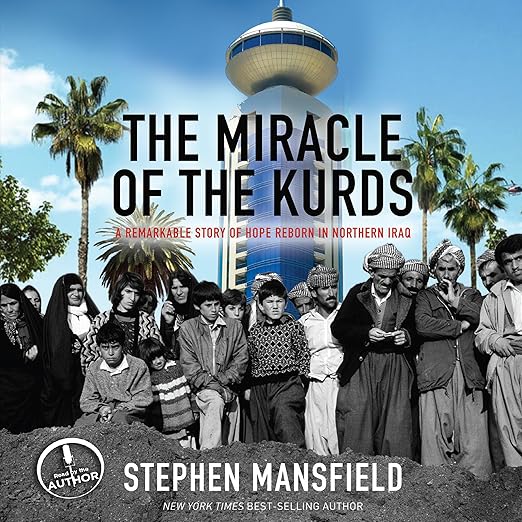
- Narration: Stephen Mansfield narrates his own book, which gives the personal passages genuine weight – he witnessed much of the history he describes, and that firsthand quality comes through in his delivery.
- Themes: Kurdish resilience and self-determination, the failure of great-power promises, economic and cultural revival after genocide
- Mood: Urgent and hopeful in equal measure – the tone of someone who has seen horror and then watched people build something from it
- Verdict: A brisk, accessible, and genuinely moving introduction to the Kurdish story, written by a New York Times bestselling author who brings both journalistic clarity and personal witness to the material.
I picked up The Miracle of the Kurds after watching the Peshmerga fighting ISIS on television and realizing that I knew almost nothing about the people I was watching. Five hours later I had a foundation I didn’t have before, and more than once I’d found myself genuinely moved by what Mansfield describes. That’s the experience this book is designed to deliver, and it delivers it efficiently.
Stephen Mansfield came to the Kurdish story through direct experience. He witnessed parts of the history he describes, and the book benefits from that proximity – it reads not as a desk-researched survey but as the account of someone who has been to the places and met the people. The opening is deliberately arresting: Kurdistan, Mansfield argues, is what America wanted Iraq to be. It is the reward for the intervention, the one region where something resembling the stated aims of the 2003 invasion – a prosperous, self-governing, tolerant society – actually began to emerge. That framing sets up the book’s central argument, which is not about what went wrong elsewhere but about what happened when a people with ancient wisdom applied it to modern economic and political challenges.
What Was Done to the Kurds
Mansfield doesn’t begin with the miracle. He begins with the catastrophe, and it is important that he does. The Anfal campaign under Saddam Hussein was one of the documented genocides of the late twentieth century: hundreds of thousands murdered, some 4,000 villages destroyed, mass graves, chemical weapons used against civilian populations. The Kurds had been betrayed before – by the British after World War I, by the Americans in the 1970s – and they were betrayed again and again as the world looked away from what Saddam’s regime was doing to them. This history is not optional context; it is the weight against which the subsequent revival has to be measured.
The history of betrayal also explains something specific about Kurdish political culture that Mansfield renders clearly: an intense self-reliance and a sophisticated, sometimes ruthless pragmatism about international alliances. A people who have been abandoned by every patron they ever had learns to build institutions that don’t depend on patron goodwill. That lesson, applied to the economic development of the Kurdistan Region of Iraq, is a significant part of what Mansfield means by the miracle.
The Rebuild and What It Means
The reconstruction chapters are where the book’s optimism is most infectious. Mansfield describes a society that took the rubble of genocide and built universities, hospitals, infrastructure, and economic institutions with unusual speed and competence. The Kurdistan Region attracted foreign investment, maintained security when the rest of Iraq was in chaos, and gave minority communities – Yazidis, Christians, Turkmen – a degree of protection they couldn’t find elsewhere in the country. The predictions that this region would eventually achieve formal independence from Iraq have remained just beyond reach, but the argument for its viability as a state is substantially made by everything Mansfield describes.
At five hours, the book is deliberately accessible rather than exhaustive. Readers who want a deeper academic treatment of Kurdish history – covering the Kurdish situation in Turkey, Syria, and Iran as well as Iraq, or the deeper history of Kurdish nationalism – will need to supplement this. Mansfield makes no pretense of being comprehensive; he is presenting a narrative of resilience and possibility aimed at a general audience that knows little about the subject. On that level, he succeeds entirely.
Self-Narration as Witness
Mansfield’s decision to narrate his own book is clearly the right one here. The moments when he says he witnessed something, or when he describes a conversation with a Kurdish official, have a different texture in his voice than they would in a professional narrator’s. There is something in the self-narration of witnessed history that a performance, however skilled, cannot replicate. The five-hour runtime passes quickly.
The Right Introduction to a Remarkable Story
If you have followed the Kurdish military and political situation in the news and wanted a foundation for understanding it, this is the right starting point. It doesn’t require prior knowledge of Iraqi or Middle Eastern history, and Mansfield’s prose is accessible enough that it works as an audiobook without demanding the kind of attention that denser academic history requires. Its limitations – the optimism may feel dated given subsequent developments, and the five-hour scope necessarily leaves much out – are real, but they don’t undermine what it does. As an introduction to a people who deserve more attention than they generally receive, it’s hard to beat.
Frequently Asked Questions
Does The Miracle of the Kurds cover Kurds in Turkey and Syria, or only Iraqi Kurds?
The book focuses primarily on the Kurdistan Region of Iraq. The Kurdish situation in Turkey, Syria, and Iran is mentioned as context but not treated in depth. Readers wanting comprehensive coverage of all Kurdish communities will need additional sources.
How has the situation in Iraqi Kurdistan changed since the book was published?
The book’s optimism about Kurdish independence has been tempered by subsequent events – including the failed 2017 independence referendum and its aftermath, which resulted in significant territorial setbacks for the Kurdistan Regional Government. The structural story Mansfield tells remains largely accurate, but some of his more optimistic projections have not materialized on the timeline he suggested.
Is the book relevant to understanding the Kurdish role in fighting ISIS?
Very much so. The book establishes the Kurdish military tradition, the Peshmerga forces, and the political infrastructure that made the Kurdish response to ISIS possible. Reading it alongside accounts of the ISIS conflict gives those events considerably more context.
Does Stephen Mansfield approach the subject from a religious perspective?
He mentions his Christian faith in some passages, and the book’s framing of Kurdish resilience occasionally carries spiritual overtones, but it is primarily a secular political and historical account rather than a religiously framed narrative. The faith dimension is present but not dominant.