Quick Take
- Narration: Johnathan Welsh handles the dense theological and scientific vocabulary with clarity, maintaining a tone that feels appropriately grave without becoming preachy.
- Themes: Transhumanism, Christian theology, human identity, technological apocalypse
- Mood: Urgent and dense, best absorbed in focused sessions rather than casual listening
- Verdict: A serious attempt to engage the transhumanist debate from a conservative Christian perspective, valuable as a document of that viewpoint even when the arguments strain under their own weight.
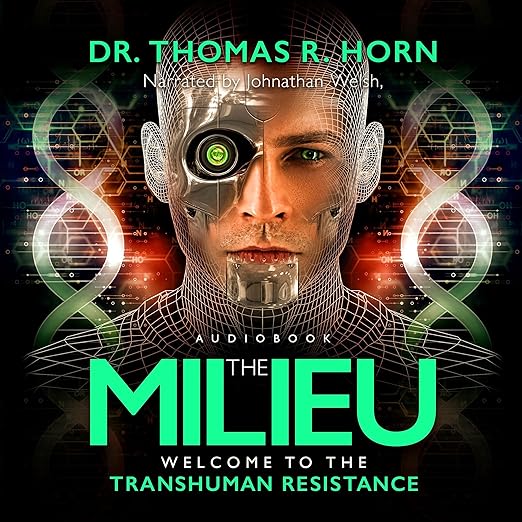
The question of what happens to human identity when we start engineering it has been circling the edges of mainstream conversation for years, and Thomas Horn’s The Milieu plants itself squarely in the center of that debate from a perspective you do not often encounter in tech-adjacent discourse: orthodox Christian resistance. I came to this one a few months after reading some of Yuval Noah Harari’s work on the subject and wanted to understand what a theologically grounded counter-argument looked like. At nearly thirteen hours, The Milieu is not a quick listen, and it rewards patience more than casual engagement.
Horn frames transhumanism as a Promethean religion rather than a secular scientific project, and this framing is actually the most interesting intellectual move the book makes. He argues that the desire to transcend biological limitation is not a neutral technological aspiration but a deeply spiritual one that happens to be oriented away from the Christian conception of what humanity is and what it is for. Whether or not you share his theology, the argument that transhumanism carries its own quasi-religious assumptions is worth taking seriously, and Horn develops it with more rigor than the genre sometimes manages.
Our Take on The Milieu
The book’s subtitle, Welcome to the Transhuman Resistance, signals that this is not an academic survey but a call to action for a specific community: Christians who feel that the accelerating pace of human enhancement technology threatens something essential about what it means to be made in God’s image. Horn identifies what he calls the Milieu, a network of writers, theologians, and researchers working to keep this conversation alive within the Church, and a significant portion of the book reads as a manifesto for that group’s continued relevance.
For readers already inside that framework, the book will feel urgent and well-documented. Horn draws on a wide range of sources, from Ray Kurzweil’s singularity thesis to CRISPR research to Revelation, and he weaves them into an argument that is more intellectually ambitious than typical Christian engagement with technology tends to be. One reviewer, who describes himself as an orthodox Preterist who does not share Horn’s eschatology, still calls the work an urgently needed study and acknowledges that the technologies Horn is concerned about are genuinely arriving.
Why Listen to The Milieu
Johnathan Welsh’s narration is well-suited to the material. He handles the scientific terminology, the theological vocabulary, and the occasional apocalyptic register with equal steadiness. The book is admittedly uneven in density across chapters, as one reviewer notes, and Welsh’s consistent delivery helps carry the listener through the denser sections without losing the thread. At nearly thirteen hours, the pacing requires commitment, but Welsh never drags.
The audiobook earns its length in the sections where Horn examines what he calls the Christian Transhumanist movement, a small but real phenomenon in which some theologians argue that enhancement technology is compatible with or even endorsed by Christian theology. Horn’s response to this movement is the sharpest part of the book, and it illuminates genuine fault lines within Christian thought that most popular coverage of religion and technology ignores entirely.
What to Watch For in The Milieu
Horn’s argument is strongest as cultural criticism and weakest as predictive analysis. The book’s use of Revelation and Daniel as frameworks for interpreting AI development and human-machine hybridization is internally consistent within a particular eschatological tradition but will strike readers outside that tradition as speculative. The link he draws between artificial intelligence and the image of the Beast from Revelation is presented with conviction but rests on interpretive choices that are far from settled even within evangelical scholarship.
The book also occasionally conflates distinct technologies: genetic engineering, brain-computer interfaces, AI, and chimeric research are sometimes grouped as if they present identical ethical and theological problems, when in fact the issues are meaningfully different. Listeners who want precise distinctions between these categories may find Horn’s broad strokes frustrating.
Who Should Listen to The Milieu
Listen if you are engaged with questions about technology and human identity from a Christian perspective, or if you want to understand what serious theological resistance to transhumanism actually looks like. Skip if you need the book to engage seriously with secular bioethics or to provide a balanced account of the science; Horn’s interest is apologetic rather than comprehensive, and the book makes no pretense otherwise.
Frequently Asked Questions
Do you need to be religious to get value from this book?
Not necessarily. The cultural criticism of transhumanism’s quasi-religious assumptions is interesting on its own terms. But Horn’s framework is deeply theological and his conclusions depend on accepting certain Christian premises, so secular readers will find themselves bracketing a lot.
How does Thomas Horn’s argument differ from secular bioethicists who also worry about transhumanism?
Horn’s concern is specifically about the spiritual and eschatological implications of altering the human form, not just about social inequality or unintended consequences. Secular bioethicists like Michael Sandel raise concerns about the ethics of enhancement, but Horn’s argument is that transhumanism is spiritually opposed to human nature as God designed it, which is a different kind of claim.
Is the book current with recent developments in AI and genetic technology?
The audiobook was released in January 2026 and references reasonably current developments in AI and CRISPR research. The theological framework is grounded in longstanding eschatological interpretation, so the most current sections are the science-facing ones.
What is the Milieu group that the book refers to?
Horn describes the Milieu as a loose network of Christian scholars, writers, and researchers who are working to keep the conversation about transhumanism alive within the Church. The book functions partly as a manifesto for this group’s mission and an argument for why the Church needs to engage these questions rather than ignore them.