Quick Take
- Narration: Author-read by Patrick Payton, direct and sincere, with the measured cadence of someone who has spent decades speaking from pulpits and public platforms.
- Themes: political polarization, civic leadership, principled pragmatism
- Mood: Earnest and hopeful, occasionally preacherly
- Verdict: A well-intentioned case for ideological moderation that will resonate most with readers already inclined toward its conclusions.
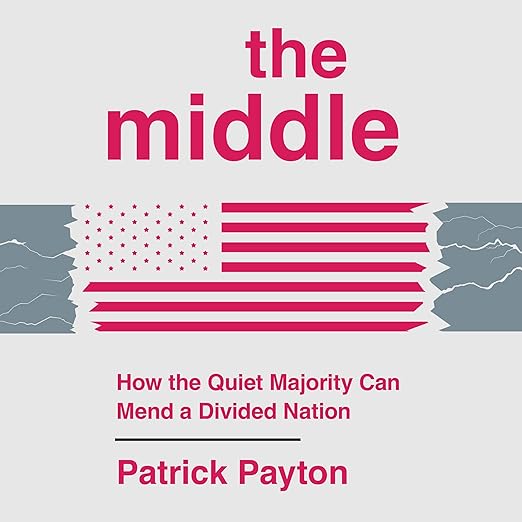
I tend to be wary of books that position themselves as the reasonable center of a polarized debate. The genre has a habit of treating moderation as its own ideology while pretending otherwise. So I came to Patrick Payton’s The Middle with my critical antennae up, ready to document the expected blind spots. What I found was more honest and more humble than I anticipated, even if some of the same tensions are still present.
Payton brings an unusual biography to this conversation. He has been a pastor, a mayor, and a business leader, three roles that each demand a different kind of persuasion and a different relationship with community trust. That combination gives him a range of real examples to draw from, and the book is better for it. This is not a think-tank white paper dressed up in populist language. It is a practitioner’s argument.
Our Take on The Middle
The book’s central argument is that the loudest voices in American political life do not represent most Americans, and that millions of people who occupy the ideological center have essentially ceded the public square to extremists on both ends. Payton wants to equip that silent majority, or at least the portion of it that is Christian, civic-minded, and frustrated, to re-engage without mimicking the tactics of the extremes. The framework he offers includes leading with character, building consensus through dialogue, and rejecting what he calls the outrage culture that rewards inflammatory positions over workable ones.
The argument is coherent and the anecdotes from his years as mayor of Midland, Texas, give it grounding. Reviewer Jim Dillow, quoted in the published reviews, called it a reality check, which is a fair description of the book’s best moments, when Payton acknowledges uncomfortable truths about how tribal behavior operates even within communities that consider themselves moderate or faithful.
Why Listen to a Civics Book Written by a Pastor and Mayor
Because Payton is writing explicitly from his experience as a pastor and Christian leader, the book carries a faith inflection that is not incidental. Reviewer Beverly Dillow noted it will resonate especially with what she called the American Christian Patriot. That framing is honest but also limiting: listeners approaching this book from outside that tradition may find some of the moral architecture less universal than Payton intends. The civic principles he advocates, humility, dialogue, rejecting tribalism, are broadly applicable, but the ground they stand on is specifically evangelical. That is worth knowing before you sit down with it.
What to Watch For in the Practical Advice Sections
Payton includes a structured set of listener takeaways: how to resist outrage culture, how to recognize extremism, how to build consensus in families and workplaces. These sections are the book’s most actionable and work reasonably well as standalone listening prompts. The risk, as with most books in this genre, is that the people who most need to hear the message about tribalism are the least likely to pick it up. Reviewer Burt Fisher praised Payton as a proven communicator and leader, and on the evidence of the narration, that is accurate. He delivers the argument with genuine conviction rather than political calculation.
Who Should Listen to The Middle
This is a good fit for listeners frustrated with political polarization who want a framework that does not require abandoning their values, particularly those coming from a faith background who are looking for permission to engage civically without aligning with either party’s most aggressive wing. It is less effective as a persuasion tool for committed partisans on either side. If you are looking for structural political analysis or policy substance, this is not that book, it is a character and leadership argument, not a policy one. But as an accessible articulation of what principled moderation might actually look like in practice, it is more honest than most of its competition in the genre. For a book released in early 2026, when the political climate it addresses feels more acute than ever, its timing is at least right.
Frequently Asked Questions
Is The Middle explicitly a Christian book or is it broadly applicable?
It sits somewhere in between. Payton does not require faith as a prerequisite for the civic principles he advocates, but his framing and much of his illustrative material comes from his experience as a pastor. Reviewer Beverly Dillow specifically recommended it to what she called the American Christian Patriot, which gives you a sense of the core audience. Secular readers will find much of value but may feel the faith scaffolding is inescapable.
Does Payton identify as Democrat or Republican, or does he avoid partisan labels?
He deliberately avoids partisan alignment, which is core to the book’s argument. He draws examples from both party contexts and is critical of tribalism across the political spectrum. His background as mayor of Midland, Texas, gives him a center-right practical context, but he is explicitly positioning himself outside party identification.
How practical is the advice for managing political disagreements within families?
Reviewer The Nominate Group specifically cited the book as useful for navigating family members with different political views. Payton offers conversational frameworks and mindset shifts rather than debate tactics, which means the advice works best when both parties are interested in genuine dialogue rather than winning arguments.
How does Patrick Payton’s self-narration compare to a professional audiobook narrator?
Payton has decades of public speaking experience as a pastor and civic leader, and it shows. His narration is measured, warm, and authoritative without feeling performative. It lacks the technical polish of a professional voice actor but has a sincerity that suits the material well, particularly in the more personal anecdotal sections.