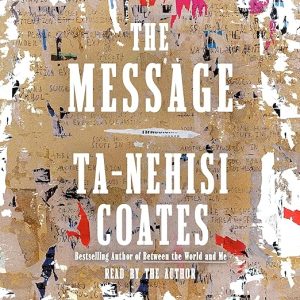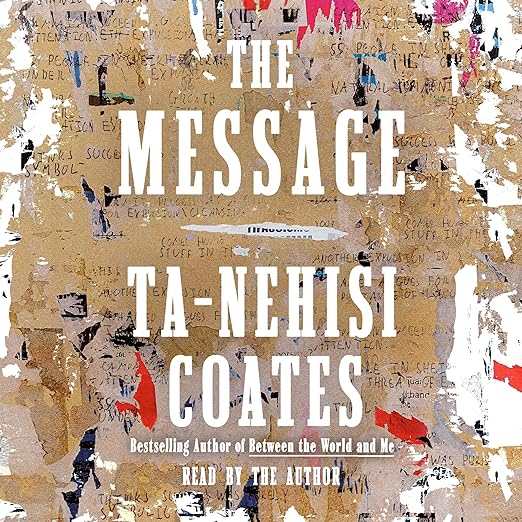
Senegal, South Carolina, and Palestine are the three real-world sites this audiobook visits, and Ta-Nehisi Coates narrating his own words is reason enough to choose audio over print. The Message began, by Coates's own account, as a book about writing itself, in the tradition of Orwell's essay on politics and the English language, before turning into something more personal: an investigation of how the stories nations tell, and refuse to tell, shape what people are willing to accept as reality. Coates first travels to Dakar, finding himself split between a modern Senegalese city and a mythic kingdom he had built in his own mind. From there he goes to Columbia, South Carolina, reporting on his own book's banning and the deeper backlash against the country's reckoning with its history, before landing in Palestine for the book's longest and most demanding section.
Coates's Own Cadence Shapes How This Reads
Coates reading his own essays gives this audiobook a register no hired narrator could fully replicate, since so much of the writing depends on the specific cadence of his sentences, the same quality that made Between the World and Me land the way it did. The Associated Press credits Coates with always writing 'with a purpose' and says these pilgrimages 'help ground his powerful writing about race.' Hearing him deliver that in his own voice, pausing where the prose pauses, gives the essays a weight that reading silently cannot fully match. Booklist's starred review credits the book with pushing readers, including 'students, parents, educators, and journalists,' to 'challenge conventional narratives that can be used to justify ethnic cleansing or camouflage racist policing.' The same review calls the whole work 'brilliant and timely.' Reviewer CheriM calls this her 'favorite book read this year' and describes being taken 'on a journey through his experiences and his thoughts about life, politics, and the influence of race on society.' Personal reportage and larger argument stay braided together this way across all three essays. Coates has spent the years since Between the World and Me, winner of the National Book Award, expanding into comics writing and cultural criticism, and The Message reads like a deliberate return to the long-form essay after that detour, sharpened by everything he picked up writing in other forms along the way. Coates's own background as a longtime magazine journalist, most notably at The Atlantic, gives the book's argument about journalists shaping conventional narratives a particular edge, since he is implicating a profession he has spent much of his career inside rather than critiquing it purely from the outside.
Nationalist Mythmaking Distorts What People See
What makes The Message work as a listen is that Coates never lets the three essays function as separate, disconnected units; Dakar's layered sense of self, Columbia's monuments and banned books, and Palestine's competing national stories all circle back to his original question about which stories get told and which get erased. Reviewer Cherline XO says she both read the book and 'listened to it as well.' She describes feeling 'blind with scales that have been removed' from her eyes partway through, a strong response to writing built to unsettle rather than reassure. The Palestine section runs longest, and Coates uses it to argue that nationalist mythmaking, on any side of any conflict, distorts what people are able to see clearly in front of them, a case he builds slowly rather than delivering as a single thesis statement. At just over five hours, the audiobook moves briskly for essayistic nonfiction this dense, helped considerably by Coates's own instinct for where a paragraph should breathe. The Orwell connection the book opens with, an explicit nod to Politics and the English Language, sets expectations for an argument about language's power to obscure as much as reveal, and Coates spends much of the book making good on that framing, tracing how word choices in news coverage, museum placards, and political rhetoric quietly shape what audiences are willing to accept as true. The Dakar essay, the shortest of the three, sets up the book's method in miniature: that same gap between the real and the imagined city becomes the lens Coates then applies, at greater length, to South Carolina's Confederate monuments and to Palestine's competing national stories.
Argument Built Around Discomfort Over Consensus
Coates's Palestine chapter, the book's longest and most argument-heavy section, is also the one most likely to challenge listeners regardless of where they start politically, since the essay is built around discomfort rather than consensus. This is dense, essayistic nonfiction rather than narrative storytelling, so listeners expecting a linear memoir in the vein of Between the World and Me should recalibrate expectations; the throughline here is an argument about myth and narrative, not a chronological account of a life. Five hours is a short runtime for material this weighty, which means some listeners may want to pause and reread passages in the print edition rather than let the audio wash over them in one or two sittings. Reviewer Sandy describes returning to reading specifically because of this book after years away from it, calling the experience like having a profound conversation about issues that affect humanity, a strong endorsement that also signals how demanding and unresolved the material can feel by the end. With a number one bestseller designation and finalist recognition from the Los Angeles Times Book Prize behind it, this arrived as a major publishing event, which means it has also been discussed extensively elsewhere already; listeners who want to experience the argument without outside framing already in their head may want to start listening before reading much additional commentary about the book first.
Built to Leave You with More Questions
Longtime readers of Between the World and Me will recognize Coates's voice immediately, and hearing him read his own follow-up work makes the connection between the two books even clearer than the page does alone. Listeners drawn to essay-driven nonfiction about race, narrative, and national mythmaking, rather than straightforward memoir, are exactly who this was written for, since the book rewards patience with abstraction more than it rewards a hunger for plot. Journalists, educators, and students, the audience Booklist names directly, stand to gain the most from Coates's argument about how professional storytelling itself can distort as easily as it can clarify. Anyone looking for a settled, comfortable conclusion should know upfront that the Palestine essay in particular is built to leave listeners with more questions than resolution, which is very much the point Coates seems to be making. Booklist's specific mention of 'students' among the audiences Coates is writing for is worth taking seriously too, since the book reads in places like an extended argument about how to read critically, a skill educators assigning this in classrooms will likely lean on directly.