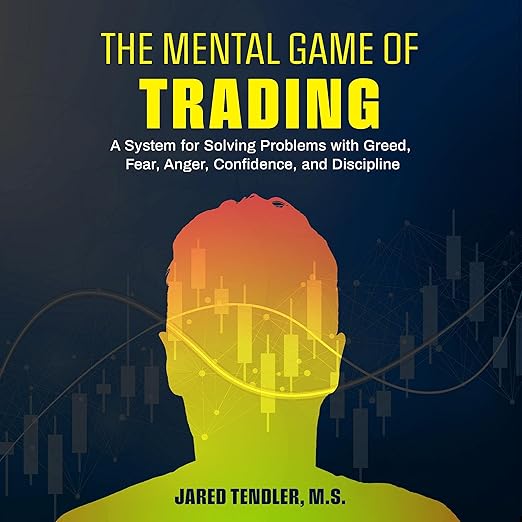
Quick Take
- Narration: Jared Tendler narrates his own work with the flat-affect directness of a coach who has heard every excuse and is not interested in them, which turns out to be exactly what this material needs.
- Themes: Trading psychology, emotional regulation, performance under pressure
- Mood: Clinical and practical, with occasional moments of genuine revelation
- Verdict: Tendler delivers a genuinely systematic approach to trading psychology that most comparable books promise and very few provide.
I do not trade equities or forex. My encounters with markets are limited to the occasional index fund rebalancing and the same vague anxiety about retirement that affects most people who work in media. And yet I found The Mental Game of Trading genuinely difficult to put down. That surprised me, and I think it is worth saying why before getting into the substance of the book itself.
Jared Tendler made his reputation as a performance coach working with professional poker players before turning his attention to traders. The cross-pollination is instructive. Poker, like trading, is a domain where technical skill is necessary but nowhere near sufficient, where emotional regulation under variance is the actual limiting factor for most practitioners, and where the gap between knowing what to do and actually doing it in the moment is where careers are made or destroyed. Tendler understands that gap, and this book is his attempt to close it.
The Diagnosis Before the System
What separates Tendler’s approach from the standard trading psychology canon is the emphasis on accurate diagnosis before any attempt at correction. He makes a distinction early in the book that many readers describe as the moment things clicked: the surface mistake you notice, chasing price, cutting winners short, overtrading, is not the problem. It is the symptom. The problem is the emotion or belief pattern generating the symptom, and until you identify that specific root cause, you are working on the wrong thing entirely.
This sounds obvious in summary. It is not obvious in practice, and the book is effective precisely because Tendler has spent years sitting across from traders who had tried to fix symptoms and were baffled when the same patterns kept returning. He has developed a taxonomy of emotional interference, organized around greed, fear, anger, and confidence failures, and the taxonomy is specific enough to be genuinely useful rather than just descriptively accurate. You are not just told that you trade poorly when angry. You are walked through the process of identifying what triggers the anger, what belief is underneath the trigger, and how to begin interrupting the cycle at the belief level rather than the behavioral level.
The Step-by-Step System in Practice
The core of the book is a five-step system for analyzing and correcting mental performance problems. Tendler uses real case studies drawn from traders around the world, and the case studies are where the book earns its readership. One reviewer, who described it as the best gift they had given themselves in 2025, emphasized how clearly the system worked when applied to their own recurring patterns. Another wrote that they never write reviews but felt compelled to because the book changed things they had been unable to change through years of other approaches.
That reviewer’s observation is worth dwelling on. There is a large library of trading psychology material, and most of it offers accurate diagnosis and entirely insufficient prescription. The diagnosis is usually something like: emotions interfere with rational decision-making. The prescription is usually something like: manage your emotions. Tendler does not accept that as a useful instruction. His system is procedural in a way that most psychology material for traders is not, and the specificity is the value. The PDF companion material, included with the Audible edition, reinforces the system with worksheets that are worth using alongside the audio.
Tendler as His Own Narrator
Tendler reads the book himself, and the performance reflects his coaching background. He is direct to the point of bluntness, moves at a pace that trusts his listener to keep up, and delivers the case studies with the dry clarity of someone recounting real sessions rather than constructed illustrations. For some listeners this will be ideal. If you want emotional range or narrative warmth in your nonfiction narration, the performance is not designed to provide that. What it provides is the sense that the person speaking has actually worked through these problems with real people and knows what he is talking about, which, for this kind of practical guide, is the more valuable quality.
The audiobook runs just under ten hours. The pacing through the early diagnostic material is steady and sometimes dense, but reviewers consistently report that the investment pays off once the case study material begins. This is not a book that benefits from having the audio running while you are doing something else. The system requires active engagement, and the case studies reward attention that the background-listening format does not provide. Treat it as a working session each time you press play, and the nine hours will be well spent.
Whether This Works If You Are Not Already a Struggling Trader
The book is explicitly addressed to traders who have already developed technical skills and are being limited by mental performance problems. If you are still in the process of learning technical fundamentals, Tendler would likely tell you to come back to this material once you have something solid to execute against. The emotional interference he describes is most costly when you know what you should be doing and cannot do it consistently, and that is a different problem from not yet knowing what to do.
For the listener who fits the intended profile, the book delivers on the promise that the case study reviewers make. For someone outside trading who is curious about performance psychology more generally, the framework transfers reasonably well to other high-stakes decision domains. The underlying model of how emotional patterns form, persist, and can be systematically addressed is not trading-specific, even if the examples are. That is why, despite having no market positions to manage, I found myself marking passages that described dynamics I recognized from entirely different arenas of performance. Good coaching tends to work that way.
Frequently Asked Questions
Is the PDF companion mentioned in the Audible description actually useful, or is it optional?
Reviewers who engaged with it describe the PDF as reinforcing the system’s worksheets and diagnostic frameworks. The audio alone conveys the concepts, but the written material supports the active practice Tendler’s approach requires.
Does Tendler’s system work differently for day traders versus long-term investors?
Tendler’s primary audience is active traders dealing with real-time emotional interference. Long-term investors face related but different psychological challenges, and while the diagnostic framework transfers, some of the specific emotional triggers he describes are most acute under the time pressure of active trading.
How does this compare to Mark Douglas’s Trading in the Zone for someone who has already read that book?
Reviewers familiar with Douglas describe Tendler as offering more procedural specificity. Douglas’s work is strong on diagnosis and philosophy; Tendler’s five-step system provides more concrete tools for the actual remediation work.
Can you listen to this book productively as background audio, or does it require focused attention?
Active attention is the recommendation. The case studies and diagnostic frameworks require engagement to apply, and passive listening will give you the vocabulary without the practice. Tendler’s system is explicitly work-based, and the audio works best when treated as a guided session rather than background material.