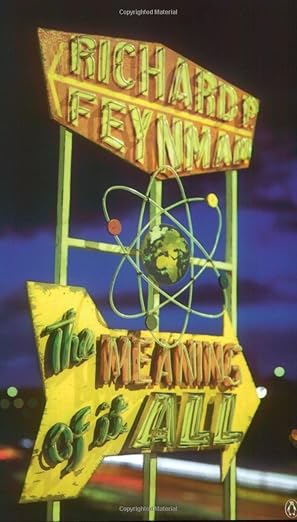
I came to The Meaning of It All late in a year when the question of what it means to know something had started to feel more urgent than philosophical. The three Danz lectures that make up this book were delivered by Richard Feynman at the University of Washington in 1963 - a year when the atomic bomb was less than twenty years old and the question of what science owed to ethics was not abstract. Feynman was at the peak of his career, two years from his Nobel Prize, and he used these public lectures to think out loud about the questions that most occupied and most troubled him.
The result is one of the stranger small books in the scientific canon: not a popularization of physics, not a memoir, but a series of provisional, self-questioning reflections on what science is, what it cannot do, and what it means to live in a world where scientific knowledge coexists with persistent irrationality. Feynman does not resolve these questions. He sits inside them and thinks, out loud, with the particular combination of rigor and play that makes him one of the most readable scientists of the twentieth century.
The book's central argument - if three loosely organized lectures can be said to have a central argument - is that skepticism is not merely a scientific tool but a moral necessity. Feynman holds that the only honest relationship to knowledge is one that acknowledges its own incompleteness and remains genuinely open to being wrong. This is a more radical position than it sounds: he applies it not only to science but to politics, religion, and ethics, drawing a distinction between questions that science can in principle answer and questions about value that it cannot, while insisting that the epistemic standards of the former should inform how we hold the latter.
The lecture on pseudoscience, flying saucers, faith healing, and astrology is the most immediately entertaining section and the one that has aged most interestingly. Feynman is not contemptuous of people who believe these things; he is troubled by them, because he understands what the spread of credulous thinking costs a society's capacity for self-governance and rational decision-making. He was worried about this in 1963. The worry has not become less applicable.
What Makes The Meaning of it All Worth Hearing
Raymond Todd narrates this with the right quality of restraint. These are transcripts of lectures - they have the rhythm of spoken rather than written language, with the repetitions and self-corrections that characterize a great mind thinking in real time rather than composing. Todd honors that origin. He does not polish the rough edges into literary performance; he reads with enough presence to keep the listener engaged and enough transparency to let Feynman's voice come through. This is harder to achieve than it sounds, particularly over nearly three hours of material this discursive.
At two hours and fifty minutes, this is among the shortest audiobooks in the science category, but the density of ideas per minute is high. It is not difficult listening - Feynman is incapable of being boring - but it is demanding in the sense that you cannot drift and return without having missed something. This is concentration listening rather than ambient listening.
Things to Know Before Starting The Meaning of it All
The book's weakness is its structural looseness. These are lectures, not essays, and the transitions between ideas are sometimes abrupt or incomplete. Feynman circles back, contradicts himself slightly, and pursues tangents that do not always resolve. Some listeners will find this authentically Feynman-like; others will want more formal architecture. If you are expecting the clean argumentative structure of a written book, the lecture format will feel rough.
The book is also, at 144 pages (roughly three hours of audio), genuinely short. Feynman does not exhaust any of his subjects; he introduces them, turns them over, and moves on. This can feel like the beginning of a conversation that deserves to continue. The Feynman Lectures on Physics and his other popular works provide that continuation, but they require a different level of commitment. This book is the gateway, not the destination.
Who Richard P. Feynman Is Writing For
Anyone curious about how a genuinely rigorous thinker approaches the intersection of science, ethics, and public irrationality should listen to this - not as a guide to any of those subjects but as a demonstration of a mind working through them honestly. Science communicators and teachers will find Feynman's framework for thinking about doubt and uncertainty practically useful. Listeners who already know their Feynman well will not encounter much that is new here, but may find value in hearing him think in the more public, less technical register that the Danz lectures demanded. The book is too short and too loosely organized to function as a comprehensive introduction to Feynman's thought, but it is a perfect place to find out whether you want more.
How does Raymond Todd's narration handle the fact that these are transcripts of spoken lectures?
Carefully and well. He preserves the conversational rhythm of Feynman's spoken style rather than ironing it into formal prose delivery. The repetitions and self-corrections that make the lectures feel authentic are honored rather than smoothed away.
The lectures were delivered in 1963 - does the material feel dated, particularly the sections on pseudoscience and UFOs?
The specific examples (flying saucers, faith healing) are period-specific, but the argument about why skepticism matters for democratic society has become more rather than less relevant. The 1963 context adds historical texture without limiting the book's applicability.
How does The Meaning of It All compare to Feynman's other popular works like Surely You're Joking, Mr. Feynman?
Surely You're Joking is a memoir, warm and anecdotal. The Meaning of It All is more serious in its ambitions - it is Feynman trying to work out what science owes to society and vice versa, without the biographical charm of the memoir. They complement each other well and appeal to somewhat different modes of engagement with his thinking.