Quick Take
- Narration: Brian Sutherland handles Peart’s prose with appropriate respect, though the absence of Peart’s own voice means the slight distance of a professional narrator rather than the direct intimacy of the author reading.
- Themes: Travel as introspection, cultural collision, the writer’s eye in unfamiliar landscape
- Mood: Dry, literary, and occasionally wry, like a companion on a difficult journey who reads extensively and notices everything
- Verdict: Peart’s West Africa cycling memoir is genuinely unusual travel writing from a genuinely unusual observer, and it rewards listeners who come for the literature rather than the rock biography.
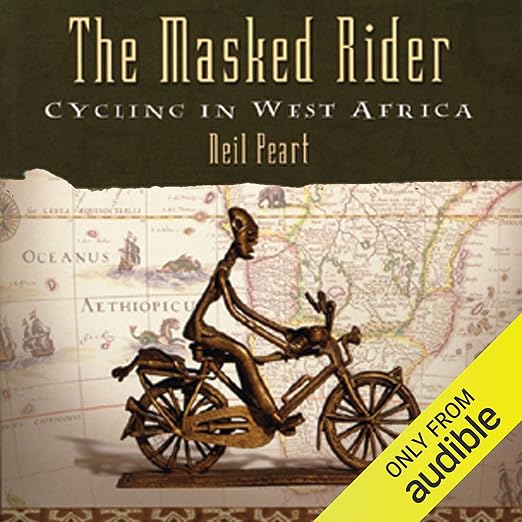
I started The Masked Rider on a Saturday morning planning to give it an hour, and I was still listening at midday. Neil Peart’s reputation is so thoroughly attached to the drums of Rush that his parallel life as a writer tends to get treated as a footnote, something fans discover with pleasant surprise rather than something that circulates in literary circles on its own merits. Reading The Masked Rider, I kept thinking that the separation is the literary world’s loss rather than Peart’s.
The book covers a cycling journey through West Africa, specifically Cameroon, with the dysentery, corrupt officials, and drunken soldiers mentioned in the synopsis presented not as inconveniences to be explained away but as the actual texture of the journey. Peart is not writing adventure travel in the sense of a survivalist narrative. He is writing a document of a particular kind of attention brought to bear on a particular part of the world, and the attention is consistently more interesting than the logistics.
Peart as Literary Cyclist Rather Than Rock Star Abroad
The thing that separates The Masked Rider from celebrity travel memoir is the density of the literary and intellectual scaffolding Peart builds around the experience. References to Aristotle, Dante, and Van Gogh are not dropped for effect. They are doing actual work in the text, helping Peart locate what he is observing within a broader history of how travelers and artists have tried to understand encounters with the radically unfamiliar. This is the literary sidekick structure the synopsis refers to, and it is more substantive than that framing suggests.
One reviewer, identifying as primarily a cycling enthusiast rather than a Rush fan, noted that the technical cycling content was lighter than expected, and that the book was primarily about the interior experience rather than the physical challenge. This is accurate. Peart cares about where he is and what it means and what it reminds him of, not about the mechanics of touring. If you come to this hoping for detailed cycling content, you will find the emphasis elsewhere. If you come to this hoping for a writer who pays extraordinary attention to everything around him and then finds the language to convey what he saw, the book is exactly that. The descriptive passages have what one reviewer called an almost mind-boggling quality coming from someone whose primary career was in music.
The Africa on the Page and the Questions It Opens
West Africa in this book is depicted with specificity and with the kind of moral complexity that honest travel writing requires. Peart encounters genuine hospitality and genuine corruption, genuine natural beauty and genuine poverty, and he does not resolve these into a coherent thesis about what Africa is or what it means. He is too intelligent a writer for that. He records the discontinuities and the contradictions and lets them sit.
Some reviewers have noted moments in the text where Peart’s perspective carries the assumptions of a Western observer looking at postcolonial Africa, and where those assumptions are not fully examined. This is a fair critical observation. Peart is working hard to be accurate and fair, and his self-reflections are genuine, but the position of the observer is the position of the observer, and readers who come to the book with strong critical frameworks for colonial gaze in travel writing will find things to push back on. Within those limits, the observations are consistently vivid and the prose is among the best travel writing I have encountered from someone whose primary career was elsewhere.
Brian Sutherland’s Narration and the Question of the Author’s Voice
Ghost Rider, Peart’s later memoir about his motorcycle journey after the deaths of his daughter and wife, was narrated by Peart himself in some editions and by professional narrators in others. The Masked Rider is a different case, predating those events, and Brian Sutherland takes on the narration here. Sutherland is a competent and thoughtful reader who serves the material without imposing himself on it. The slightly dry, precise Peart prose comes through clearly.
What Sutherland cannot replicate is the specific dryness of Peart’s own voice, which was, by all accounts from those who heard him speak, an unusual and specific instrument. Reviewers who came to this book as long-time Peart readers describe Sutherland’s narration as functional and respectful. The book’s writing is strong enough to work well with a skilled professional narrator, which is the appropriate standard to apply. At ten hours and eleven minutes, the runtime covers the full journey with the room that Peart’s observational style requires.
Who Finds This Book Essential and Who Needs a Different Starting Point
Rush fans who have not yet read Peart’s prose work will find The Masked Rider a revelation that reframes what they thought they knew about him. Cycling enthusiasts who are also interested in literary travel writing will find the book deeply satisfying as long as the technical cycling content gap is understood going in. Readers who enjoy travel writing in the tradition of writers who bring a serious intellectual framework to geographic displacement, the Paul Theroux mode rather than the Bill Bryson mode, will find Peart an unexpected peer. Readers who want sunny or comfortable travel writing will find ten hours of challenging and rewarding material that is neither.
For readers who have already encountered Peart through Ghost Rider, the earlier book provides a useful contrast. The Masked Rider was written before the personal catastrophes that shaped Ghost Rider’s grief, and the different emotional register, lighter despite the physical hardships of the journey, gives the two books a complementary relationship that rewards reading both. Several reviewers who had read Ghost Rider first describe The Masked Rider as essential context for understanding Peart as a writer across his full range.
Frequently Asked Questions
Do you need to be a Rush fan or know Neil Peart’s music to appreciate The Masked Rider?
No. The book stands entirely on its own as a piece of travel literature. Rush is not mentioned, and the journey is presented as the account of a cyclist and writer rather than a rock star abroad. Rush fans will bring an additional layer of context, but it is not required.
How does The Masked Rider compare to Ghost Rider for someone who has read that book?
Ghost Rider, written after the deaths of Peart’s daughter and wife, carries a much heavier emotional weight and is explicitly a grief memoir alongside a travel narrative. The Masked Rider is an earlier, lighter work in tone, though still substantive. Most readers who love one find value in the other.
Is the dysentery and physical difficulty of the journey a significant part of the narrative, or does Peart focus elsewhere?
The physical hardships are present and described vividly, but Peart’s attention is primarily on the interior and intellectual experience of the journey. The challenges are texture rather than the story’s central subject.
Does Brian Sutherland’s narration capture Peart’s distinctive writing voice?
Sutherland is a careful and respectful narrator who conveys the text clearly. He cannot replicate Peart’s own vocal personality, but the prose quality comes through well enough that most reviewers describe the narration as serving the book effectively.