Quick Take
- Narration: Rory Stewart narrates his own book with the measured intelligence of someone who has walked the ground and thought carefully about every mile of it.
- Themes: Border identity, father and son across generations, empire and its afterlives, Scottish independence
- Mood: Meditative and elegiac, with an undercurrent of political urgency about a Britain in the middle of redefining itself
- Verdict: One of the more thoughtful travel memoirs of the past decade, using physical walking as a framework for genuinely profound reflection on identity and continuity.
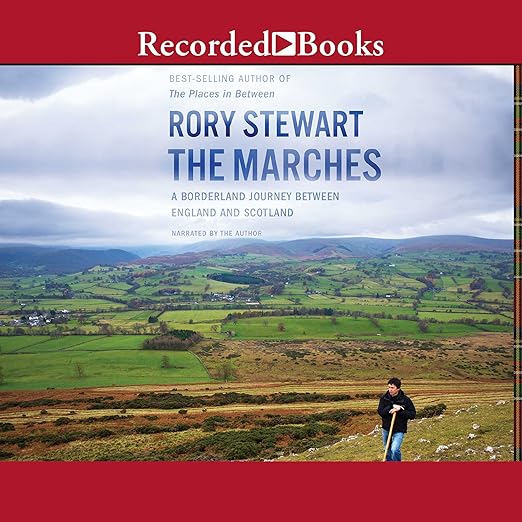
I put this on during a stretch of autumn evenings when I was reading about the edges of things, borders and frontiers, the places where one identity ends and another begins. The Marches arrived at exactly the right moment. Rory Stewart’s walk between England and Scotland, a thousand miles along the historical borderland between the two countries, is not primarily an adventure story. It’s a meditation on what it means to belong to a place, to a tradition, to a father, and to a political identity that is actively dissolving around you as you walk.
Stewart’s credentials for this particular journey are considerable. He was raised on this border, represents this borderland as a Member of Parliament at the time of writing, and his father, who joins him for parts of the walk at the age of 90, has lived on this land his whole life. The walk begins at the moment Scotland is preparing to vote on independence and Britain’s future is genuinely uncertain. The personal and the political are woven together here in a way that neither feels forced nor feels incidental.
Our Take on The Marches
The book’s architecture is unusual. One reviewer described it as working in three parts: a shorter opening section about the early stages of the walk, a long middle section dense with border history, and a final third that returns to the relationship between Stewart and his father. That structure tracks, and it means the book’s emotional core, the father-son dynamic, is book-ended around the historical content rather than running through it continuously. Some readers find the middle section too dense with local history; others find it the most absorbing part. I was in the second camp, though I’d acknowledge you need genuine interest in Roman Britain and medieval border politics to stay engaged through it.
One reviewer compared this to Hillbilly Elegy, which is an interesting comparison but not quite right. Stewart’s class background and political context are entirely different, and the book’s relationship to region is more historically grounded and less polemical than Vance’s memoir. A better comparison might be Robert Macfarlane’s walking books, though Stewart’s political life gives The Marches a dimension of civic responsibility that Macfarlane’s more purely literary work doesn’t carry.
Why Listen to The Marches
Stewart narrating his own book is the right decision. His voice carries the measured intelligence you’d expect from someone with his educational background and political career, and he reads with the cadence of someone genuinely present in the landscape he’s describing rather than performing it. Several reviewers noted they found the book more affecting on re-reading, and I suspect the audio format particularly rewards return listeners, since the historical passages become easier to absorb once you know where the emotional argument is heading.
The Scottish independence context gives the book a political urgency that saves it from becoming purely personal memoir. Stewart is a serving MP for the borderland he’s walking, and his reflections on what the potential dissolution of Britain means for communities that sit precisely on the line between national identities are grounded in his professional understanding of what sovereignty actually means for daily life.
What to Watch For in The Marches
The relationship between Stewart and his father is the book’s emotional spine, and it’s worth paying attention to how carefully Stewart handles it. Brian, who turns 90 at the beginning of the journey, is a complex figure: a former colonial administrator whose career embedded him in the British Empire’s operations in Asia, a man of immense discipline and intellectual confidence, and a father whose relationship with his son is warm but not uncomplicated. Stewart writes about him with love and with clear eyes, which is harder to do than it sounds.
The Roman history sections are the ones most likely to lose casual listeners. Stewart is genuinely interested in Hadrian’s Wall and the broader Roman occupation of Britain as a frame for thinking about how empire leaves its mark on landscape and identity, and he goes into considerable detail. If you have no existing interest in Roman Britain, these passages may feel like a detour. If you do, they’re some of the best material in the book.
One reviewer who walked the Hadrian Way Pathway noted they read the book three times, each time finding different layers. That’s a reliable indicator that the work has depth worth returning to.
Who Should Listen to The Marches
Essential for listeners interested in British political geography, particularly the England-Scotland relationship and the question of national identity in a time of constitutional uncertainty. Also strong for travel memoir readers who want genuine intellectual substance alongside the physical journey, and for anyone interested in father-son memoir that avoids both sentimentality and harshness. Less recommended for listeners who want clear narrative momentum throughout; the historical middle section requires patience and some prior interest in the region’s past.
Frequently Asked Questions
Do I need to know British history to enjoy The Marches?
Basic familiarity with the England-Scotland border and the broad outlines of British history helps considerably, particularly for the Roman and medieval sections. The book doesn’t assume specialized knowledge, but readers who come with some prior interest in the region will get significantly more out of the historical passages.
How does Stewart’s political career as an MP affect the book’s perspective?
It’s central rather than incidental. He represents the borderland he’s walking, and his professional understanding of what constitutional questions like Scottish independence mean for actual communities gives his reflections a specificity that purely personal memoir would lack. The book sits between political analysis and travel memoir, and the MP dimension holds those strands together.
Is this a good audiobook for listeners who enjoyed Rory Stewart’s other books or his podcast work?
Yes. The Marches shares the measured intelligence and historical curiosity that characterizes his other work. Listeners who followed his political career and podcasts will recognize the voice, and those who read The Places in Between, his earlier walking memoir across Afghanistan, will find this a natural companion.
Why do multiple reviewers say they read this book more than once?
The book operates on several levels simultaneously: as a physical travel narrative, as a father-son memoir, and as a meditation on imperial history and national identity. On first listen, the historical middle section can feel dense; on return, knowing where the emotional argument leads, it reads differently. The depth that multiple reviewers found rewards the additional time.