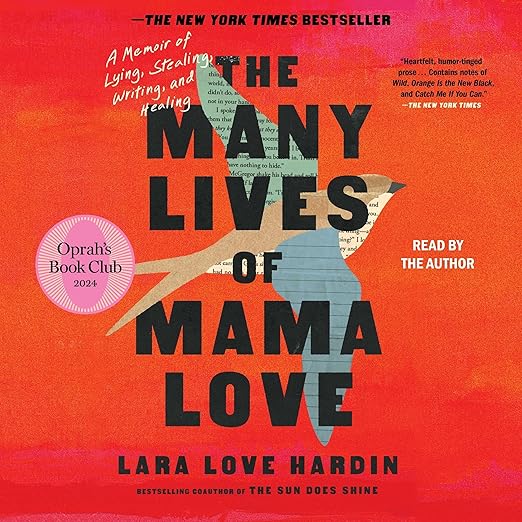
Soccer mom to inmate S32179 to ghostwriter is a strange enough arc that The Many Lives of Mama Love almost doesn't need Oprah's endorsement to earn attention, but the audiobook has it anyway. Lara Love Hardin narrating her own story turns out to matter more than the celebrity blurb does, since the whole premise depends on believing one specific voice telling the truth about her own worst decisions.
Furniture Built From Tampon Boxes
A genuine gut-punch of a contrast opens the book: a million-dollar cul-de-sac housewife funding a heroin addiction by stealing her own neighbors' credit cards, then getting convicted of thirty-two felonies and becoming inmate S32179. Hardin doesn't soften the specifics, and the synopsis leans into the contradiction rather than around it, which is part of what several reviewers respond to.
The jail sections carry their own strange social detail: furniture built from tampon boxes, Snickers bars functioning as currency, and a power structure Hardin herself compares to Lord of the Flies. Out of that environment comes the nickname that gives the book its title, Mama Love, earned by bringing care and structure to fellow inmates rather than by staying separate from them.
A hard pivot defines the back half, from incarceration into a ghostwriting career built on legally inhabiting other people's identities on the page, which puts Hardin in rooms with Oprah, the Dalai Lama, and Archbishop Desmond Tutu. The synopsis is honest that the shadow of her past follows her into those rooms too, framing shame as something closer to an ongoing condition than a chapter that closes once the addiction ends.
Present Tense, Read Aloud by the Person Who Lived It
The synopsis closes on a line that doubles as the book's thesis: that this is a journey from shame to redemption inside a system that makes it almost impossible to move beyond the worst thing a person has ever done. That framing, a structural argument about how hard the world makes forgiveness rather than just a personal story of overcoming, is part of what separates this from a simpler addiction-to-recovery arc.
Stevie Trujillo's review makes a specific craft observation worth passing along directly: the book is told in first person present tense, credited with giving it real narrative speed and high emotional stakes rather than the more distanced past-tense reflection memoirs often default to. Hearing that present-tense telling read aloud by the person who lived it is a different experience than a hired narrator performing the same pages would deliver.
Once You Start, You Won't Want to Stop
The Oprah's Book Club selection is not just a marketing sticker here; the synopsis quotes Oprah Winfrey directly, saying that once you start reading, be prepared, because you won't want to stop, which is the kind of specific attributed endorsement worth more than a generic five-star badge.
Trujillo's review also mentions a personal parallel to Hardin's history, trauma, addiction, and recovery, alongside a shared love of books and writing, and says that connection made it impossible to read slowly or study the craft from a distance. That is one reviewer's specific stated experience rather than a universal promise, but it points toward the same conclusion from a different angle: the intensity this premise promises reads as a delivered quality rather than marketing language.
Reviewer Kim describes an arc within the listening experience itself worth flagging: starting out disliking the author for her early choices and mindset, then gradually rooting for her by the end. That kind of reversal only works if the narration earns it moment to moment, which is a real point in favor of Hardin reading her own account rather than a neutral third party performing sympathy the listener has to build independently. Edward Plucinski's review adds a shorter, blunter version of the same reaction, describing being drawn in immediately despite rarely reading memoirs at all.
The Print Is Too Light to Read
Reviewer Todd gave the book four stars specifically because, in Todd's words, the print is so light it made the book hard to read, a complaint that plainly belongs to a physical or e-book edition rather than the audio production. Anyone scanning ratings and wondering why a four-star review exists among a page of five-star praise should know that specific complaint has nothing to do with Hardin's narration.
Biography, true crime, and personal development are all represented in the genre tagging here, and while true crime fits the real convictions and real prison time at the book's center, it also risks setting up expectations for a puzzle-driven or procedural structure that this is not. The engine here is Hardin's own reckoning, not an investigation, and reviewer Polly's account, which cuts off mid-sentence in the source material before finishing its point about the criminal justice system, still makes clear the book leans toward personal reflection over procedural detail.
Given the subject matter, active addiction, incarceration, and the mechanics of a credit card theft scheme, listeners sensitive to detailed accounts of substance abuse or crime should know the synopsis does not soften those specifics for a general audience.
Simon & Schuster Audio released this in August 2023, giving it a couple of years in the market by the time most new listeners find it, which is worth mentioning only because a book this reliant on a single Oprah's Book Club moment can sometimes fade from algorithmic visibility faster than its actual reader response would suggest. The steady five-review spread of four and five-star ratings here suggests the book has held up past its initial press cycle rather than depending entirely on launch-week attention.
In Her Own Voice, Her Own Worst Chapter
Redemption narratives with real stakes, rather than a tidy or sanitized recovery story, is what memoir listeners get here, particularly anyone who values hearing an author narrate her own worst chapter in her own voice. Oprah's Book Club followers already have a built-in reason to trust the pick, and the present-tense, first-person telling that Trujillo highlights gives the book real momentum for a nine-and-a-half-hour listen.
Listeners specifically wanting a procedural true-crime investigation, with detectives, evidence, or a puzzle to solve, should look elsewhere, since nothing here is built around suspense in that sense. A tidy, sanitized recovery arc is not on offer here, and listeners currently in early recovery or otherwise sensitive to detailed substance-abuse content should weigh that against the book's unflinching specifics before starting.
Does the Mama Love audiobook include content about active addiction and crime in detail?
Yes. The synopsis is direct about Hardin funding a heroin addiction by stealing her neighbors' credit cards and the thirty-two felony convictions that followed. Listeners sensitive to detailed accounts of substance abuse or criminal activity should know the book does not soften those specifics for a general audience.
Why does one review mention the print being hard to read if this is an audiobook?
One four-star review specifically complains that the print is too light to read comfortably, which is a physical or e-book edition issue rather than anything related to the audio production. It has no bearing on Lara Love Hardin's narration and appears to be feedback carried over from a different edition of the book.
Is the Many Lives of Mama Love audiobook narrated by the author herself?
Yes. Lara Love Hardin narrates her own memoir, and one reviewer specifically notes the book is told in first-person present tense, credited with giving the story real narrative speed. Hearing that account read by the person who lived it is a key part of the audiobook's appeal.
Is this audiobook more true crime or more memoir in how it actually plays out?
It leans memoir. True crime elements are real, the convictions and prison time genuinely happened, but the book is centered on Hardin's personal reckoning and reinvention rather than a procedural investigation. Listeners expecting a puzzle-driven true-crime structure should adjust their expectations accordingly.