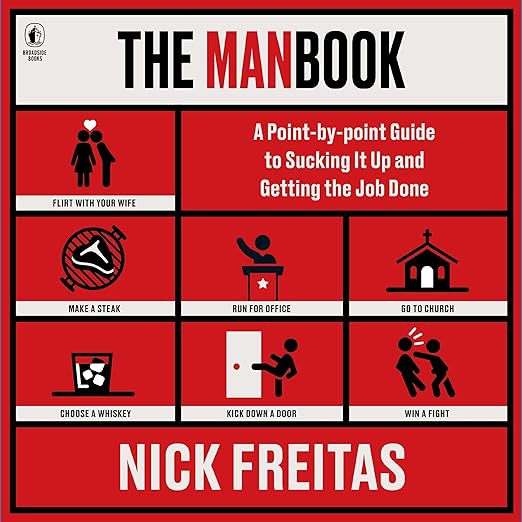
In Brief
- Performance: Nick Freitas reads his own book, so the war stories, the politics and the timing of every joke arrive from the person they belong to, with no second voice on the Broadside Books credit.
- What it covers: Practical masculinity, marriage and fatherhood, lessons out of war and politics, strength paired with honor.
- Feel: Blunt, wry, unapologetic.
- Our call: Buy it for the author's voice and the concrete lists, not for a debate about what men are for.
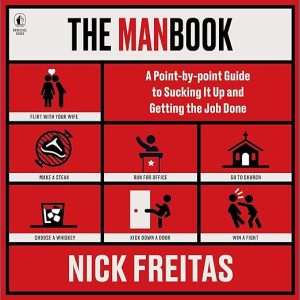
Over fifty masculine skills is the number the description promises, and it names five of them: how to win an argument fairly, how to plan the perfect date, how to win a fight, how to prepare a steak and how to pit a car. That is a spread running from ethics through cooking to vehicle maneuvers, and the other forty-five go unlisted. Nick Freitas reads the audiobook himself, which on a book of this kind is most of the product.
The opening premise is the best thing here. You are not the man you want to be, the description says, because none of us are, and it is a quest rather than a destination. That framing does something unusual for the genre: it removes the finish line, which removes the shame, and shame is the mechanism most masculinity writing quietly runs on. A book that begins by conceding the author has not arrived either is a book you can argue with.
The material comes out of marriage, fatherhood, war, business and politics, a base wide enough that no single chapter has to carry the whole case. Freitas is a retired Green Beret, a husband, a father and a Virginia legislator, and the copy leans on that range rather than on any one credential. The lessons are described as hard, learned rather than researched, which sets the register accurately before anybody pays for it.
The thesis arrives without hedging: the answer to the crisis of masculinity is not docility or weakness but men who are both strong and honorable. Whether you find that obvious or contentious will decide most of your reaction, and it counts in the description's favor that the position sits in plain view instead of emerging forty minutes in. Nobody buying this will be caught out by what it argues.
Freitas Delivers the Joke as He Intended It
An author reading his own advice is not always an improvement. Here it comes close to essential. The description promises a signature blend of humor and hard-earned wisdom, and humor is the one quality that cannot be delegated: timing, dryness and the decision about which line to underplay all belong to the person who wrote them. The credit names Freitas as the reader, so what reaches you is the joke as intended rather than the joke as interpreted.
The war and politics material gains in the same way. Advice about fighting, about arguing fairly and about holding up in demanding jobs lands differently when the voice delivering it belongs to somebody who did those things, and no amount of professional reading supplies that. This is the standard argument for an author-narrated nonfiction title, and it applies with more force than usual because the authority here is biographical rather than researched.
The structure suits listening too. A list of discrete skills, each carrying its own lesson, is close to ideal for audio, since a listener who misses a section has lost one item rather than the thread of an argument. Five hours and forty-three minutes across fifty-odd entries means nothing outstays its welcome, and the shape tolerates being picked up and put down over weeks with no need to remember where you stopped.
Five Skills Named, the Rest Left Out
The star line on this listing is empty. No rating, no counter and no written responses, on a title released April 14, 2026 by a publisher with a real imprint name. That is unremarkable in itself and it costs something specific here: on a book that sells wry delivery alongside hard experience, spoken in the author's own voice, the thing you most want to know is whether the jokes work, and nobody has said.
The second gap is the contents. Five of the fifty-plus skills get named and the rest do not, and the five chosen for the description do not add up to a coherent book: fair argument is an ethical discipline, the perfect date is a relationship skill, winning a fight is physical, steak is cooking, and pitting a car is a driving maneuver the copy never pauses to explain. A buyer cannot tell what proportion of the book is which.
Then the shelving, which does this title no favors at all. It sits across politics and social sciences, relationships and personal development, and religion and spirituality simultaneously, with a Politics and Government tag over the top. A book of practical advice about being a husband and a father is being presented first as a political object, which will attract buyers who want a political argument and repel buyers who came for the advice.
The title compounds that. The Manbook displays as one word with no subtitle attached anywhere, so the page offers nothing to say which kind of book you are getting: not a memoir, not a political tract, not a marriage manual, though it touches all three. On a shelf where the subtitle normally does the explaining, its absence leaves the cover and the genre placement carrying a job that neither is equipped for.
Written for Fathers Handing Down a Checklist
Men who like their advice concrete are the audience, particularly anyone who has bounced off the more therapeutic end of the shelf and wants instructions rather than invitations to reflect. It suits fathers looking for something to hand a son, and it suits younger men who want a checklist of competences they suspect nobody ever got around to teaching them. Listeners who already share the book's politics will find the framing comfortable throughout.
Leave it alone when you want the argument about masculinity examined rather than answered, because the position arrives settled and the book's job is application instead of debate. Anyone allergic to the political framing should also stay away, since the shelving is no accident. And readers hoping for the war memoir buried inside the biography will get lessons drawn from it rather than the story itself.
The honest summary is that this is a self-help book with a soldier's biography behind it and a legislator's politics around it, sold under a one-word title across three different shelves, read by the man who wrote it and reviewed so far by nobody. The author-read credit is the strongest asset this listing has, and the reason to sample rather than guess. Everything else a buyer wants to know currently comes down to trusting the description.
Does the audiobook work for somebody who does not share the author's politics?
Partly. The advice about arguing fairly, planning a date, cooking and handling yourself does not depend on any political position, and most of the fifty-odd skills are like that. The framing does depend on one: the crisis of masculinity is named as a crisis and answered rather than examined. Expect to take the lists and leave the diagnosis behind.
Is the audiobook something to share with a teenage son?
It is written to be handed down, and the fatherhood material assumes exactly that. The caution is tonal rather than explicit: the book argues a position about what men should be, at the age when a teenager is forming one, so plan to listen alongside rather than to hand it over. The skills half is the part that will actually get used.