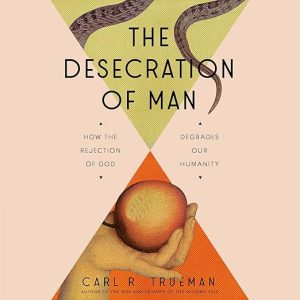
Four months on sale from a major audio house, and not one person has rated this audiobook. No stars, no written responses, nothing at all on the page where buyers normally leave something. Carl Trueman reads the whole argument aloud across six and a half hours, and the argument is that Western culture is coming apart because it has stopped believing human beings are made in the image of God. Whatever you make of that claim, the silence surrounding it is the first surprise this listing delivers.
Blaming the Rejection of the Imago Dei
The thesis is stated without hedging, which is worth respecting whether or not you accept it. Trueman takes falling church attendance, climbing suicide rates and plummeting birth rates as symptoms, rejects the common explanation that disenchantment and lost tradition are to blame, and argues the cause is simpler and graver: the rejection of the imago Dei, the doctrine that human dignity rests on being made in God's image. Everything else in the book follows from that single move.
Method matters as much as conclusion here. The description promises pastoral wisdom, church history and command of philosophical genealogies, and that last phrase is the one to notice, because genealogy means tracing how an idea arrived rather than refuting it directly. A listener should expect long stretches of intellectual history explaining where a modern assumption came from, rather than a point-by-point argument with contemporary opponents. That approach persuades some readers deeply and leaves others unsatisfied.
Positioning is explicit. This is sold as coming from the author of The Rise and Triumph of the Modern Self, and it reads like a companion argument aimed at the same readership. Nothing requires the earlier book, though the terms arrive faster if you have met them before. What the bare title will not tell you is that the argument is theological from the first premise to the last, and that its solution is explicitly religious.
Trueman Reads His Own Load-Bearing Clauses
Self-narration is a genuine advantage on a book of this kind. Argumentative prose lives or dies on emphasis, and when the person reading is the person who chose every clause, you hear which qualifications are load-bearing and which asides are throwaway. A hired reader has to reconstruct that from punctuation. Trueman does not, and on material where a single concessive clause can change the whole force of a paragraph, that is not a small thing.
Structure also suits the format. The book moves from an abstract premise about human dignity to concrete practices, naming abortion, pornography, casual sex and gender transitions as the places where the rejection shows itself. Whether you find that sequence convincing or infuriating, it is easy to follow by ear, because each step is announced. Nobody will lose the thread of what is being claimed, which is more than can be said for most cultural criticism.
The rhetorical opening deserves credit too. Beginning with three measurable trends rather than with scripture is a deliberate choice, and it earns the book a hearing from people who would close it if it opened with doctrine. The copy closes on the same instinct, noting that the Early Church triumphed over Rome because it offered life in place of death, and proposing that modern Christians attempt something similar.
Filed as Philosophy, Written as Apologetics
Shelf placement will mislead people. This sits under politics and social sciences with a philosophy tag, and it is neither: it is Christian apologetics addressed primarily to believers, arriving at consecration to a living God as its remedy. Readers browsing philosophy for a secular treatment of human dignity are going to be startled, and readers who actively want a theological case may never find it where it has been filed.
The subject matter is named plainly and buyers on every side should know that going in. Practices many listeners regard as settled personal freedoms are described here as desecrations, in direct language, at length. That is the book's stated project rather than an incidental aside. Anybody purchasing this for a book group, a classroom or a parent should be clear about the register before pressing play, because the recording does not soften it.
Then the empty rating line, which will not improve with time in the way you might hope. On a book this contested, the pool that eventually accumulates will function as a referendum on the thesis, with sympathetic buyers awarding top marks and opponents awarding the minimum, and almost nobody grading the reading itself. Waiting six months for reviews to appear is unlikely to give you the information you actually want.
Sources are the practical gap. An argument built on intellectual genealogy leans hard on them, and audio gives you no footnotes, no bibliography and no way to see a citation as it passes. The page lists no companion document either. If you intend to check where a historical claim comes from, or to argue with it seriously, plan on having the print edition within reach rather than relying on what you can catch by ear.
Six and a Half Hours of Trueman's Own Argument
Readers who finished The Rise and Triumph of the Modern Self and wanted the argument carried further are the obvious buyers, and they will find this shorter, more concentrated and more openly pastoral than that book. Christians looking for a theological account of why the last two decades feel the way they do, delivered by somebody willing to name specifics, will get exactly the thing they came for.
A second audience is worth naming: people who disagree and want the case in its strongest form rather than in caricature. Trueman is a serious writer, the prose is unusually clear, and six and a half hours in the author's own voice is a far better way to understand an argument than any summary of it. Reading opponents properly is the only way to answer them properly.
Where this stops working is with a listener who wants the case tested against its strongest opposition. The book states and traces; it does not stage a debate, and no counterargument gets equal time. Anyone hoping for a neutral survey of how modern societies ground human dignity should look for a different title. Come knowing it is a committed argument, and it is a lucid and well-made one.