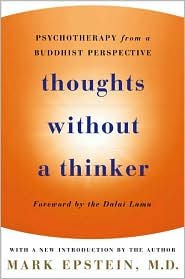
- Voice: Mark Epstein narrates his own work with the unhurried intimacy of a therapist at ease with silence, which suits the book's meditative register exactly.
- Big ideas: Buddhist psychology and Western psychotherapy, the nature of the self, meditation as clinical insight
- Atmosphere: Reflective, intimate, and intellectually generous
- Worth it?: A landmark integration of two traditions that has aged remarkably well, and hearing Epstein narrate his own updated introduction adds a layer of reflection the print edition cannot offer.
Thoughts without a Thinker occupies a particular place in the literature of psychology and contemplative practice. When Mark Epstein first published this synthesis of Buddhist teaching and Western psychotherapy, the intersection of those two worlds was not the crowded territory it has since become. Reading it now, or more precisely listening to Epstein narrate this audiobook himself at seven hours, is to encounter both a historical document and a living resource. The new introduction, in which Epstein reflects on the book's impact and on how the relationship between psychotherapy and Buddhism has evolved since publication, is the kind of addition that makes a re-release genuinely worth the time of both new listeners and those returning to it after years with the print edition.
Mapping Anatta Onto the Psychoanalytic Ego
Epstein is a New York-based psychiatrist trained in classical Freudian methods, and his project in this audiobook is to show what Buddhist psychology can offer to Western therapeutic practice and vice versa. The premise might sound like it could produce an awkward hybrid, but Epstein's particular gift is writing in accessible, intimate language that does not condescend to either tradition. He does not reduce Buddhism to a stress-management technique or a lifestyle optimization strategy. He does not reduce Freudian psychoanalysis to a secularized religious structure. He holds both seriously and finds genuine points of contact that illuminate each through the other.
The core contribution the book makes, and this is why it has remained in print and in the conversation for decades, is the description of Buddhist psychology's approach to the self and suffering in terms that Western therapeutic frameworks can engage with rather than dismiss. The problem of the ego in psychoanalytic tradition maps onto Buddhist concepts of anatta, no-self, in ways that Epstein traces carefully and without forcing the correspondence beyond what the texts support. The meditation path is described in contemporary psychological language that makes its stages legible to readers with no prior Pali or Sanskrit knowledge, without reducing those stages to Western analogues that would misrepresent them.
Epstein's narration is the decisive reason to choose the audiobook over the print edition for a first encounter. He reads with the quality of a thoughtful person revisiting their own work again, rather than performing it for an audience who expects a finished delivery. The intimacy of the first-person voice that runs through the book's original prose is amplified by hearing Epstein himself as its vehicle, and the seven-hour runtime gives the ideas room to develop without being compressed into quotable units.
Epstein's Reading Makes Inner Experience Audible
The audio format serves this particular book in ways that go beyond the convenience of hands-free listening. Epstein's subject is the relationship between inner experience and the structures we use to interpret it, and audio engages that subject through a different channel than print does. Hearing someone describe the meditative experience of watching thoughts arise without identifying with them lands differently as sound than as text. The transmission quality that Buddhist teaching has always attached to the spoken word feels present in a way that the audiobook format, when the speaker is the author, can honor.
The new introduction adds substantial value to this edition. Epstein reflects on how the relationship between psychotherapy and Buddhism has evolved since the book's original publication, a period that has seen mindfulness move from the margins of clinical practice to mainstream acceptance and the emergence of Mindfulness-Based Cognitive Therapy, Acceptance and Commitment Therapy, and other evidence-based approaches that draw on contemplative traditions. His perspective on what the book got right, what has been superseded, and what remains genuinely unresolved gives returning readers a reason to listen again and gives new listeners a twenty-first-century frame for the original content.
Dated Freud, but Timeless Buddhist Insight
Some listeners will find the Freudian framework Epstein draws on dated, particularly in a clinical landscape where psychoanalytic approaches have given way to CBT and other evidence-based modalities as the standard of care. Epstein acknowledges this dimension in his introduction and reflects honestly on how the field has shifted. The core insights about Buddhist psychology's account of suffering, impermanence, and the constructed self remain as current as they were at first publication, but listeners who are skeptical of psychoanalytic frameworks will find certain sections operating in a register that feels historically specific rather than timeless.
The book is not a practice guide. Listeners who want step-by-step meditation instruction, a structured introduction to mindfulness techniques, or a clinical protocol for integrating Buddhist approaches into therapy will need to look at Epstein's subsequent writing or other resources. This is a conceptual and theoretical integration, written in accessible language but focused on ideas and their relationship to experience rather than on techniques for producing specific states. Understanding that scope going in prevents the frustration of expecting something the book does not claim to deliver.
Meant for Therapists and Theory-Minded Meditators
Therapists and clinicians who want to understand the psychological dimensions of Buddhist practice, and why clients who meditate report the specific kinds of shifts they report, will find this audiobook substantive and intellectually honest about the limits of both traditions. Meditators who want a theoretical framework for their practice and are comfortable with some psychoanalytic vocabulary will benefit from the depth Epstein brings to the intersection. General readers drawn to the psychology of consciousness, the nature of the self, and contemplative approaches to suffering will find Epstein's accessible language and genuine expertise a reliable and engaging guide. Those expecting clinical protocols, step-by-step meditation instruction, or a purely secular mindfulness guide should look elsewhere, as the book operates in a more philosophical register.