Quick Take
- Narrator: Andrew Weissmann narrates his own work, which gives the prosecutorial arguments a direct authority and urgency that a professional narrator would struggle to replicate.
- Subjects: Political deception, legal accountability gaps, democratic vulnerability
- Tone: Urgent and analytical, with the precision of a legal brief aimed at a general audience
- Bottom line: A compact, purposeful argument about political lying and its legal remedies from a prosecutor who knows exactly what the stakes look like from inside the courtroom.
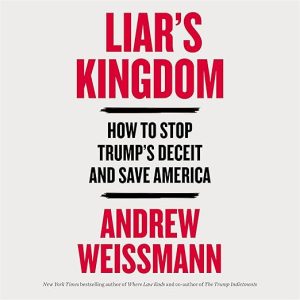
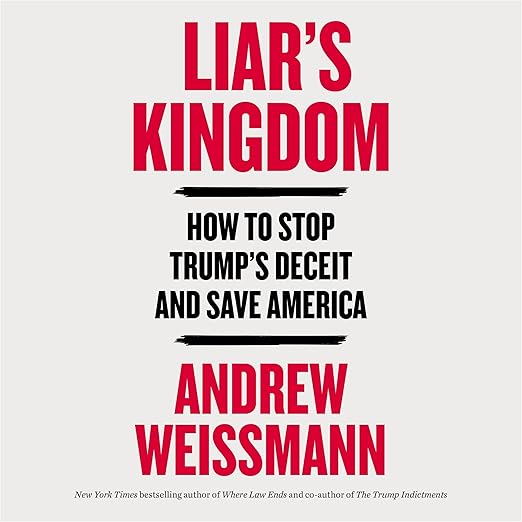
Andrew Weissmann self-narrates Liar's Kingdom, and you feel the difference immediately. This audiobook carries the particular quality that comes when the person making the legal argument is also the person delivering it in your ear: the weight of the specific claims, the control of emphasis on prosecutorial concepts, the patience with which Weissmann explains the constitutional quirk at the center of his argument. Running 5 hours and 30 minutes, the book is a deliberate size, tight enough to read as an extended legal brief but developed enough to cover historical context, constitutional analysis, and concrete proposals for reform.
Lying to the Electorate Carries No Legal Consequence
Weissmann's central argument is both simpler and more legally specific than most political commentary about lying. The premise is this: in the United States, lying about a business or an individual can expose you to criminal prosecution and civil liability. Lying about matters of fact to the electorate as a whole carries no such legal consequence. This is not, Weissmann argues, a First Amendment protection written into the Constitution. It is an assumption, a habit of legal thinking that treats political speech as categorically immune from the accountability mechanisms that apply everywhere else in American law. His position is that this assumption is neither constitutionally required nor democratically justified, and that the courtroom, properly reimagined, offers a forum for sorting fact from fiction in political claims.
What makes this argument distinctive is Weissmann's prosecutorial precision. As a lead prosecutor in the Mueller investigation and an MSNBC legal analyst, he approaches the problem not as a commentator offering opinions but as a practitioner asking which legal tools actually exist, which do not, and what the constitutional path to creating new accountability mechanisms might look like. The specific examples he uses, the statements about election integrity, deportation justifications, and institutional credibility that he categorizes as factually falsifiable rather than merely politically disputed, ground the argument in the events that animate it without turning the book into campaign commentary.
Defamation, Fraud, and Perjury Already Draw This Line
The audiobook is at its most compelling in the sections where Weissmann distinguishes between different categories of political speech. He is careful to acknowledge that political hyperbole, exaggeration, and contested interpretation are protected speech and should remain so. His focus is narrower: verifiably false factual claims made to the public about elections, legal proceedings, and government actions. The line between protected political speech and actionable false statement is not always easy to draw, and Weissmann does not pretend otherwise. But his argument is that the legal system already draws versions of this line in defamation, fraud, and perjury cases, and that the technology for fact-adjudication in courtroom settings is mature enough to apply to political claims if the political will to do so exists.
Weissmann's call for reimagining democratic institutions rather than defending old norms at all costs is the book's sharpest edge. He explicitly criticizes what he frames as the Biden administration's instinct to cling to norms even when those norms were being systematically exploited. This is a genuinely interesting legal argument regardless of the reader's political orientation, because it pushes past partisan framing into structural territory: not who is lying, but what mechanisms could hold anyone accountable for verifiable falsehoods in public office.
Weissmann Delivers a Lawyer's Closing Argument
Listeners should know that this audiobook has a clear thesis and a clear political object of concern. Weissmann makes no pretense of presenting a both-sides account of political deception. His case study is specific, his antagonist is named, and his prosecutorial career directly involves the material he is analyzing. That directness is an asset for listeners who want a clear argument, but listeners hoping for a more neutral survey of the legal landscape around political speech will find this a persuasive brief rather than an academic overview. The book's slim length means certain constitutional counterarguments are addressed briefly rather than exhaustively, which may frustrate readers with legal training who want fuller engagement with the First Amendment debates.
The self-narration is worth returning to as a point of evaluation. Weissmann does not perform the book in the way a professional actor would. His delivery is measured and purposeful, more like a lawyer's closing argument than an audiobook performance. For some listeners that will feel authoritative. For others accustomed to polished narration it may feel uneven in energy. No listener reviews are available to cross-reference, so calibrating expectations about the listening experience is worth doing in advance.
For Mueller-Investigation Followers Wanting the Legal Angle
Listeners interested in the legal and constitutional dimensions of political accountability rather than in political commentary alone. Weissmann's background as a federal prosecutor, not a pundit, makes this a different kind of analysis from what most cable news commentary offers. The audiobook rewards listeners who want to understand the structural mechanics of how political lying functions within the legal system, rather than simply cataloging instances of dishonesty. People who followed the Mueller investigation and want to hear one of its principal architects analyze what legal tools remain available and what does not yet exist. Those curious about how courtroom fact-finding mechanisms might be extended to political speech in a constitutionally viable way. Anyone who found Lawrence Lessig's arguments about institutional design compelling will find Weissmann's prosecutorial version of similar concerns worth the five-hour investment. Listeners who want politically neutral legal analysis should note that this book takes a clear position and names its antagonist explicitly. Those who want deeper First Amendment scholarship should supplement this with academic legal writing.