Quick Take
- Performance: MacLeod Andrews brings Pulitzer Prize finalist Ben Montgomery's prose to life with a cadence that honors both the biographical and social history dimensions of Plennie Wingo's Depression-era trek.
- What it covers: Depression-era American resilience, the pursuit of individual meaning through spectacle, cross-cultural encounter on the road
- Feel: Warm and propulsive, part biography and part lively social history of a pivotal American moment
- Our call: The Man Who Walked Backward earns its place alongside the best narrative nonfiction about the Great Depression because Wingo's journey is both literally and figuratively facing the wrong direction for all the right reasons.
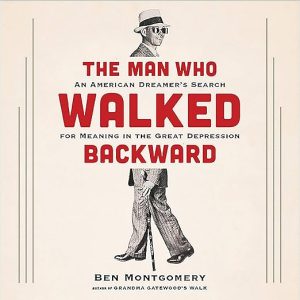
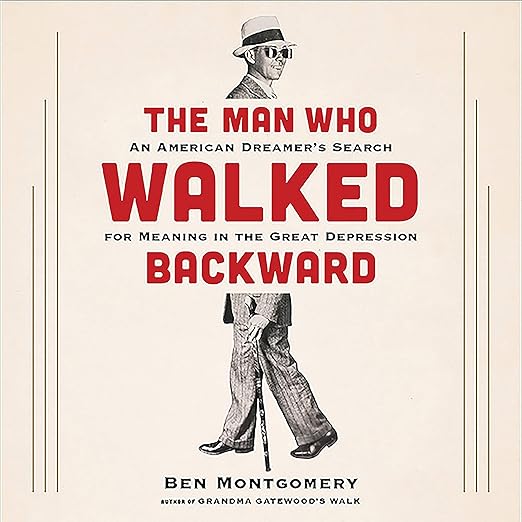
Plennie Wingo walked backward around the world during the Great Depression, and the fact that this sentence exists in the historical record is, as Ben Montgomery demonstrates in this audiobook, the beginning rather than the end of the story. Montgomery is a Pulitzer Prize finalist, and The Man Who Walked Backward has the structural assurance of someone who knows that the right biographical subject, handled with sufficient historical context, can carry a reader through periods of history that textbooks flatten into abstraction. MacLeod Andrews narrates across eight hours and fifty minutes with the kind of measured energy that suits both the quirkiness of Wingo's enterprise and the genuine hardship that surrounded it.
Plennie Wingo was a small-restaurant owner in Abilene, Texas, when the bank foreclosed during the Depression. After months of digging ditches to feed his family, he decided to do something extraordinary, something that would, in his own accounting, resurrect the spirit of adventure and optimism he felt he had lost. He decided to walk around the world, but backward, using mirrored eyeglasses to see where he was going. It is the kind of decision that makes more sense the longer you sit with the conditions that produced it. The Depression did not just take jobs; it took the sense of agency that makes a person feel like a participant in their own life rather than a casualty of forces they cannot influence.
First, the Big Picture
Montgomery frames Wingo's journey carefully against the America that was producing Woody Guthrie, John Steinbeck, and the New Deal simultaneously. The Depression is not backdrop decoration in this book; it is the reason the story exists and the lens through which Wingo's choices make sense. A man who has lost everything material and decides to stake his dignity and his future on an act of pure physical spectacle is doing something specific to his historical moment, and Montgomery does not let the reader forget that specificity. The economic collapse and Wingo's response to it are in constant conversation throughout the eight-plus hours.
Reviewer Nicolle Goldman describes the book as part biography, part lively social history, and captures the structural approach precisely. Each town Wingo passes through, each law enforcement encounter in Germany and Turkey and beyond, each comical misadventure that the synopsis accurately flags, becomes an occasion for Montgomery to open out from the individual to the era. You understand 1932 better by the end of this audiobook than you did when you started, and you understand it through the experiences of someone you would not otherwise have met in any history class.
Why The Man Who Walked Backward Works as an Audiobook
Andrews narrates with the quality of a reader who has genuinely engaged with the material. His pacing distinguishes between the comedic misadventures and the genuinely grueling stretches of Wingo's trek, and he handles the tonal shifts, from absurdist to elegiac to socially observant, without jarring the listener. Reviewer T. White describes it as a modern Forrest Gump tale, which is a pop-culture shorthand that actually captures something real about the way Wingo's journey intersects with major historical events and figures at each stage of the route.
The international dimension is one of the audiobook's more interesting sections. When Wingo crosses the Atlantic and moves through Germany and Turkey, Montgomery places him against a Europe in its own crisis, with political shifts underway that would become catastrophic within a few years. The hostile foreign police mentioned in the synopsis are not incidental color; they are specific people representing specific institutional responses to a peculiar American wanderer, and those encounters carry historical weight alongside the personal comedy. The contrast between Wingo's Depression-era optimism and the darker currents in the European political landscape is quietly devastating in context.
A Few Reservations
Reviewer Sandee notes an element that sits uneasily in an otherwise admiring portrait: Wingo left his wife and child to undertake this trek, and that absence is present in the book even when it is not the focus. Montgomery handles it honestly rather than either eliding it or using it to undermine Wingo entirely. Listeners who find the human cost of individual adventure stories a relevant consideration will find it acknowledged here rather than ignored or dismissed as the kind of thing you do not mention in a celebration of eccentric achievement.
The audiobook lands most fully for listeners who enjoy historical nonfiction that combines vivid individual biography with serious social history. Those looking for pure travel adventure without the Depression-era context may find the historical sections more substantial than they expected. Montgomery is a journalist as well as a biographer, and he writes with a journalist's conviction that context is never decorative, and that the road backward makes sense only if you understand what the road forward had become for millions of Americans by 1932.
Who Should Pick Up The Man Who Walked Backward
Fans of narrative nonfiction about Depression-era America, Steinbeck readers, and anyone drawn to the Forrest Gump mode of biography, where an individual's journey illuminates an era, will find this audiobook deeply satisfying. Andrews's narration suits the material throughout, and the eight-plus hours move faster than the runtime suggests because the book is genuinely propulsive in a way that is unusual for biography.
Listeners who prefer pure travel writing without historical depth, or who want biography focused on more conventional markers of achievement, may find the book's structure more layered than they are looking for. For everyone else, this is exactly what the best popular history audiobooks should do: make one person's improbable journey feel like the whole world narrowed to a single compelling point of view, facing backward into the future with mirrored glasses and nowhere left to go but forward.
Frequently Asked Questions
Does this audiobook cover both Wingo's American journey and his international route?
Yes. Montgomery follows Plennie Wingo from Texas across America and then through Europe and beyond, including detailed sections in Germany and Turkey. The international portions give the book a genuinely global perspective on the Depression era rather than limiting the story to American history.
How does MacLeod Andrews handle the tonal shifts between humor and hardship in this audiobook?
Andrews calibrates well between the comedic misadventures and the genuinely difficult stretches of Wingo's journey. The Depression-era social history sections and the biographical narrative are paced differently, and Andrews distinguishes between them without losing the book's overall forward momentum.
Is this audiobook appropriate for younger listeners or is it written for adult audiences?
The Man Who Walked Backward is written for adult readers with an interest in American history and biography. The content is appropriate across a wide adult age range, and the historical depth is pitched at adults rather than at young readers.