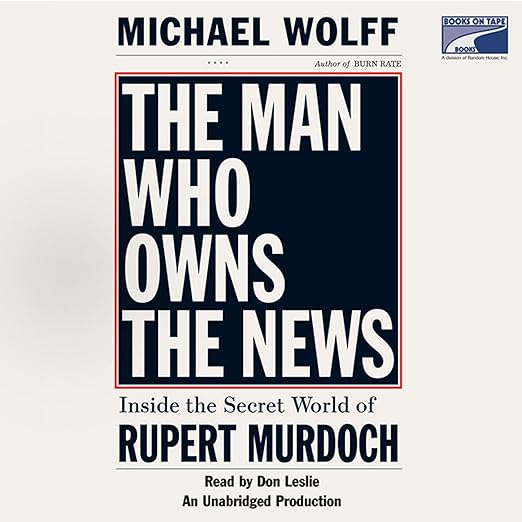
Rupert Murdoch has spent decades simultaneously making news and owning the outlets that report it, and Michael Wolff's audiobook about him is shaped by that paradox from the first chapter. Wolff had unprecedented access, meaning he spent considerable time with Murdoch himself and with his family and associates, and the resulting portrait reads differently depending on what you come to it expecting. If you want a comprehensive, neutrally rendered account of Murdoch's life and business decisions, you will find it imperfect. If you want to understand how someone builds and exercises a particular kind of media power over several decades, you will find The Man Who Owns the News genuinely indispensable.
Don Leslie narrates with the polished ease that Wolff's prose requires. The Vanity Fair columnist register, chatty, confident, occasionally name-heavy in a way that assumes the reader is also in the room, is something Leslie renders without making it feel performatively insider. At fifteen hours and forty minutes, the audiobook is a substantial commitment, and Leslie's consistency across material that shifts between intimate family drama, dealmaking narrative, and organizational history keeps the long form listenable without losing the thread of Wolff's argument about who Murdoch actually is.
Surpassing Shawcross's Seminal Biography, in Access
The most substantive reviewer in the pool describes Wolff's treatment as the best book on Murdoch among a competitive field, surpassing even William Shawcross's seminal biography in terms of access and intimacy. That is a significant claim, and it reflects something real about what Wolff accomplishes when the book is working at full strength: the family dynamics he documents, from internal succession battles to the reconciliations that only seemed to consolidate Murdoch's position, carry genuine narrative momentum. The Dow Jones takeover, used as a structural through-line for the broader Murdoch history, gives the audiobook spine even if some listeners found that particular deal insufficiently dramatic as an anchor point for fifteen hours of biography.
A dissenting reviewer described the book as meandering and gossipy, using the Dow Jones deal as a narrative device that cannot justify the weight placed on it. That criticism is not entirely without merit. Wolff's prose style is distinctive enough that it will either feel like the voice of an insider finally delivering a frank account or like a columnist who enjoys his own company somewhat too much for the reader's comfort. Leslie's narration threads this needle reasonably well, giving the opinionated passages their due register without amplifying Wolff's self-regard beyond what the text already contains.
Leslie Keeps Family Material From Turning Gossipy
The portraits of individual Murdoch ventures are where the audiobook delivers its most durable value. The New York Post, Fox News, and the Wall Street Journal acquisition are each given substantive treatment, and Wolff's access allows him to render the internal logic of each decision in ways that less connected journalists could not. The Fox News material in particular is rendered with enough historical specificity to function as essential background for anyone trying to understand how that network came to occupy its current position in American media and political discourse.
The family dimension gives the audiobook an energy that a purely organizational biography would lack. Murdoch's children, their varying relationships to the business and to their father, and the succession question that haunts the latter portion of the book are rendered with the kind of detail that suggests Wolff understood the emotional dynamics at play rather than simply reporting them from the outside. These sections are among the audiobook's strongest, and Leslie handles the family material with enough tonal sensitivity to prevent it from sliding into celebrity gossip territory.
Historically Valuable, Short on the Most Recent Chapters
Wolff's perspective on Murdoch is not neutral, and the audiobook does not pretend otherwise. He finds his subject both compelling and troubling, and that ambivalence produces passages that are sharp and genuinely revelatory alongside sections where the prose gets lost in its own cleverness. The structural decisions around the Dow Jones deal as through-line do not always serve clarity, and the chronological movement through Murdoch's career history is harder to follow in some sections than it needs to be. Leslie's narration cannot fully compensate for organizational choices that work better in print than in audio.
Listeners who are new to the Murdoch story should note that the audiobook was published before several significant subsequent developments in the News Corp narrative, so some of what Wolff treats as uncertain has since resolved in ways he could not anticipate. The portrait is historically valuable but not comprehensive through the present, and readers following current Murdoch family dynamics will want supplementary sources for the most recent chapters.
An Ambivalent Verdict on a Media Titan
Listeners with a strong interest in media history and the mechanics of press power will get the most from this audiobook, particularly those curious about how acquisition strategy and editorial philosophy interact at Murdoch's scale. Those who found the family dynamics of Succession compelling as cultural commentary will find the real-world equivalent uncomfortably recognizable in Wolff's portrait. Listeners who need their biography strictly chronological and their prose restrained will find Wolff's style a consistent source of friction. The gossip that at least one reader came specifically seeking is abundant, so those who want the inside texture of the Murdoch operation rather than a policy critique will be generously served. This is a book that arrives at an ambivalent verdict on its subject, which is either a journalistic virtue or a frustrating refusal to commit depending on what you expect from the biography form.
At a Glance
- Narrator: Don Leslie suits the chatty, inside-baseball tone of Wolff's prose, delivering the book's considerable gossip with the confidence of someone who actually has the receipts.
- Subjects: Media power and its consolidation, dynastic succession and legacy anxiety, the blurred line between news ownership and political influence
- Tone: Compulsively listenable but occasionally indulgent, like an extended magazine profile stretched to fifteen hours
- Bottom line: Michael Wolff's Murdoch biography is vivid, uneven, and almost certainly the most entertaining account of how one man reshaped the English-language media landscape by buying it.
A Few Questions About The Man Who Owns the News
Is The Man Who Owns the News audiobook sympathetic to Murdoch or sharply critical of him?
Neither cleanly. Wolff maintains an ambivalent stance throughout, finding Murdoch both fascinating and troubling. The book is not a takedown, and it is not hagiography. Wolff's unprecedented access produced intimate material, but his authorial perspective is evident in the framing of virtually every scene.
Does this audiobook cover the full scope of Murdoch's media holdings or focus on specific acquisitions?
Wolff uses the Wall Street Journal acquisition as a narrative spine while ranging across News Corp's major properties, including the New York Post, Fox News, and international operations. The coverage is selective rather than encyclopedic, organized around narrative interest and the access Wolff obtained rather than a comprehensive audit of holdings.
At fifteen hours, does the audiobook sustain its energy throughout or are there sections that drag?
Reviewers are divided. Some find the access-driven intimacy compelling across the full runtime. Others note that the Dow Jones deal used as structural anchor is less inherently gripping than the family dynamics or the Fox News material. The prose style is consistent, meaning its virtues and its indulgences both persist across the full fifteen hours.
How does this audiobook compare to other Murdoch biographies for listeners who want the definitive account?
At least one reader who had worked through multiple Murdoch biographies, including Shawcross's widely cited earlier account, ranked Wolff's treatment highest for access and intimacy. The tradeoff is that Wolff's style is more personal and opinionated than standard biography, which some readers find liberating and others find limiting as a mode of historical assessment.