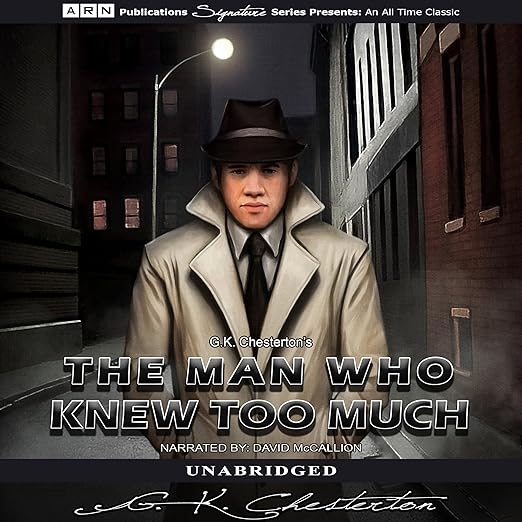
Somewhere between this listing's byline and its description, two completely different books have been welded into one page, and anyone buying the audiobook should know which half they are getting. The byline reads David Leavitt and the shelving files the title under computing, science and engineering, and LGBTQ+ history. The description, the publisher and every single written response describe something else entirely: G.K. Chesterton's 1922 collection of eight mystery stories built around Horne Fisher.
McCallion's Single Voice, Eight Resetting Casts
Take the evidence at face value and the Chesterton side wins on volume. Five signed responses discuss Fisher, Harold March, and the corrupt political world the stories move through; none mentions computing, engineering or a biographical subject. A.R.N. Publications issued this in April 2016, which fits a public-domain reissue far better than it fits a contemporary work of science history. Buyers wanting the Leavitt title should look elsewhere. Buyers wanting Chesterton are almost certainly in the right place.
What Chesterton is doing in these eight stories is stranger than the detective label suggests. Fisher solves the crimes and then declines to act, because acting would bring down people the state cannot afford to lose, and the title refers to exactly that predicament: a man who knows everything and can reveal none of it. The July 2017 response captures the appeal well, praising a writer who was insightful and reflective without ever turning pedantic.
David McCallion takes the A.R.N. Publications edition, five hours and thirty-nine minutes, which spreads the eight stories at a shade over forty minutes each. That is a useful shape for a commuter-length listen and a demanding one for a single voice, since each story resets the cast except for Fisher and March. This is an independent-label production of a text out of copyright, not a studio reissue with a full cast.
Opening With a Dead Man in the Park
Chesterton's puzzles are the draw, and the pleasure they deliver is unusual for the period. A February 2026 entry calls the collection a gem carrying much of what makes the Father Brown stories work, then quotes a line about the past being a foreign country where things are done a little differently. That is the register: mysteries that keep pausing to say something sharp about how power actually behaves, before returning to the body in the park.
Opening with The Face in the Target sets the pattern cleanly. Fisher and two companions find a dead man in a park, the dead man turns out to be a political figure, and Fisher works out immediately that solving the case publicly would damage the city more than the murder did. Every story afterward tests a variation on that trade, and the accumulation is what makes the collection feel like an argument rather than an anthology.
March is the other reason the book holds together. A political journalist who never stops being astonished by Fisher's deductions, March gives the reader somewhere to stand, and the friendship between the two supplies the warmth the plots withhold. By the closing story, when Fisher walks into what is framed as a moment of destiny, the question is not whether the crime gets solved but whether a man who has spent seven stories staying silent can finally do something about it.
Two Votes That Cannot Reach 3.9
Before anything else, the numbers. The page posts a 3.9 average over exactly two ratings, and two votes can only produce whole and half values, so 3.9 is a figure that grid cannot reach. Meanwhile five written responses sit right below it, grading five, four, three, five and four for an average of 4.2. The counter is reporting fewer votes than the page displays opinions, and the value it reports is unreachable either way.
Dates are the second problem. Its written pool starts roughly two and a half years before this 2016 audio edition existed, which means text grades and audio grades have been merged under a single figure, and three of the five explicitly call the book a read. Whatever those stars measure, it is Chesterton's prose in some edition or other rather than this particular package.
Chesterton's stories carry a real caveat, and the three-star response names it best: this is realistic, so the good guys do not win and the bad guys do not lose. Fisher's refusals accumulate into something close to political despair, and listeners arriving for tidy period-mystery resolutions will find the endings deliberately withheld. That same response frames the collection as part mystery and part commentary on the corruption of the English government of Chesterton's day.
Wrong Page for Computing History Seekers
Classic detective-fiction readers who already know Father Brown are the core audience, and they will recognize the machinery instantly while noticing how much darker the politics run. Listeners who enjoy the Holmes-and-Watson shape will find Fisher and March mapped onto it almost exactly, with the crucial difference that this detective's solutions are unpublishable. Anyone interested in early twentieth-century political satire gets a good deal more than the mystery packaging implies.
Going in cold is a defensible strategy. An October 2013 response, filed at four stars, recommends exactly that, having started with no idea what the book was about and found it more refreshing and original for the ignorance. At five hours and thirty-nine minutes, the collection is short enough to gamble on, and the episodic structure means an unsatisfying story is over in forty minutes rather than sinking the whole.
Buyers hunting the computing history behind the byline should stop here and search under the author's name instead, because the product on this page is not that book. Give it a miss if you want your mysteries resolved and your villains punished, since the entire collection is engineered to deny both. Grab it for intelligent, bleak, funny short crime fiction from a writer who thought the corruption mattered more than the corpse.
Common Questions
Why does this audiobook listing name David Leavitt when the description is about G.K. Chesterton?
Two records appear to have merged. The byline and the computing, science and LGBTQ+ history shelving belong to a different title carrying the same name, while the description, publisher and every written response describe Chesterton's 1922 mystery collection. Verify the edition before buying if you specifically want the Leavitt book.
Is the 5 hour 39 minute audiobook enough for eight full mystery stories?
It works out to roughly forty minutes each, which suits Chesterton's compressed method. These are not novellas; every one sets up a death, a small cast and a reversal, then stops. The brevity makes the collection easy to sample, though it does feed the abruptness that some listeners find frustrating.