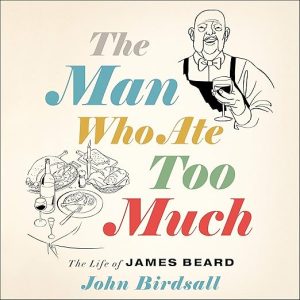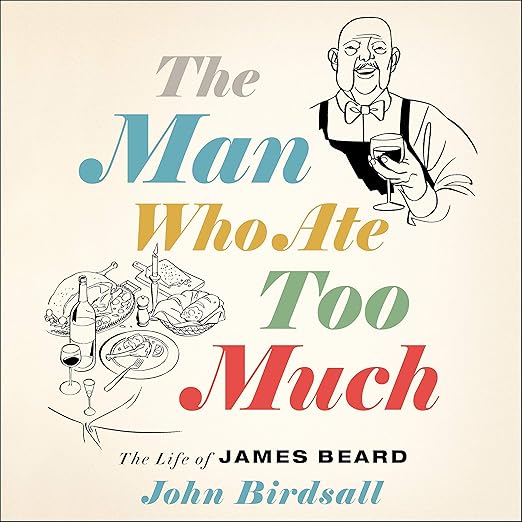
John Birdsall's The Man Who Ate Too Much is the biography James Beard has needed for decades, and the audiobook makes that evident within its first few chapters. The existing accounts of Beard's life treated his queerness as background noise in the story of the man who invented American cuisine. Birdsall, writing with the resources of newly surfaced correspondence and years of archival work, makes the argument that you cannot understand what Beard built without understanding what he concealed, and he makes it with a clarity and emotional precision that the subject deserves. This recording runs to nearly fifteen hours, and it earns them through the quality of the biographical argument rather than through sprawl.
Beard's achievement was genuinely strange for his moment. In an era when fine dining meant French restaurants and continental pretension, he insisted that American ingredients prepared simply and well constituted a legitimate cuisine, arguably a better one. That argument sounds obvious now because Beard won it. But the audiobook restores the strangeness of the original position: Beard was selling something the food establishment did not want and an American public that did not yet have the vocabulary to fully value. He was also doing this while managing a private life that, had it been public, would have ended his career on contact. The tension between those two realities is what makes Birdsall's account feel like biography rather than tribute.
What Birdsall accomplishes that prior tellings have not is giving Beard's queer life texture and consequence rather than mere acknowledgment. The correspondence Birdsall draws from reveals someone navigating constant contradiction: a man who turned an unapologetic pursuit of pleasure into a professional identity but who could not live openly in the area of his life where pleasure was most personal. One reviewer specifically noted that Birdsall does not shrink from revealing Beard's tendency to take credit for others' contributions, and that honesty gives the portrait its weight. The book is a serious biographical argument, not a celebration.
The food history is embedded in the life rather than parallel to it, which is the right structural choice. Birdsall traces how Beard's personality and appetites shaped the kind of food authority he became, and how the culture of American cooking in the twentieth century created conditions both for his success and for his compromises. One reviewer described this as simultaneously a foodie book and a history chronicle, with Beard's culinary talent and his place in gay history woven together in a way that is genuinely unique in the literature on either subject. That assessment is accurate, and it understates the ambition of what Birdsall has attempted and largely achieved.
Henning's Measured Gravity for a Long Biography
Daniel Henning's narration is well-suited to Birdsall's prose style. The book's early chapters are self-consciously literary and somewhat verbose, a tendency one reviewer noted before describing how the prose loosens into something more natural as the biography finds its footing. Henning navigates that early section without overselling it, and as the writing relaxes, his reading gains its own confidence. By the middle sections, when Birdsall has established both the historical context and the emotional register he is working in, the listening experience becomes genuinely absorbing. Henning's voice has the kind of measured gravity that a long biographical account requires, and he does not perform the emotion that Birdsall's prose is already carrying.
The audiobook's length is appropriate for its scope. Birdsall is covering Beard's entire life, the cultural history of American food in the twentieth century, and the social history of queer life in America during a period when openness was not a viable option. None of those threads can be rushed without losing the texture that makes the account meaningful. At nearly fifteen hours, the book does not feel padded but proportionate to what it is doing.
Generous and Difficult in Equal Measure
The early chapters are the test. Birdsall's opening register is self-consciously literary in a way that the subject has not yet earned on the page, and listeners who find that early prose difficult should know the book finds itself and becomes considerably richer as Beard's career develops. Patience with those first hours is rewarded with something that operates at a level most biographical recordings never reach.
This is also a book that does not protect its subject from complexity. Beard was generous and difficult, prone to taking credit for ideas that were sometimes other people's, and consistent in his pleasures even when consistency cost him professionally and personally. Listeners who want their biographical subjects as straightforward heroes will find the portrait uncomfortable, and usefully so.
The food history is also genuinely surprising on a scene-by-scene level. Birdsall is writing about a man who helped invent the idea that American cooking was worth taking seriously, and he traces that argument through specific episodes: Beard's early career as an actor and caterer, his wartime work that expanded his reach, his position as the first celebrity food personality in the modern sense. Each of these episodes connects to the larger argument about what Beard was building and what he was concealing simultaneously. The archival work is present in the texture of the narrative rather than in footnotes, and it gives the audiobook a density of detail that justifies its length.
Earned Its Ending After Fifteen Hours
This audiobook is for listeners who care about American cultural history and want a biography that takes both the food world and the queer experience of twentieth-century America seriously as interwoven historical subjects. It is also for anyone who has spent time in professional kitchens, food media, or book publishing and wants to understand the figure who did more than anyone to shape what American food writing became. Listeners who prefer linear narrative without literary ambition may find the early chapters a test of patience. Everyone who commits to the full fifteen hours will find the book has earned its ending and its reputation.
Questions Listeners Ask
Is the audiobook of The Man Who Ate Too Much accessible to listeners who are not already familiar with James Beard?
Yes, Birdsall builds Beard's life and context from the beginning, so no prior knowledge of his work or reputation is required. The audiobook also functions as a history of American food culture in the twentieth century, giving unfamiliar listeners rich context throughout.
Does this audiobook cover Beard's queerness as a central theme or as background context?
It is central. Birdsall's core argument is that you cannot understand what Beard built without understanding what he concealed, and he draws on previously overlooked correspondence to give Beard's private life texture and consequence throughout the entire biography.
At nearly 15 hours, is the length of The Man Who Ate Too Much audiobook justified by the content?
Yes, Birdsall is covering Beard's full life, the cultural history of American food, and the social history of queer life in mid-century America simultaneously. Reviewers who noted the slow start generally describe the middle and final sections as fully worth the investment in time.