Quick Take
- Narration: Christopher Romance reads Patterson’s 1907 account with a period-appropriate formality that serves the text, this is a Victorian soldier writing about extraordinary events in dry, matter-of-fact prose, and Romance does not oversell the drama.
- Themes: Colonial engineering under extreme pressure, man-animal conflict, Victorian stoicism as a survival mechanism
- Mood: Gripping in a period-specific register, the understatement makes the danger more vivid, not less
- Verdict: The original source for one of history’s most famous animal attacks is still the most compelling version of the story, Patterson’s firsthand account of the Tsavo lions is as strange and unsettling as anything a novelist could invent.
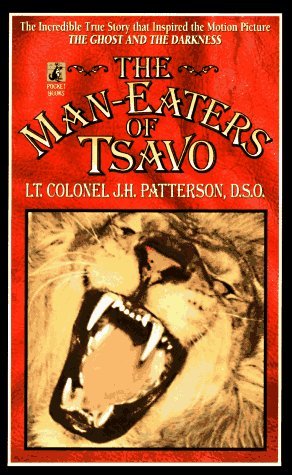
Most people who know the Tsavo lion story know it through The Ghost and the Darkness, the 1996 Val Kilmer film that dramatized Lt. Col. John Henry Patterson’s 1907 account of two maneless lions that killed and ate an undetermined number of workers during the construction of the Uganda Railway in 1898. Several reviewers mention the film as their entry point, and it is a reasonable one. But Patterson’s actual book, which the film was based on, is a stranger and more satisfying object than the movie suggests, partly because Patterson himself is such a peculiarly Victorian figure: a man who seems genuinely incapable of communicating how frightened he must have been.
There is no synopsis attached to this Audible edition, so a brief summary is warranted for listeners arriving cold. What Patterson wrote was a combination of field diary and popular memoir, published in 1907 when he was already famous for having hunted both lions and wanted to document exactly what had happened before memory distorted it further. The book covers not just the famous lion hunt itself but the months-long siege that preceded it, during which the two lions were killing workers from a large railway construction camp near the Tsavo River in what is now Kenya, entering tents at night and dragging men away into the darkness.
Patterson’s Maddening Understatement
The quality that makes this book genuinely haunting, and that reviewers consistently identify, even when they can’t quite name it, is Patterson’s refusal to dramatize. He is a British military officer writing in the conventions of his class and period, and those conventions required a stoic, matter-of-fact tone toward danger that reads, a century later, as almost surreal. He describes setting elaborate traps that fail, nights spent in improvised shooting platforms while the lions circled below, workers fleeing the camp en masse, all in the same register he might use to describe an administrative problem with the railroad’s water supply.
Christopher Romance’s narration captures this precisely. He reads with a dry authority that mirrors Patterson’s own prose voice, letting the horror accumulate through the weight of accumulated fact rather than through theatrical signaling. One reviewer noted this book should be required reading for engineers, and there is something to that. Patterson was primarily on the Tsavo River to oversee bridge construction, and his parallel account of keeping the railroad project moving while simultaneously hunting two cats that were disrupting his entire labor force produces an almost absurdist portrait of colonial project management under extraordinary circumstances.
The Field Museum and the Actual Lions
For those who have seen the Tsavo lions themselves, Patterson eventually sold the skins to the Field Museum in Chicago, where they were mounted and are still on display, listening to his account of the hunt while holding that image in mind produces a specific kind of doubling that is hard to achieve any other way. The skins are famously smaller than legend suggests and smaller than the movie portrays, which is itself an argument for the irreplaceable quality of primary sources over dramatized adaptations. The lions on display are both more ordinary and more disturbing than The Ghost and the Darkness’s version, and Patterson’s prose produces the same effect.
The ‘Other East African Adventures’ and What They Add
The second half, covering Patterson’s subsequent game hunting in East Africa, including rhino, elephant, and hippopotamus, is less dramatically gripping than the lion narrative but functions as a valuable time-capsule document of East African wildlife at the turn of the twentieth century. The game was still present in an abundance that is now impossible; Patterson’s descriptions of what he encountered and how he moved through the landscape capture a vanished world. One reviewer noted some uneven firearms advice in this section, Patterson was courageous to excess and that sometimes produced tactical suggestions that experienced hunters would question. This is part of the book’s character rather than a defect.
Who Should Listen / Who Should Skip
Listeners who saw The Ghost and the Darkness and want the actual source will find Patterson’s account both confirming and deepening their understanding of events the film inevitably simplified. Readers of Victorian natural history and adventure writing will find this squarely in a tradition they already know how to navigate. Listeners who need fast pacing and contemporary prose conventions may find the period register requiring adjustment. At six hours, the commitment is modest; the material fully justifies it.
Frequently Asked Questions
How does Patterson’s original account compare to the 1996 film The Ghost and the Darkness in terms of accuracy?
The film took significant liberties, most notably adding a fictional second hunter played by Michael Douglas who does not exist in Patterson’s account, Patterson hunted both lions alone. The film’s depiction of the camp’s terror and the ineffectiveness of the early traps is reasonably faithful to the written account, though compressed and heightened for cinematic purposes.
How many workers did the Tsavo lions actually kill, and does Patterson address this question directly?
Patterson estimated 135 killed. Modern analysis of the lions’ skulls, including isotope studies of bone material, suggests a lower figure, possibly around 35 workers, though the methodology of those estimates is itself debated. Patterson’s figure represents his own assessment based on his time on-site; the book does not hedge it.
Is the ‘Other East African Adventures’ section worth listening to, or is the Tsavo lion narrative the only essential part?
The second half is genuinely interesting as a period document of East African wildlife at the turn of the twentieth century, though it lacks the concentrated drama of the lion story. Listeners primarily interested in the Tsavo events can treat the second half as supplementary context. At six hours total, neither section is long enough to comfortably skip.
This is a public domain text, are there multiple audiobook recordings, and how does this Christopher Romance edition compare?
Multiple recordings of Patterson’s 1907 text exist as it has long been in the public domain. Production quality varies significantly across editions. The 4.4 stars across 246 ratings for this Audible edition suggests it maintains reasonable quality standards relative to the available alternatives.