At a Glance
- Narrator: Joe Barrett delivers Johnston's reporting in an even, unhurried register that lets the documented facts carry the weight rather than performing outrage.
- Subjects: Media savvy and self-promotion, the family origins of a business empire, patterns that recur across a long public career
- Tone: Brisk, documented, and quietly critical
- Bottom line: A tightly reported early biography, strongest for listeners who want Trump's pre-presidency history from a Pulitzer winning investigative journalist.
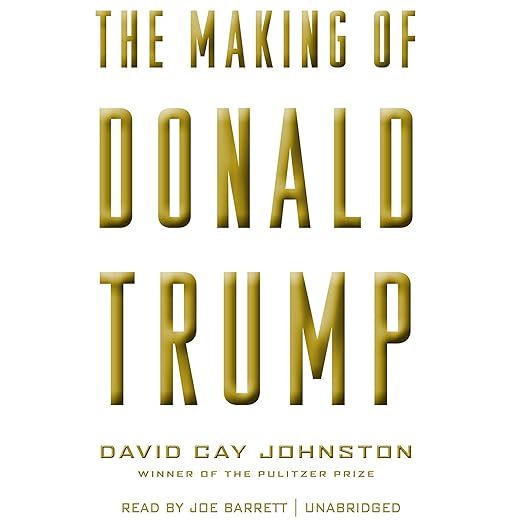
Queens, New York shaped Donald Trump long before Manhattan skyscrapers did, and David Cay Johnston spends nearly thirty years of accumulated reporting proving it across this audiobook's five hours and forty-seven minutes. Johnston, a Pulitzer Prize winning investigative reporter, has covered Trump longer and closer than almost any other journalist working today, and that access shows in the specificity of the detail here, court documents, financial records, decades of interviews, rather than in secondhand anecdote or partisan color commentary.
I listened to this one in a single extended sitting, curious whether a book this compact could actually deliver on a claim that large. It mostly does, though the compression has real consequences worth knowing about going in.
Woody Guthrie Once Wrote a Scathing Song
The book traces a clear arc: a childhood in a quiet section of Queens, the family real estate fortune built by his father Fred, Trump's own education and early career, and the growth of a business empire that Johnston repeatedly describes as too big to fail. Johnston also works in genuinely surprising historical color, Woody Guthrie once wrote a scathing song about Fred Trump, and Red Scare prosecutor Roy Cohn shows up as a formative mentor figure, both details that place Trump inside a longer American story rather than treating him as a sudden phenomenon.
What comes through most clearly is Johnston's reporter's instinct for pattern. He is less interested in any single controversy than in showing how the same moves, aggressive media management, legal brinkmanship, financial risk-taking, recur across decades of Trump's career well before his political life began. Reviewer Peter's take, that the book raises real questions about how well the broader press had covered Trump before this, captures the book's actual argument better than any summary of individual anecdotes could.
Structured So the Risk Would Land on Lenders
Johnston's own credentials matter here. He won the Pulitzer Prize for Beat Reporting in 2001 for his coverage of tax policy and inequality, a specialty that shows up directly in how this book handles Trump's finances, closer to a forensic accountant's patience than a campaign reporter's quick turnaround. Reviewer D. J. Vaniskhian singles out the family background chapters specifically, the early upbringing and the values that shaped him, as some of the book's most informative stretches, more revealing than the later, more familiar controversies.
Roy Cohn's presence in the book deserves a little more context than the synopsis alone provides. Cohn first made his name as chief counsel to Senator Joseph McCarthy during the Red Scare hearings of the 1950s, then spent his later career as a combative New York lawyer before becoming one of young Trump's most influential mentors. Johnston uses that lineage to argue that Trump's combative media strategy and legal brinkmanship were learned, not improvised, a genuinely useful piece of historical grounding.
The 'too big to fail' framing Johnston applies to Trump's business empire is doing real analytical work rather than functioning as a throwaway phrase; he traces specific decisions, leveraged debt, aggressive licensing deals, repeated bankruptcies of individual properties that never touched Trump's personal fortune, to build the case that risk in his empire was always structured to land on lenders and partners rather than on him personally.
Barrett's Restraint Lets the Reporting Carry Weight
Joe Barrett narrates with an even, unhurried delivery that suits investigative nonfiction well; he does not inject audible outrage or admiration into Johnston's prose, which lets the reporting carry its own weight rather than performing a verdict for the listener. For a book built on documents and interviews rather than dramatic scenes, that restraint is the right choice.
Reviewer Candace Williams wrote her review during the first chaotic week of Trump's presidency, noting that the book's account of his lifelong pattern of knee jerk reactions and controlled chaos already explained what she was watching unfold in real time. That kind of predictive power is a genuine credit to Johnston's decades of close observation, and it holds up as a listening experience even removed from that specific moment.
A Decoder Ring for Events Still Unfolding
Five hours and forty-seven minutes is compact for a project built on nearly thirty years of reporting, and it shows. This is a tight, journalistic overview rather than an exhaustive, door-stopper biography, closer in scope to a long magazine investigation than to a multi-volume project. Listeners wanting granular detail on every business deal or lawsuit will find the pace brisk rather than comprehensive.
This is also an early biography by design. It was written and published around Trump's first presidential run and inauguration, so it does not cover his full first term, his years out of office, or his return to the presidency. Anyone wanting his more recent history will need a different, newer book alongside this one.
Reviewer Candace Williams's five star review is worth reading in full for how specifically it is dated: written during the first week of a presidential term, it treats the book less as history and more as a decoder ring for events still actively unfolding. That immediacy was part of its original appeal, and it is worth remembering the book was never positioned as the final word, only as the most thoroughly reported word available at the time.
Reviewer Peter's take is worth sitting with specifically: his real complaint is less about Trump than about the press that covered him for decades without producing reporting this thorough. That framing positions Johnston's decades of access as filling a gap other outlets left open, which is a useful lens for understanding why this particular book carries more weight than a typical campaign-season biography.
One Well-Reported Voice Among Several Others
This suits listeners interested in Trump's pre-presidency business and personal history from a credentialed investigative angle, readers of Johnston's earlier Trump reporting, and anyone who wants documented pattern recognition over either hagiography or outrage.
Skip it if you are looking for coverage of anything after his first inauguration, since the book's scope simply ends before that history happens. And skip it if you want a sympathetic account; Johnston's decades of reporting produce a critical portrait, clearly sourced but unmistakably skeptical throughout.
Listeners pairing this with other Trump-era journalism will get the most out of it, since Johnston's book works best as one well-reported voice among several rather than the single, final account of a still-unfolding public figure.