Quick Take
- Narration: Sumit Kaul reads with a measured, clear tone suited to the journal-entry format – though the episodic, non-linear structure can make sustained listening feel more like auditing notes than following a narrative.
- Themes: Bear market psychology, behavioral biases in investing, long-term value principles
- Mood: Reflective and earnest, written from inside uncertainty rather than looking back with hindsight
- Verdict: A niche book that rewards listeners already invested in value investing frameworks and Baid’s particular journey through the Indian bear market – divisive among general investors for its format and regional specificity.
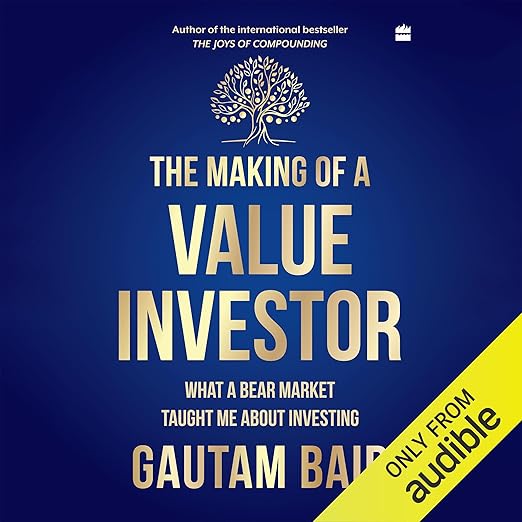
There is a specific kind of financial book that I find more useful than any other: the one written from inside the difficulty, not after it. Anyone can write a post-game analysis of a market downturn. The harder thing is to capture what it felt like to navigate one in real time, making decisions with incomplete information and the full weight of uncertainty pressing down. Gautam Baid’s Making of a Value Investor attempts exactly that, and how well it works for you will depend almost entirely on how you feel about reading someone else’s journal entries.
The book is drawn from Baid’s investment journal kept during a brutal Indian bear market – roughly the 2018 to 2020 period. The journal entries are presented chronologically, with Baid adding retrospective commentary to connect his in-the-moment thinking to what he eventually learned. The result is something genuinely unusual in the investing space: a document of process rather than outcome, showing the emotional swings, the course corrections, and the sustained application of value principles under conditions where those principles are most difficult to maintain.
Our Take on The Making of a Value Investor
The book’s thesis is that investment education happens through experience and reflection, not through theory in isolation. Baid is drawing on Buffett, Munger, and the broader value investing tradition, but he is applying those frameworks to his own specific position in a specific market during a specific period of extreme volatility. The time-travel storytelling structure, as he calls it, is meant to let listeners experience the learning as it happened rather than receiving it as distilled wisdom after the fact.
Reviewer Sarveshwaran, who came to the book as a newer investor, found the day-by-day emotional swings and course corrections vividly explained, and useful precisely because of that specificity. Reviewer Arun Verma, also from India, praised the storytelling and the chronological structure as a treasure trove of investment principles. These responses reflect the intended audience for the book: investors who are already within the value investing tradition and who want the psychological and behavioral texture of the journey rather than a clean framework delivered from a position of certainty.
Why Listen to The Making of a Value Investor
Sumit Kaul’s narration is well-matched to the material. He reads with a measured, clear delivery that suits the journal format – this is not a book that calls for theatrical performance, and Kaul’s restraint is appropriate. The material itself is text-first in the way that investing books tend to be, and Kaul keeps the focus on the content rather than imposing a reading personality that would compete with Baid’s voice.
The addition of retrospective commentary alongside the original journal entries gives the book a structural sophistication that straight journal publication would lack. Baid is effectively in dialogue with his past self, which creates a kind of time-layered perspective on the same market events. For listeners who are working through similar market conditions, having access to both the real-time uncertainty and the later understanding creates a more useful map than either alone would provide.
What to Watch For in The Making of a Value Investor
The reviews are unusually polarized, and the reasons are specific enough to be actionable. The strongest criticisms center on two features: the format and the regional focus. Reviewer Frank, who highly praised Baid’s prior book The Joys of Compounding, could not get past the initial section of this one, citing the lack of structure and flow in the journal-entry format. Reviewer Pat called it the biggest waste of time and money, characterizing the journal entries as relevant only to Baid personally. The review from Jacob raised a pointed question about prioritization: why release this as an audiobook when The Joys of Compounding, apparently the stronger work, is not available in audio format?
These are not trivial criticisms. The Indian stock market context is specific, and listeners without familiarity with that market’s structure and history will find some of the period detail less meaningful than intended. The journal format is also genuinely uncommon for a financial audiobook, and those who need conventional chapter structure and synthesized takeaways will be frustrated. Baid is not delivering a framework you can apply immediately. He is documenting how a framework developed under duress, which is a different proposition.
Who Should Listen to The Making of a Value Investor
This is a book for investors who already operate within the value investing tradition and who are specifically interested in the behavioral and psychological dimensions of applying those principles during a bear market. If you have read Baid’s Joys of Compounding and want more of his thinking in a less polished but more immediate form, this delivers that. If you are new to investing, or if you need conventional structure and synthesized advice, this is the wrong starting point. And if you are someone for whom the Indian market context is unfamiliar, you should go in knowing that some of the specificity will function more as atmosphere than as directly applicable data. The book is honest about what it is. The question is whether what it is matches what you need.
Frequently Asked Questions
Is it necessary to have read Gautam Baid’s previous book, The Joys of Compounding, before listening to this one?
It is not strictly necessary, but several reviewers who had read both suggest that The Joys of Compounding is the stronger, more conventionally structured work. Starting there gives you a clearer picture of Baid’s investment philosophy before this book drops you into the less organized journal format. If you find The Joys of Compounding compelling, this makes sense as a follow-up. If you haven’t read it, know that it may serve you better as an introduction to Baid’s thinking.
How does the retrospective commentary work structurally – is it separated from the journal entries or integrated throughout?
The retrospective commentary is integrated throughout the book rather than separated into a distinct section. Baid layers his current understanding over the original entries, creating a kind of dialogue between his past thinking and what he later learned. This structure can feel rich or disorganized depending on the listener’s tolerance for non-linear investment storytelling.
How specific is the Indian bear market context – will it be useful if I invest primarily in US or other markets?
The behavioral and psychological principles Baid draws on are broadly applicable to any value investor in any market. The specific stock names, regulatory context, and market events are particular to India, and listeners unfamiliar with that market will find those details less immediately meaningful. The book’s value for international investors lies in the universal behavioral dynamics it documents rather than in market-specific analysis.
Sumit Kaul narrates the book – does his delivery keep the journal-entry format engaging over eight hours?
Kaul’s delivery is clean and measured, which helps maintain clarity in a format that risks becoming monotonous. The episodic, non-linear structure of the journal entries means the listening experience is more fragmented than a conventional investing book. Kaul doesn’t impose artificial drama, which is the right call, but listeners who need pace variation and narrative momentum will find extended sessions more demanding than the runtime suggests.