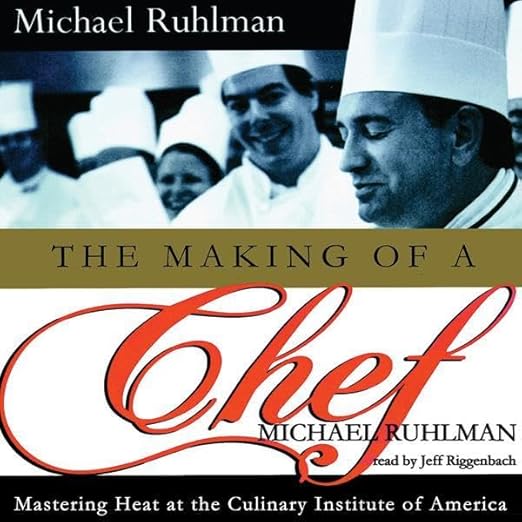
Culinary education rarely gets examined from the inside with the rigor that Michael Ruhlman brought to the Culinary Institute of America. The Making of a Chef audiobook, narrated by Jeff Riggenbach, is the product of Ruhlman's decision to don the chef's jacket and houndstooth-check pants and attend Skills One at the CIA in Hyde Park, New York, not as an observer but as a student. Twelve hours of audio. Twelve hours of knife skills, stock reduction, the correct way to hold a spatula, and what happens to a journalist's ego when it meets classical French technique for the first time.
The CIA, in Ruhlman's framing, is not primarily a cooking school. It is an institution with a philosophy: that cooking is a craft requiring discipline, repetition, and the kind of precision that cannot be faked or talked around. Ruhlman arrives as a writer accustomed to his own authority and leaves having understood, as he puts it, that the skills were real and the knowledge was hard-won. That arc, the intellectual humbling of someone who came to document and ended up transformed, is what elevates this audiobook above a straightforward institutional profile.
Ruhlman's greatest structural decision was to make his own learning the narrative spine. This is not a tour of the CIA with occasional human-interest vignettes. It is a progressive account of what it means to move from knowing what good food tastes like to understanding why it tastes that way and what physical and procedural knowledge produces it. The early chapters on stocks and mother sauces are fascinating because Ruhlman is genuinely a student of them, making mistakes and receiving corrections, and his descriptions of specific failures, the stock that lacks body, the sauce that breaks, the vegetable that is cut unevenly, carry the immediacy of someone who has just burned their hands.
Jeff Riggenbach is a good choice for this material. His voice has the slightly detached quality of a journalist narrating his own experience rather than dramatizing it, which suits Ruhlman's prose style precisely. Ruhlman writes with clarity and physicality rather than with the heightened language of food writing at its most self-indulgent. Riggenbach matches that register, giving the technical passages their due weight without letting them become lectures, and moving through the human sections, the friendships formed in the kitchen, the instructors who seem terrifying and then reveal complexity, with appropriate warmth.
Riggenbach's Delivery Peaks at American Bounty
The audiobook is a document of a specific institution at a specific moment. The CIA that Ruhlman describes is the CIA of the mid-1990s, when Escoffier's legacy still dominated the curriculum and the culinary world was in the middle of a transformation that the school was beginning to grapple with. Listeners who know the contemporary culinary landscape, where farm-to-table, fermentation, and a dozen other movements have reshaped what professional cooking means, will find historical interest in seeing the institution before those changes fully arrived. One reviewer with a son currently enrolled noted that Ruhlman's descriptions still ring true, which suggests the core institutional culture has remained more constant than the broader culinary world.
The sections dealing with the American Bounty Restaurant, the CIA's final kitchen where students complete their training by cooking for real paying diners, represent the emotional climax of the audiobook. Ruhlman's account of what it means to take your learning into a live service context, where the stakes are real and the safety net of the classroom is gone, is gripping in a way that food writing rarely achieves. Riggenbach's delivery of these chapters is among the strongest in the audiobook, matching the elevated stakes with slightly increased intensity without overdoing it.
For listeners who have themselves attended culinary school or professional cooking programs, the recognition factor is considerable. Several reviewers who brought prior institutional knowledge to this audiobook noted the accuracy of Ruhlman's observations about instructor dynamics, the specific culture of kitchen hierarchy, and the psychological pressures of a curriculum designed to push students past their comfort levels. This kind of insider validation is not universal in culinary memoirs, and it speaks to the quality of Ruhlman's immersive reporting.
Twelve Hours That Reflect the Depth of Reporting
Listeners who approach this audiobook expecting a celebratory portrait of the CIA should know that Ruhlman is a journalist first and does not suspend critical judgment simply because he is embedded in his subject. He is honest about the tensions within the institution, including debates about what culinary education should be preparing students for, and his account of certain instructors includes both admiration and reservation. This is one of the audiobook's strengths, but readers who are passionate CIA advocates may find some passages more critical than they expected.
The audiobook is also twelve hours long, which reflects the depth of Ruhlman's reporting rather than any failure of editing. Listeners who want a short, inspiring story about food will find this more demanding than they anticipated. It rewards sustained attention over multiple listening sessions, and the detail accumulates in ways that make the final chapters more meaningful for listeners who have followed the full arc.
Required Listening for Aspiring Chefs and Cooks
This audiobook is required listening for anyone serious about understanding professional culinary culture from the inside. Aspiring chefs, culinary students, and food industry professionals will find Ruhlman's observations directly applicable to their own experience. Food writers and journalists interested in immersive nonfiction will find it a model of the form. Home cooks with serious interest in classical technique will find the explanations of foundational skills both practical and philosophically illuminating.
Listeners who prefer lighter food writing, the pleasurable travel essay, the restaurant memoir, the celebrity chef narrative, will find The Making of a Chef more rigorous and less romantic than they want. It is serious about craft in a way that demands serious attention from the listener.
Before You Listen
Is The Making of a Chef audiobook relevant to home cooks, or is it primarily for culinary professionals?
Both find value in it, but for different reasons. Home cooks with serious interest in classical technique will find Ruhlman's explanations of foundational skills illuminating and practically useful. Culinary professionals and students will find the institutional portrait and the discussion of culinary philosophy particularly resonant.
Does Jeff Riggenbach's narration suit the material in this audiobook?
Very well. His controlled, journalistic delivery matches Ruhlman's prose style, which is precise and observational rather than lyrical. He handles the technical cooking passages with appropriate weight and the human sections with enough warmth to make the character portraits vivid without overplaying them.
How dated is The Making of a Chef audiobook given that it covers the CIA in the mid-1990s?
The core material about culinary philosophy, craft, and institutional culture holds up well. The specific historical context, a CIA before the full arrival of farm-to-table and modernist techniques, is part of the audiobook's value as a document of that moment. Listeners familiar with contemporary culinary culture will find the historical perspective interesting rather than limiting.