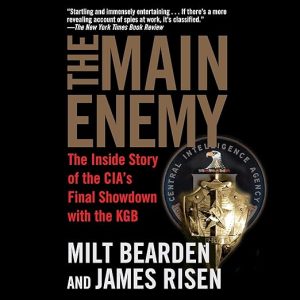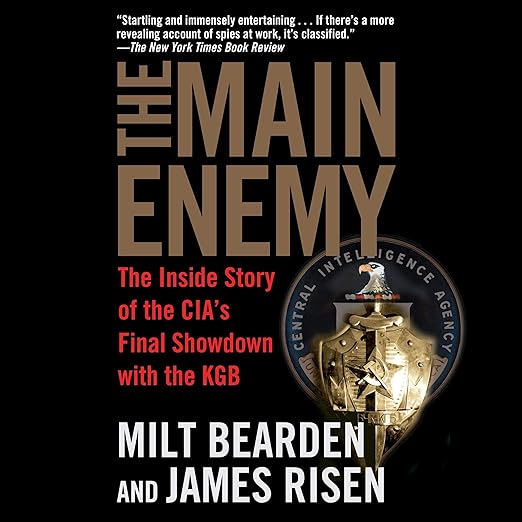
I finished the final hours of The Main Enemy on a gray Tuesday afternoon, the kind of day that makes you feel the particular weight of history. I had been nursing this one over two weeks, listening in stretches on evening walks, stopping mid-block to replay a passage. Milton Bearden is not a writer by trade. He is a spy. And that distinction matters enormously here, because the result reads nothing like a thriller constructed for narrative pleasure. It reads like memory: dense, digressive, and completely authoritative.
Bearden spent thirty years in the CIA, most of them deep in the Soviet operations game. His co-author James Risen, the Pulitzer Prize-winning journalist, shapes the material without smoothing out the texture. What emerges is a book that sits somewhere between oral history, institutional memoir, and strategic analysis. The audiobook, narrated by Christopher Lane for Brilliance Audio, runs nearly twenty hours and earns every minute of that runtime.
What We Made of It
What separates The Main Enemy from the crowded shelf of Cold War retrospectives is that Bearden was actually present for the events he describes. He ran CIA covert operations in Afghanistan during the Soviet occupation, helped engineer the logistical and financial architecture of the mujahideen resistance, and then returned to Washington just in time to watch the Berlin Wall come down. He became chief of the Soviet and East European Division at the precise moment the entire edifice of Soviet power began to crack.
The book's account of the Afghan war is particularly striking. Bearden is candid about the strategic calculations behind American backing of the Afghan resistance, including the uncomfortable question of whom exactly America was backing and why. He does not moralize. He explains. There is a meaningful difference between those two postures, and readers who want tidy retrospective judgments may find that frustrating. For everyone else, the granularity of his account offers genuine historical illumination that simply cannot be manufactured by a journalist working from declassified documents alone.
Why Listen to The Main Enemy
The spine of the narrative is what Bearden and Risen call the Year of the Spy, the period in the mid-1980s when the CIA's agents in Moscow began to be betrayed and killed one by one. The culprits, eventually identified as Aldrich Ames and Robert Hanssen, appear here not as the familiar stock villains of spy thriller casting but as organizational failures, symptoms of institutional rot that the CIA was structurally unable to confront. Bearden's treatment of this material is notably careful. He was a colleague of Ames. He knew some of the officers who died because Ames sold them.
One reviewer who identified himself as a former counter-intelligence agent with the U.S. Army praised the book's treatment of intelligence gathering, disinformation dissemination, and propaganda as factual and impressively detailed. Another reviewer described the moment of comprehension about Soviet reasoning on Afghanistan as viscerally startling: all I could think was, Oh, are you SERIOUS? THAT is what they thought? That sentence captures something the book does repeatedly. It makes the irrational logic of Cold War decision-making legible without condescending to the reader.
What Might Not Land
Intelligence memoirs by former operatives often suffer from one of two failure modes: either the author sanitizes everything into vagueness to protect sources and methods, or the author overstates their own role into hagiography. Bearden and Risen avoid both traps with real discipline. One reviewer praised the authors for using good judgment as to the right level of detail to promote understanding without becoming tedious, and for resisting the urge to sensationalize events that would tempt a lesser writer toward dramatization.
That restraint is genuine. The book is not trying to sell you a movie version of the Cold War. It is trying to explain how an actual intelligence bureaucracy functioned under pressure, made decisions with incomplete information, and occasionally got things catastrophically wrong. The fail-safe back channels between the CIA and KGB, the double and triple agents operating in Berlin and Prague, the fateful autumn of 1989 when everything accelerated: these are handled with the precision of someone who was accountable for outcomes, not just observing them from a safe narrative distance.
The Right Listener for The Main Enemy
Christopher Lane's narration serves this tone well across nearly twenty hours. His voice is steady and unflashy, which is exactly right for material that does not need theatrical embellishment. He handles the parade of Russian names, institutional acronyms, and operational code words without fumbling, which matters more than it might seem when you are ninety minutes into a listening session and the text suddenly introduces three new officers and two cryptonyms. Some audiobook narrators impose a cinematic urgency on nonfiction that distorts the source material; Lane does not do this. He reads the way a serious colleague might brief you.
This audiobook rewards listeners who come prepared to sit inside complexity. The density that might deter someone seeking a quick overview is the same quality that makes the book authoritative. The 4.4 rating across 666 listeners reflects a readership that knows what rigorous historical nonfiction requires and found Bearden's account worthy of that standard. For patient listeners willing to bring the same deliberate attention that Bearden brought to three decades of tradecraft, The Main Enemy delivers something genuinely rare: a first-person account of the Cold War's ending from someone who shaped it, delivered with the particular gravity of a man who still carries the weight of what he knows.