Quick Take
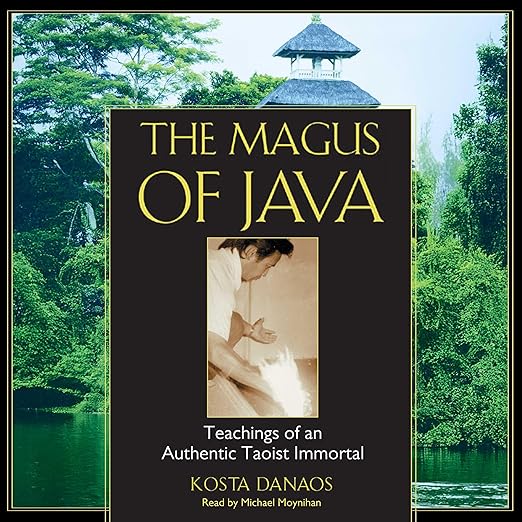
- Narration: Michael Moynihan delivers a measured, respectful tone that keeps the more extraordinary claims grounded without undercutting their weight.
- Themes: Bio-energy and chi cultivation, East-West esoteric exchange, the limits of scientific materialism
- Mood: Quietly astonishing, meditative, paradigm-challenging
- Verdict: A credible, firsthand account of one of the most documented paranormal practitioners of the modern era – essential for anyone curious about nei kung or the outer edges of human potential.
I came to this one skeptical. I have spent enough years reading esoteric literature to know how quickly extraordinary claims curdle into fantasy when put under any real scrutiny. But I had also watched the footage from the 1988 documentary Ring of Fire years before, that remarkable sequence of John Chang apparently generating electrical current from within his own body, and I never quite stopped wondering what to make of it. I finished The Magus of Java on a long, still evening, sitting in the kind of silence that feels appropriate for a book that insists the world is not what you think it is.
Kosta Danaos is, by profession, a mechanical engineer. That credential matters here, not because engineering training makes someone immune to delusion, but because Danaos approaches John Chang’s abilities with the vocabulary and habits of mind of someone who is used to asking how things work. He is not a mystic looking for confirmation. He is a man who witnessed pyrokinesis, levitation, and telepathy at close range and spent years trying to understand what he saw. The result is a book that occupies rare territory: it is neither a credulous believer’s hagiography nor a skeptic’s debunking exercise.
Our Take on The Magus of Java
What makes this audiobook genuinely unusual is the double frame Danaos constructs. There is the outer story, Danaos as a Westerner navigating his apprenticeship under John Chang, learning the discipline of Mo-Pai, a lineage the book claims traces back to the sixth-century philosopher Mo-Tzu. And then there is the inner story: John Chang’s own biography, his long years of training, his philosophical beliefs, his decision after decades of privacy to allow this book to exist. Both layers reward attention.
The Mo-Pai system is presented here as a structured discipline involving the cultivation and circulation of bio-energy through the body, what Chang calls yin and yang chi. Danaos explains it with real technical care, drawing on comparisons to electromagnetic fields and bioelectric phenomena. Whether you find these explanations persuasive will depend on how open your epistemological doors are, but even the skeptical reader will have a harder time dismissing the sheer accumulation of specific, witnessed detail. Danaos is not vague about what he saw. He describes timestamps, settings, the specific conditions under which demonstrations occurred. One reviewer with a background in the internal martial arts noted that anyone who has practiced nei gong at depth has experienced at least some shadow of what Danaos describes; others with no such background found the claims extraordinary but the storytelling impossible to put down.
Why Listen to The Magus of Java
The audiobook format suits this material unexpectedly well. Michael Moynihan’s narration is calm without being dry, carrying the stranger passages with a steady gravity that keeps things from tipping into sensationalism. This is the right register for a book that describes a man setting a newspaper on fire with his bare hands: not excitement, but sober attention. Moynihan gives Danaos’s more personal passages a genuine intimacy, and his handling of the dialogue with Chang preserves the texture of a relationship that took years to build.
The listening experience also gives you time to sit with individual claims before the next one arrives. At just over seven hours, the pacing is deliberate enough that you never feel rushed past something that warrants reflection. For a book about training the mind and the body to operate at different speeds, this slower rhythm feels apt.
What to Watch For in The Magus of Java
The skeptical reader should know that Danaos himself anticipates the memory objection. One reviewer raised it directly: how does someone recall years of conversations with a master in such precise detail? It is a fair question, and Danaos does not fully answer it. The book reads at times like a reconstruction, with dialogue rendered more fluently than memory alone could reasonably produce. This is not necessarily bad faith, reconstructed dialogue is a standard convention in memoir, but it does mean you are sometimes reading something that aspires to the texture of direct reporting without quite being it.
There is also the matter of verification. John Chang was documented, the Ring of Fire footage exists. But Danaos’s personal experiences, the conversations he had with spirits, the secrets of reincarnation Chang is said to have shared, these cannot be independently confirmed. The book asks you to trust its author, and it gives you more reason to do so than most books in this territory, but the epistemological weight ultimately lands on the reader’s own judgment.
Who Should Listen to The Magus of Java
This audiobook is built for listeners who are genuinely curious about the edges of human capability and who can hold extraordinary claims with open, critical attention rather than either immediate dismissal or uncritical acceptance. It will resonate strongly with practitioners of internal martial arts, qigong, or any of the contemplative traditions that take bio-energy seriously. Researchers and readers interested in cross-cultural esoteric exchange will find the Mo-Pai lineage material fascinating. Skip it if you require peer-reviewed replication before engaging with a claim at all; the book does not offer that, and would not pretend to.
Frequently Asked Questions
Is John Chang a real person, and is there any documentation of his abilities beyond this book?
Yes. John Chang appeared in the 1988 documentary Ring of Fire, where footage of him demonstrating what appeared to be pyrokinesis was filmed. That documentary predates Danaos’s book and provides an independent visual record. Danaos was one of five Westerners accepted as apprentices by Chang.
Do I need a background in martial arts or Eastern philosophy to follow the book?
No prior background is required. Danaos writes for a general Western audience and takes care to explain concepts like chi, nei kung, and the Mo-Pai discipline in accessible terms. A background in internal martial arts will deepen certain passages, but the book works without it.
How does Michael Moynihan’s narration handle the more extraordinary claims in the book?
Moynihan maintains a calm, measured tone throughout, which serves the material well. He does not editorialize or inject skepticism, but his grounded delivery keeps the more remarkable passages from feeling sensationalized. The narration is clear and paced deliberately.
Is this a how-to guide for learning Mo-Pai, or is it primarily a biographical narrative?
It is primarily a narrative, not an instruction manual. Danaos covers the history of the Mo-Pai lineage and some of the principles behind the discipline, but he explicitly does not teach the practice in the book. Readers seeking a training curriculum will not find one here.