The Short Version
- Voice: Niall Breslin's self-narration draws real weight from growing up in the shadow of the hospital he's investigating.
- Big ideas: Irish psychiatric asylum history, family investigation, institutional silence
- Atmosphere: Somber and personally invested, never exploitative
- Worth it?: A compact, emotionally honest documentary production, best suited to listeners ready for sensitive subject matter.
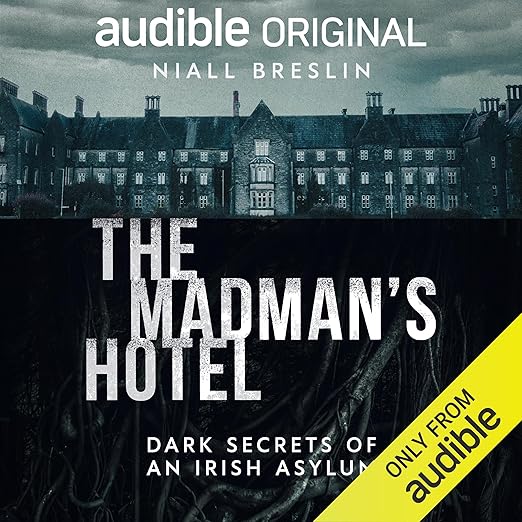
Ireland's old psychiatric asylums sit at an uncomfortable intersection of local memory and national silence, the kind of history that towns living in their shadow rarely discuss out loud. This audiobook opens exactly there, with Niall Breslin returning to St Loman's Hospital near Dublin, a huge abandoned asylum he knows intimately because he grew up in the town next door.
A family reaches out to him for help finding the truth about their long-lost great-grandmother, Julia Leonard, who died inside St Loman's walls, and what follows is as much a personal reckoning for Breslin as it is an investigation on the family's behalf.
Institutions like St Loman's operated for well over a century across Ireland and the wider UK, part of a network of large psychiatric asylums built in the nineteenth and twentieth centuries, many of which held patients for reasons that had little to do with the medical understanding of mental illness recognized today.
A Neutral Outside Narrator Simply Couldn't Replicate
Julie Clarke's search for her great-grandmother structures the whole project, but Breslin, an Irish mental health advocate, widens the lens considerably along the way, using Julia's story as a door into Ireland's much broader history of 'lunatic asylums' and the citizens who were locked away inside them. That widening lens is what keeps this from playing as a single missing-persons case; by the midpoint it has become an inquiry into an entire institutional system, not just one woman's fate within it.
Breslin narrates his own investigation, and the personal geography is genuinely load-bearing here rather than incidental. His own struggle with mental health, referenced directly in one episode, and his lifelong proximity to St Loman's give the project an emotional stake that a neutral outside narrator simply couldn't replicate.
A Shared Reckoning Several Households Didn't Know They Needed
Community response drives much of the story forward too: once Niall and Julie go public with their search, other families with their own connections to St Loman's begin coming forward, widening one family's private grief into a shared reckoning several other households didn't know they needed until it arrived.
The synopsis's episode-by-episode breakdown reveals a deliberate structure: the opening episode introduces Julia and the central mystery, the middle stretch traces the physical investigation and exhumation process, and the final episodes widen into community response and institutional accountability, a shape closer to a three-act structure than a loosely connected documentary series.
Julie Clarke's role throughout deserves its own note: this isn't Breslin investigating on a family's behalf from a comfortable remove, it's Breslin working alongside a family member who remains present and active in her own search throughout the series, which keeps the emotional center of the story with the family rather than with the presenter.
Dolby Atmos Sound Design Rewards Focused Listening
This audiobook is produced with Dolby Atmos sound design, and the documentary-style production, closer in feel to a scripted podcast than a traditional single-narrator memoir, uses that soundscape deliberately rather than as a gimmick. Productions built this way reward focused, engaged listening rather than background use, and the episodic structure gives it a natural rhythm for that kind of attention.
The investigation opens outward from one family's specific grief into a genuine piece of institutional history, and the synopsis is upfront that historical language considered offensive today appears here for context, normalized in its era but treated deliberately rather than casually by the production.
Getting Real Answers From Those Currently in Charge
The bureaucratic obstacles Julie Clarke faces trying to secure an exhumation, tracked across several episodes, turn what could have stayed a straightforward historical documentary into something closer to a procedural, with real stakes about whether the family gets its answers at all.
One episode's description of getting real answers from those currently in charge of the hospital signals the investigation doesn't stay purely historical; it holds present-day institutional accountability in view as much as the century-old history, a structural choice that keeps the stakes from feeling purely academic.
The synopsis's own list of crisis-support organizations, appended directly after its content warnings, signals a production genuinely concerned with listener wellbeing rather than treating sensitive subject matter as pure entertainment value, a meaningful choice for a true-crime-adjacent series built around real, still-grieving family members.
This Title Carries No Listener Reviews Yet
The content warnings here matter and are worth taking seriously: episode five contains a direct reference to self-harm, and the series overall handles mental health, death, and outdated institutional language throughout. This is sensitive material handled with evident care, but listeners should know what they're walking into before they start.
No listener reviews are attached to this title yet, which is worth naming plainly rather than glossing over. As a newer release built around real, ongoing family history, audience response is still developing, and early listeners will effectively be forming the first wave of public reaction to it.
At just over four hours split across seven episodes, individual installments run short, closer to twenty or thirty minutes each. That format suits episodic listening between other things rather than one long continuous sitting, which is worth knowing going in if you prefer to finish a story in a single session.
The seven-episode structure also means future installments could theoretically extend the investigation further depending on what the family and production team uncover next, giving this a slightly more open-ended quality than a tightly closed single documentary film would have.
A Presenter Whose Connection Runs Deeper
True crime and history listeners drawn to institutional history specifically, along with anyone who appreciated other personally-invested documentary-style audio productions, are the clearest audience. Irish social history listeners in particular will find real depth in how far Breslin traces the asylum system's reach beyond Julia's individual story.
Listeners who found personal-investigation-style true crime audio compelling elsewhere will recognize the format here, translated to Irish institutional history with a presenter whose connection to the material runs deeper than a typical host's. Julia Leonard's story anchors the whole series specifically because her great-granddaughter was willing to pursue it publicly, and the production seems aware that many other families connected to St Loman's likely never got the same attention.
Skip this if self-harm references or exhumation and graveyard content would be genuinely distressing rather than difficult-but-manageable, or if you strictly prefer traditional single-narrator memoir pacing over a documentary-style, multi-episode production.
Does The Madman's Hotel audiobook contain sensitive content listeners should know about beforehand?
Yes. The synopsis directly flags a self-harm reference in episode five, along with strong language and historical language considered offensive today, used deliberately for context rather than casually.
How long is The Madman's Hotel audiobook, and how is it divided into episodes?
The full runtime is just over four hours, split across seven episodes of roughly twenty to thirty minutes each, which suits listening in shorter individual sessions.