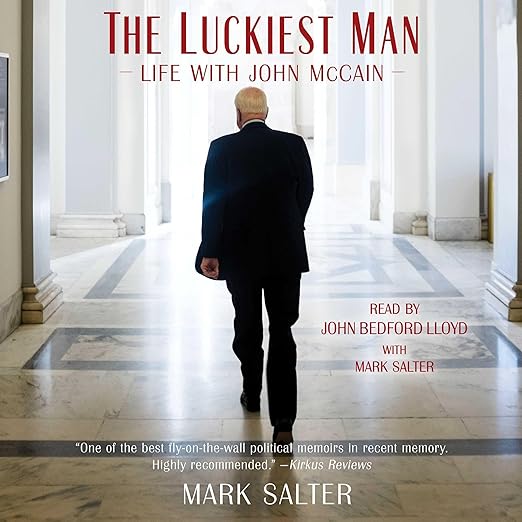
Mark Salter cowrote seven books with John McCain before sitting down to write this one alone, and that decades-long partnership shapes every page of The Luckiest Man. This audiobook covers McCain's peripatetic childhood, his service as a Navy aviator during the Vietnam War, and the political career that followed, but the real distinction here is access: almost no one outside McCain's immediate family knew his thinking as intimately as Salter did, and that closeness is what The Wall Street Journal called a 'moving and lucidly written memoir.'
A Psychological Portrait of Restlessness and Curiosity
This isn't a standard outside-biographer's account. Salter spent decades as McCain's collaborator and confidant, and that vantage point produces what The Washington Post described as a 'psychological portrait' rather than a chronological résumé of accomplishments. The synopsis promises glimpses of restlessness, curiosity, courage, and sentimentality that the public rarely saw, and the presence of the Salter-McCain friendship as its own narrative thread, not just a framing device, is what separates this from a more conventional political biography.
Reviewer Mark Bogart makes a point of noting the book doesn't flinch from McCain's rougher edges, describing it as showing his faults and attributes in what he calls 'a candid, emotional way,' including a temper Bogart describes as volatile. That candor matters for a book written by someone this close to its subject. It would have been easy to produce hagiography instead, and multiple reviewers credit Salter with resisting that pull.
The synopsis also promises the story of how Salter and McCain first met, treated as a meaningful narrative thread rather than a throwaway detail, which underscores how much of this book is really a dual portrait rather than a single-subject biography. Salter positions himself less as a biographer studying a subject from outside and more as a participant recounting a relationship that shaped both of their professional lives for decades, and that dual framing runs through the entire project.
POW Chapters That Land Harder Read Aloud
Cross-partisan admiration shows up directly in the reviews on record. Gary, who identifies as a lifelong Democrat in Arizona, singles out the chapters covering McCain's years as a prisoner of war in Vietnam as the emotional core of the book, the kind of material that lands harder read aloud than skimmed on a page, and that admiration recurs throughout the listings, suggesting the book's appeal extends well past McCain's own political coalition.
Beyond the biography, the synopsis frames McCain's later-in-life political philosophy of bipartisan leadership as a genuine throughline, not just a coda. For listeners interested in what public service looked like practiced by someone willing to break with his own party, that philosophical thread running alongside the life story is a big part of the book's pitch, distinct from a pure chronicle of events.
Stories McCain Was Too Modest to Tell
The book's account of McCain's presidential campaigns, including his primary loss in 2000 and his general election run in 2008, benefits from Salter having been inside the operation both times, not observing from outside as most campaign chroniclers do. That insider vantage extends the book's value beyond personal biography into a genuine record of how modern presidential campaigns actually get run day to day, warts and strategic missteps included alongside their high points. For listeners interested in campaign strategy and political operations as much as in McCain himself, this angle offers material a more conventional biography, written without that level of access, simply couldn't provide with the same specificity or confidence.
The synopsis describes the book, in its own words, as 'the authoritative last word on the stories McCain was too modest to tell himself,' a claim that only really works coming from someone with Salter's specific access. For listeners who've encountered other, more distant McCain biographies or news coverage over the years, this promises material that simply wasn't available anywhere else until now, drawn from private conversations rather than public record.
The book's framing of McCain as someone who considered himself fortunate despite hardship, captivity, and difficult health news late in life shapes the entire project's emotional register. Rather than a story of grievance or unfinished business, Salter presents a man reckoning honestly with his own mortality, and that framing shapes how the harder chapters land, less as tragedy and more as clear-eyed acceptance.
Lloyd Sustains Gravitas Without Tipping Into Reverence
At just under twenty-five hours, this is a serious commitment, closer to a major biography than a quick memoir. Narrator John Bedford Lloyd brings measured gravitas well suited to political and military tribute writing, and he sustains that register across the full runtime without either flattening into monotone or tipping into reverence, but listeners should still plan for a multi-week listen rather than a weekend project.
Because Salter writes as the friend in the room rather than a historian at a distance, this leans toward an admiring account even where it includes real criticism. Reviewer Patrick calls Salter a trusted advisor who 'does his life justice,' which is exactly the kind of praise that signals authorized-account territory. Readers wanting dispassionate policy analysis of McCain's Senate record specifically should know that isn't really this book's mode.
The density of detail across McCain's naval career, his congressional years, and his presidential runs rewards steady, unhurried listening rather than binge consumption. Pairing a chapter or two with a daily commute or exercise routine will likely serve the material better than long uninterrupted sessions, since specific names and events introduced early sometimes resurface many hours later.
Listeners new to Salter's writing specifically, rather than to McCain's life story, should know he's a practiced political writer with a distinct voice of his own, not simply a transcriber of McCain's memories. That authorial presence shows up in how scenes are constructed and paced throughout, giving the audiobook more narrative shape than a straightforward oral-history collection would have offered.
Seven Earlier Books Make the Partnership the Subject
Readers of political memoir, McCain admirers across the political spectrum, and anyone specifically drawn to Vietnam-era prisoner-of-war accounts are the clearest fits. Given the emphasis on Salter and McCain's friendship, listeners interested in collaborative political relationships, the kind rarely documented this closely, will also find real value here.
Listeners drawn to collaborative writing partnerships and ghostwriting relationships specifically, not just political biography as a genre, will find something here too, since the Salter-McCain partnership across seven earlier books is itself a rare subject for a memoir to take seriously.
Those seeking a critical, arm's-length assessment of McCain's voting record or Senate career will want a different, more academically detached book, since Salter's proximity to his subject shapes the entire project, even in its more unflinching moments.
Before You Press Play
- Narrator: John Bedford Lloyd brings measured gravitas that suits a political tribute biography without tipping into reverence, sustained across a nearly 25-hour runtime.
- Subjects: bipartisan public service, wartime captivity and resilience, a decades-long political friendship
- Tone: Reflective and weighty
- Bottom line: A rewarding, demanding listen for anyone invested in McCain's life or in insider political memoir, less suited to those wanting critical distance.
Common Questions
Does this audiobook cover John McCain's time as a prisoner of war in Vietnam?
Yes, and reviewer Gary specifically calls those chapters the emotional core of the book, describing McCain's naval aviator service and Vietnam-era captivity as some of the most powerful material in the audiobook.
Is The Luckiest Man audiobook a neutral biography or shaped by Mark Salter's closeness to McCain?
It's shaped by that closeness throughout. Salter cowrote seven earlier books with McCain and writes from decades of personal access, so this reads as an intimate, largely admiring account rather than an arm's-length historical assessment.
How long is The Luckiest Man audiobook, and is it worth the time commitment?
At nearly 25 hours, it's a major listen, closer to a full biography than a quick memoir, and reviewers describe it as rewarding for anyone genuinely invested in McCain's life rather than a casual, single-sitting choice.
Does John Bedford Lloyd's narration hold up across nearly 25 hours of material?
Yes, his measured, gravitas-driven delivery stays consistent across the full runtime, suited to political and military tribute writing without drifting into monotone or excessive reverence.