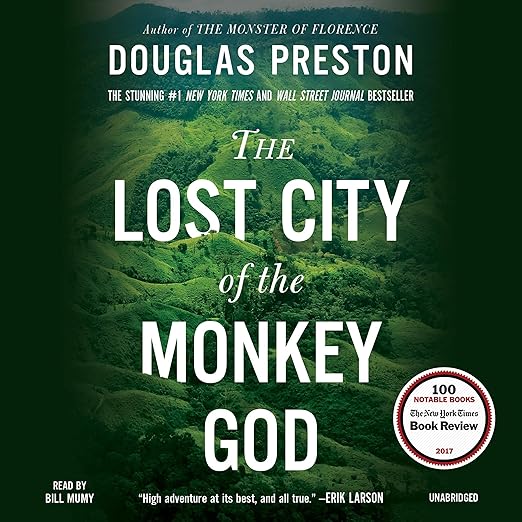
At a Glance
- Narrator: Bill Mumy reads Preston's firsthand account with a tone that matches the dual register of the book, part adventure yarn, part medical horror, landing the dramatic reversals without overplaying them.
- Subjects: Archaeological discovery, colonial legacy, emerging disease
- Tone: Propulsive and unsettling, with a scientific undercurrent that turns genuinely alarming
- Bottom line: Preston's account of finding a lost Honduran civilization and then contracting a disfiguring disease inside its ruins is stranger and more scientifically substantive than the title suggests.
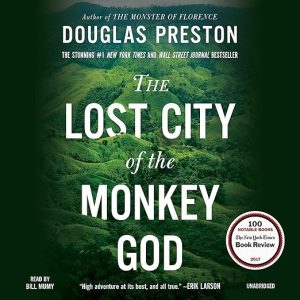
Douglas Preston's The Lost City of the Monkey God audiobook arrives with the pedigree of a bestseller and the structure of a genuine adventure - but what caught me by surprise, about two-thirds of the way through the 10 hours and 29 minutes, was how completely the book shifts register. What begins as a compelling account of a lidar-assisted archaeological expedition through the Honduran rainforest becomes, without any narrative warning, a medical investigation into leishmaniasis, the disfiguring parasitic disease that Preston and several team members contracted in the ruins. The tonal shift is jarring, and entirely intentional - and it is the second act that makes the first one retroactively more disturbing.
The backstory Preston assembles before the 2012 expedition is rich. Swashbuckling journalist Theodore Morde returned from Honduras in 1940 claiming to have found the legendary White City - then committed suicide without revealing its location. Spanish conquest narratives, indigenous oral tradition, and decades of failed expeditions layer into a cultural mystery that predates Preston's involvement by centuries. When he boards the rickety single-engine plane carrying the lidar equipment, the reader already understands what a discovery in that unexplored valley would mean - not just archaeologically but in terms of the history of Mesoamerican civilization adjacent to the Maya.
Indigenous Warnings Turn Out to Be Biology
Preston is at his best in the expedition sequences. The lidar reveal - the moment an unmistakable grid of a lost city emerges from the data on a laptop in the jungle - is handled with the restraint of a writer who knows a real discovery does not need embellishment. He logs the mud, the quicksand, the jaguars, the disease-carrying insects, and the logistical chaos of moving a team through a wilderness that has never been properly mapped. The narrative is grounded in the physical reality of being there, which separates it from the genre of adventure writing that aestheticizes discomfort without actually sitting in it.
The archaeological sections are also more nuanced than the bestseller framing suggests. Preston is careful about the ethics of publicizing the site's location, discusses the risks of looting, and engages seriously with the question of whose history this discovery belongs to. The indigenous communities who warned for generations that entering the White City would bring illness turn out, in retrospect, to have been right - not through supernatural mechanism but through the biological reality of a disease that thrives in the soil of ancient ruins. That irony is explored rather than dismissed, and it adds a dimension the adventure-narrative framing could easily have sacrificed.
Bill Mumy Stays Measured Through the Horror
Bill Mumy's narration handles the tonal shifts between adventure, archaeology, and medical emergency with competence. His read is measured - he does not lean into the horror of the disease sequences or play up the swashbuckling elements of the expedition. That evenness works: Preston's material is sensational enough on its own, and a narrator who amplifies rather than reports would undercut the credibility that makes the book's stranger claims believable. The 10-plus-hour runtime feels proportional to the scope of the material, which covers multiple expeditions, considerable historical background, and the medical aftermath of the team's discovery.
The leishmaniasis section is genuinely alarming in a way that lingers. Preston describes the disease's progression in clinical detail - it destroys mucous membranes, disfigures the face, and in its mucocutaneous form can be fatal. The irony that a group of researchers who had survived quicksand, jaguars, and a logistical nightmare in the Honduran wilderness returned home to find themselves carrying something that had incubated invisibly in the ruins adds a dimension that no fictional thriller could have manufactured. One reviewer described it as the story of change at a civilizational scale - the collapse of the culture that built the city, the disease that outlasted that civilization, and the scientists who unknowingly walked into it.
Morde's Story Gets the Most Speculative Treatment
The book's weakest sections are the historical digressions. Preston is a novelist as well as a journalist, and his tendency to animate secondary figures - the 1940s journalist Morde in particular - with dramatic detail can occasionally tip into reconstruction that feels more speculative than the rest of the text. Readers who prefer strict journalistic sourcing may find some of the historical color lightly attributed. Additionally, while Preston addresses the ethical complexities of publicizing the site, a more rigorous engagement with indigenous land rights and the ongoing political context in Honduras would have strengthened a book that is clearly aware those dimensions exist.
The rating of 4.3 across the small sample of 17 reviews reflects a split between listeners drawn in by the adventure and those who expected more sustained archaeological depth. The book is not an academic treatment of Mesoamerican civilization; it is a firsthand narrative of discovery written by someone who was present. Within those parameters, it delivers on its promise. The medical mystery in the final third, in particular, is the kind of material that stays with you.
Readers of the Pendergast Novels Know This Pace
Listeners who enjoyed Preston's fiction - the Pendergast series in particular - will recognize the pacing and the pleasure he takes in atmospheric detail. Nonfiction readers drawn to expedition narratives, archaeology, or emerging-disease science will find substantial material in all three registers. Those looking for a comprehensive academic treatment of the lost civilization or a deep dive into the ethics of archaeological practice will find the book more surface-level on those fronts than the subject warrants. But for a well-paced, genuinely surprising account of a real discovery with real consequences, this audiobook covers territory that few first-person narratives manage to cross.
Frequently Asked Questions
Does this audiobook require any background knowledge of Mesoamerican archaeology to follow the story?
No prior knowledge is needed. Preston provides historical context throughout, and the narrative is structured as a firsthand account rather than an academic study. Listeners unfamiliar with the region's history will pick up the necessary background from the text itself.
How does the audiobook handle the shift from adventure narrative to medical investigation?
The transition is abrupt and deliberate. The final third of the runtime shifts from expedition account to a detailed description of leishmaniasis and the team's treatment. Bill Mumy's even-keeled narration holds the two sections together without dramatizing the shift, letting the inherent strangeness of the situation register on its own terms.
Is the audiobook appropriate for listeners interested in the ethics of archaeological discovery and indigenous rights?
Preston raises these questions but does not engage with them at scholarly depth. He discusses the risks of publicizing the site's location and the history of colonial conquest in the region, but listeners expecting a sustained ethical analysis will find the treatment limited. The book is more concerned with narrating the discovery than interrogating the politics around it.
How long is the audiobook, and is the runtime well used across all the material it covers?
At 10 hours and 29 minutes, the runtime covers expedition history, the 2012 and follow-up missions, considerable background on the White City legend, and the medical aftermath. Most of the runtime is well proportioned, though a few historical sections run longer than the narrative needs. The expedition and disease sequences are the strongest portions of the listening experience.