Quick Take
- Narration: Stuart Wilde reads his own text with a distinctive British-accented ease that reviewers find central to the book’s appeal, the voice is inseparable from the message.
- Themes: Money as a spiritual relationship rather than a practical system, abundance consciousness, self-worth and financial identity
- Mood: Breezy and confident, with an unconventional blend of mysticism and pragmatism that requires sympathetic ears
- Verdict: A short, idiosyncratic entry into prosperity consciousness thinking, best appreciated by listeners already drawn to Wilde’s worldview or to spiritual approaches to personal finance.
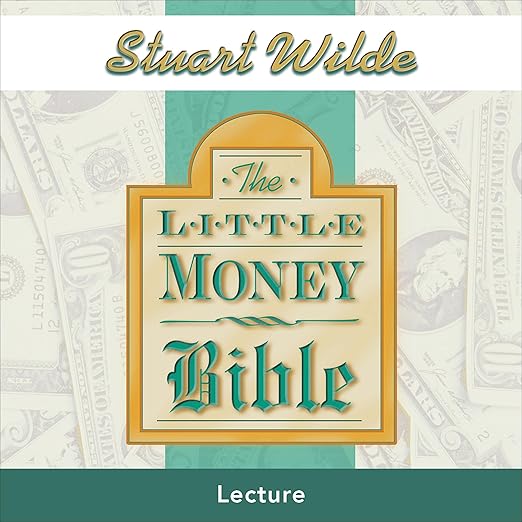
Stuart Wilde was not a personal finance writer in any recognizable sense. He was a British-born philosopher of what he called the infinite self, a speaker and writer whose work occupied a particular corner of the late-twentieth-century spiritual marketplace, adjacent to New Age thinking but sharper and more irreverent, resistant to the earnest uplift that characterizes most of that tradition. The Little Money Bible is not, despite what the title implies, a book about budgeting or investing or compound interest. It is a book about the relationship between self-conception and financial reality, and it runs its argument in a register that is equally likely to resonate completely or to seem categorically wrong, depending entirely on the listener’s priors about the nature of consciousness and material experience.
The core proposition is announced plainly: “Moneymaking is not a serious business, it’s a game. At first it may seem that it’s a game that you play with forces outside yourself, the economies of the marketplace, so to speak. But as you proceed, you discover that it’s actually a game you play with yourself.” This is not a claim that external circumstances do not matter. It is a claim that the primary obstacle to financial abundance is internal, that the limiting beliefs people carry about their worthiness, their relationship to money, and the scarcity or availability of resources are more determinative than market conditions. Whether you find that argument liberating or infuriating will tell you most of what you need to know about whether this audiobook is for you.
What Wilde Does With 158 Minutes
The recording is short, two hours and thirty-eight minutes, and Wilde uses that runtime with the economy of a writer who trusts his listener to follow implications rather than requiring every argument to be spelled out and repeated. The book moves through several interconnected ideas: that abundance is a natural state that humans learned to restrict through cultural conditioning; that focusing on service and emotional giving tends to create financial flow more reliably than focusing on money directly; that the fear of lack is itself a generator of lack. One reviewer quotes Wilde: “The way to ensure that you will always have enough is to forget about the money and concentrate instead on giving of yourself emotionally.” That line summarizes the orientation of the entire book and represents the kind of counter-intuitive proposition that either immediately makes sense to you or immediately does not.
The Author-Narrator Advantage and Its Limits
What makes this recording distinctive, and what reviewers consistently mention first, is Wilde himself reading it. His voice, described by one reviewer as having a distinctive “British/Italian” accent, carries an authority that a third-party narrator could not replicate. Wilde is not simply performing text; he is inhabiting a worldview that he built over decades of writing and speaking, and the difference is audible in the pacing, the emphasis, and the moments where he departs slightly from the literal text to clarify a point. Several reviewers note that Wilde’s other books, The Force, Miracles, Silent Power, Life Was Never Meant to Be a Struggle, are stronger overall in terms of comprehensive argument, and that The Little Money Bible occupies a secondary position in his catalog. For existing Wilde fans, it is essential context. For newcomers, those other titles may offer a more complete introduction to the framework before this more specific application of it.
The Spiritual Finance Argument and Its Intended Audience
The honest caveat to any review of this kind of book is the one a reviewer offers implicitly when they describe it as going “too much on the spiritual part.” Wilde’s argument depends on a particular metaphysical framework, the idea that consciousness and material reality are more interconnected than conventional materialism allows, and listeners who do not share that framework will find the specific recommendations either incomprehensible or unfalsifiable. That is not a flaw in the book so much as a description of its design. The Little Money Bible is spiritual counsel in the form of financial advice, and it works best for people who are already sympathetic to that genre of thinking and are looking for a framework that integrates their spiritual life with their relationship to money and abundance.
Who Has Found This Book and Why They Return to It
The 4.7 rating across nearly 600 reviews, for a book first published in the late 1990s and reissued in audio format in 2022, suggests a readership that has found Wilde’s framework genuinely useful and continued to recommend it across decades. Reviewers describe returning to the book, finding it applicable in different life circumstances, and using it as a touchstone rather than a one-time read. That pattern of return is characteristic of books that function less as arguments to be evaluated and more as frameworks to be lived with. The Little Money Bible is that kind of book, small in runtime, expansive in the scope of what it is trying to shift, and entirely dependent on the listener’s willingness to meet it where it is rather than where they expected it to be.
Who should listen: Readers who find conventional personal finance advice useful but incomplete; listeners curious about Wilde’s broader body of work and where money fits into his philosophical system; anyone who feels their relationship to abundance is being constrained by attitudes and beliefs rather than purely by external circumstances. Who should skip: Listeners looking for actionable financial strategy, specific investment advice, or a secular approach to wealth-building, this book will not provide any of that, and the mismatch between expectation and delivery will be frustrating from the first chapter.
Frequently Asked Questions
Is The Little Money Bible connected to Stuart Wilde’s other books, or does it stand alone?
It stands alone in terms of content but is best understood as part of Wilde’s broader body of work. Reviewers who are already familiar with his other titles, The Force, Miracles, Silent Power, find it a useful complement. For newcomers, starting with one of his more comprehensive works before this shorter and more specific one is likely to be more satisfying.
Is this a practical personal finance guide or something closer to a philosophical or spiritual text?
Definitively the latter. Wilde does not offer budgeting frameworks, investment strategies, or debt management advice. His argument is that financial abundance follows from a shift in self-conception and relationship to scarcity, it is a consciousness book about money rather than a finance book.
How does Stuart Wilde’s self-narration affect the listening experience?
Significantly and positively, according to reviewers. His accent and delivery are described as a key part of the appeal, and the sense that the author inhabits the worldview he describes rather than performing someone else’s text gives the recording an authority and intimacy that third-party narration would not replicate.
At under three hours, does this recording feel complete or truncated?
It feels appropriately compact for what it is. Wilde’s style has never been expansive or repetitive, he states his ideas and trusts the reader to work with them. Two hours and thirty-eight minutes is enough to deliver the framework fully, though listeners who want sustained engagement will find his longer books more comprehensive and ambitious.