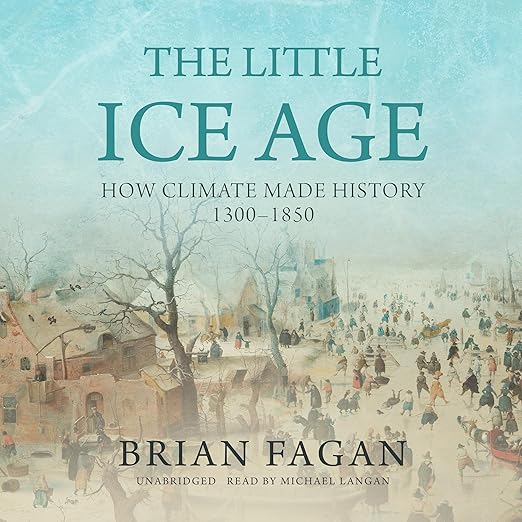
Basque fishermen chasing shoals of cod across the North Atlantic sound like an odd place to start a climate book, but that is exactly where Brian Fagan's The Little Ice Age earns its keep. This audiobook builds its argument the way a good detective story builds a case: cold water shifted where fish gathered, fishing fleets followed the fish, and entire national economies rearranged themselves around a temperature drop most of the fishermen never consciously registered. Fagan is an archaeologist by training, not a climatologist, and that shows in the best possible way. He is less interested in ice-core data for its own sake than in what a five-hundred-year cold stretch, roughly AD 1300 to 1850, actually did to the people living through it. The book moves from Norse Greenland to French famine to English farm reform without ever losing the thread connecting them: weather most people could not measure, quietly rewriting history most people assumed was purely political.
Climate Applies Pressure, but Never Dictates Fate
What makes the book work is Fagan's refusal to treat climate as destiny. He is careful, almost insistent, about the difference between an environmental pressure and an inevitable outcome. The generations-long subsistence crisis in France gets connected to social disintegration and eventually revolution, but Fagan walks through the intermediate steps: failed harvests, grain price spikes, a monarchy slow to adapt, decades of accumulated resentment. Reviewer Roger D. Launius, who has followed Fagan's work for years, points out that this is not a new interest for him. Fagan has spent more than two decades studying how climate pressure moves through human institutions, and The Little Ice Age reads like the mature version of that long project, confident enough to make connections without forcing them.
The English material is the most surprising thread. Fagan traces a line from deteriorating harvests and colder growing seasons to agricultural improvement schemes designed to squeeze more food from the same acreage, then follows that line forward into the Industrial Revolution itself. It is a genuinely startling argument: the technologies that eventually produced modern global warming may have been partly a response to an earlier cooling crisis. Reviewer Alan Lenton calls the book 'fascinating' while noting it avoids being 'at all deterministic,' and that balance is the real achievement here. Fagan wants listeners to see causation without accepting simple cause-and-effect stories, and the book keeps that tension alive through its full runtime rather than resolving it too neatly in the introduction.
Ocean Hydrodynamics, Explained Before the Big Claims
The book also earns real credibility from how patiently it handles the science underneath its historical claims. Reviewer Alan Lenton specifically praises how it 'explains, in layman's terms, the hydrodynamics of the oceans as we currently understand them,' rather than gesturing vaguely at temperature charts. That grounding matters because so much of the historical argument depends on listeners trusting the climate reconstruction methods Fagan describes early on, and he earns that trust before spending it on the bigger historical claims that follow.
Michael Langan Never Rushes the Technical Sections
Michael Langan narrates with the measured, unhurried pace this material needs. The Little Ice Age spends real time on hydrodynamics, ocean current shifts, and the mechanics of how climatologists reconstruct centuries-old temperature records, and Langan never rushes past the technical sections to get back to narrative. He treats the science and the history as equally load-bearing, which matters in a book that keeps switching between them every few minutes. Listeners who have struggled with narrators who audibly perk up for anecdotes and flatten out for data will notice the difference immediately. This is eight and a half hours of consistently engaged, evenly paced delivery, which suits a book built on patient accumulation of evidence rather than dramatic reveals.
The book's structure rewards audio specifically because Fagan keeps circling back to the same handful of throughlines: cod, Norse settlement, French grain, English farms. Hearing those threads return every hour or so, rather than skimming past a chapter heading on the page, reinforces how connected they actually are. Reviewer Tim F. Martin calls it 'very readable,' and in audio that readability becomes something closer to momentum. A real pleasure comes from following an archaeologist think out loud across five centuries of weather data, watching him build toward the modern climate change comparison the book has been quietly setting up since its opening pages.
The term 'Little Ice Age' itself is worth pausing on, since reviewer Tim F. Martin notes it was coined by glacial geologists studying the period, not by historians looking for a dramatic label. That origin matters: the name entered the historical conversation through physical evidence, moraines, ice cores, tree rings, before anyone connected it to the Basque cod fleets or the French subsistence crisis. Fagan is essentially reverse-engineering a human story from a term that started as pure earth science, and hearing him do that reconstruction step by step is more compelling in audio than skimming the same argument on a page.
The Climate System Itself Is the Real Protagonist
This is analytical nonfiction, not narrative history with a cast of characters to follow. Listeners expecting the personal, ground-level detail of a disaster-narrative style history should recalibrate. Fagan's protagonist, if the book has one, is the climate system itself, and the human figures who appear, English farmers, French peasants, Basque sea captains, function more as case studies than characters with arcs. That is not a flaw, but it does mean the emotional register stays fairly consistent throughout: interested, measured, occasionally alarmed, never melodramatic. Listeners who want their history audiobooks to build toward one climactic scene will not find that here.
Reviewer Roger D. Launius notes the book suggests recorded history contains 'fundamental shifts in climate' that 'portended changes, sometimes drastic ones,' and that word 'sometimes' is worth sitting with. Fagan is disciplined about not overstating his case, which means a few of the connections he draws, particularly around the slower-moving social effects, land as plausible and well-argued rather than proven beyond doubt. Listeners who want hedged, honest scholarship will find that restraint reassuring. Listeners who prefer a more forceful, single-cause argument may occasionally wish Fagan pushed harder on his own conclusions instead of qualifying them as carefully as he does throughout the book.
One Variable Ripples Through Five Centuries of History
This audiobook suits listeners who came to climate change discourse through the science and want the historical half of the picture, along with anyone who enjoys archaeology, environmental history, or the specific pleasure of watching one variable, temperature, ripple through economics, migration, and revolution across five centuries. It also rewards listeners of Fagan's other work, since the through-line connecting climate and civilization is clearly a career-long preoccupation rather than a one-book detour.
Skip it if pure narrative history is what you are after, or if eight and a half hours of steady, evidence-driven argument sounds more like homework than entertainment. This is a book for listeners genuinely curious about mechanism, not just outcome, and it rewards patience more than it rewards excitement.
Does the audiobook of The Little Ice Age require any background in climate science?
No. Brian Fagan writes for a general audience, translating ice-core data and ocean hydrodynamics into plain language before connecting them to historical events like Norse settlement and the French Revolution. Prior knowledge of climatology or European history helps but is not required to follow the argument.
Is The Little Ice Age audiobook more about climate science or European history?
Both, deliberately balanced. Fagan uses climate reconstruction as the evidence base, then spends most of the book tracing how a five-century cold period affected fishing economies, farming, migration, and eventually revolution across Europe.