- Narrator: John Vorhaus narrates his own material, and the delivery itself functions as proof of concept for the comic timing and rhythm he is teaching.
- Subjects: sitcom structure and craft, comedy writing fundamentals, creative career entry points
- Tone: Brisk, funny, and practically minded
- Bottom line: A sharp, fast primer for anyone serious about learning sitcom writing from someone who can actually demonstrate the timing he teaches.
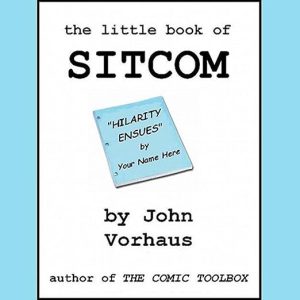
John Vorhaus calls sitcom writing 'the gateway drug to longer forms of writing,' and this audiobook edition of The Little Book of Sitcom spends two hours making the case that a short script, a small cast, and a handful of standing sets are actually the easiest way into a writing career, not the hardest. Vorhaus, author of the widely referenced screenwriting guide The Comic Toolbox, narrates his own material here, walking listeners through the specific tools and problem-solving techniques he uses to teach situation comedy as a learnable craft rather than an inborn gift a writer either has or does not.
Vorhaus Reframes Sitcom Rules as Scaffolding
The book's central argument is refreshingly deflationary for a creative-writing guide: sitcom is not hard because so much of the format is already defined for you. Episode length, cast size, location constraints, established character voices, all of that structure, Vorhaus argues, is scaffolding rather than a limitation, and a writer who understands the scaffolding can move fast inside it. That reframing pushes back directly against the common assumption that sitcom is a lesser, disposable form compared to prestige drama or film, a more generous and more useful pitch than most craft books manage.
Because Vorhaus is teaching timing, rhythm, and comic instinct, not just structure, the actual experience of listening becomes a kind of live demonstration of his own advice. A comedy-writing teacher who cannot deliver a joke with the right rhythm undercuts his own credibility fast, and this audiobook puts that risk front and center by having him read it himself rather than handing the material to a professional voice actor.
A neat structural irony runs underneath the whole project: a short book about writing a short format. Vorhaus spends the opening chapters arguing that sitcom's brevity is a feature, not a limitation, and then builds a two-hour audiobook that makes exactly the same case about itself, dense with usable material and entirely unpadded. That kind of formal self-consistency is easy to get wrong in craft books, many run twice as long as their material actually requires, and Vorhaus avoids that trap here.
The toolbox framing carries through consistently: this is not a book of inspirational anecdotes about a writing career, it reads closer to a mechanic's manual for a specific kind of joke and scene construction. That practicality is exactly what one reviewer meant describing it as written by 'an adult who cuts to the chase and teaches you the things that are ACTUALLY important,' a review that reads like relief at finding a craft book willing to skip the padding.
Even the book's title plays along with its own argument: 'little' doing double duty as both an honest description of its length and a wink at how unintimidating the craft itself turns out to be once broken into Vorhaus's specific tools.
Vorhaus's Delivery Doubles as a Demonstration Reel
Self-narration is a genuine asset here rather than a budget shortcut. Vorhaus is a working comedy professional, and hearing him deliver his own material means the audiobook doubles as a demonstration reel of the comic timing and delivery choices he is actively teaching, not just a recitation of tips written by someone the listener has to trust secondhand. One reviewer captured this exactly, writing that listening 'feels like you've somehow appeared in a sitcom writers' room, John spotted you, and took you aside to give you a quick crash course.'
Another reviewer went further, calling Vorhaus 'the Robert McKee of Comedy writing,' invoking the screenwriting world's best-known structural authority as a direct comparison. That is a meaningful signal about how seriously working writers take this material: not as a light hobbyist's guide but as a legitimate craft text from someone who has actually built a career teaching this specific skill, distilled here into a format short enough to finish in a single sitting.
The gateway drug framing from the synopsis is not just a punchy phrase, it is the book's actual thesis about career strategy. Vorhaus positions sitcom writing as a low-barrier way to build the fundamental muscles, character voice, scene economy, joke construction, that transfer directly into longer forms once a writer is ready to attempt them. That practical, career-minded framing gives the book a shelf life beyond a single listen, useful both to a total beginner and to someone already mid-career looking to sharpen fundamentals.
Two Hours Dense Enough to Cost Sixty Dollars
At two hours and six minutes, this is a fast, dense primer rather than an exhaustive textbook, and it should be approached that way. Listeners wanting comprehensive coverage of every sitcom subgenre or a deep dive into single-camera prestige comedy specifically should treat this as a strong foundation to build on rather than the last word on the subject; the print edition runs a lean 114 pages by one reviewer's count, and the audio experience matches that same compact scope.
Craft books like this one typically reward pausing to actually try the techniques being described, and audio listening, especially the passive kind done during a commute, can work against that hands-on application. Listeners serious about putting Vorhaus's tools to use should consider keeping a notebook nearby rather than treating this purely as background listening, since the value compounds when the ideas get applied rather than just absorbed.
One reviewer put a specific price tag on the material's value, writing it was 'worth about $60' despite its short length, a way of saying the density of usable craft advice outweighs the modest running time. That value-for-density argument is a fair one: length was never the point here, and padding this out to match a more conventional craft-book runtime would likely have diluted rather than strengthened its advice. Because the material is organized around discrete, specific techniques rather than one continuous argument, it also holds up well as a reference to revisit chapter by chapter rather than something that needs to be absorbed in a single sitting.
Multi-Camera Sitcom Writers Are the Target
Aspiring sitcom writers, screenwriting students building out their toolkit, and comedy writers wanting a sharp refresher will all get real value here, as will existing fans of The Comic Toolbox looking for Vorhaus's ideas applied to a specific format. Its short runtime also makes it an easy add for anyone already curious about the craft but not ready to commit to a longer writing guide.
Skip it if you need a workbook format with structured exercises rather than a spoken lecture, since audio inherently limits the hands-on practice this material is built to support. Writers focused specifically on single-camera or streaming-era comedy structures, rather than the classic multi-camera, standing-set sitcom Vorhaus is describing, may also find the framing slightly narrower than what they need.